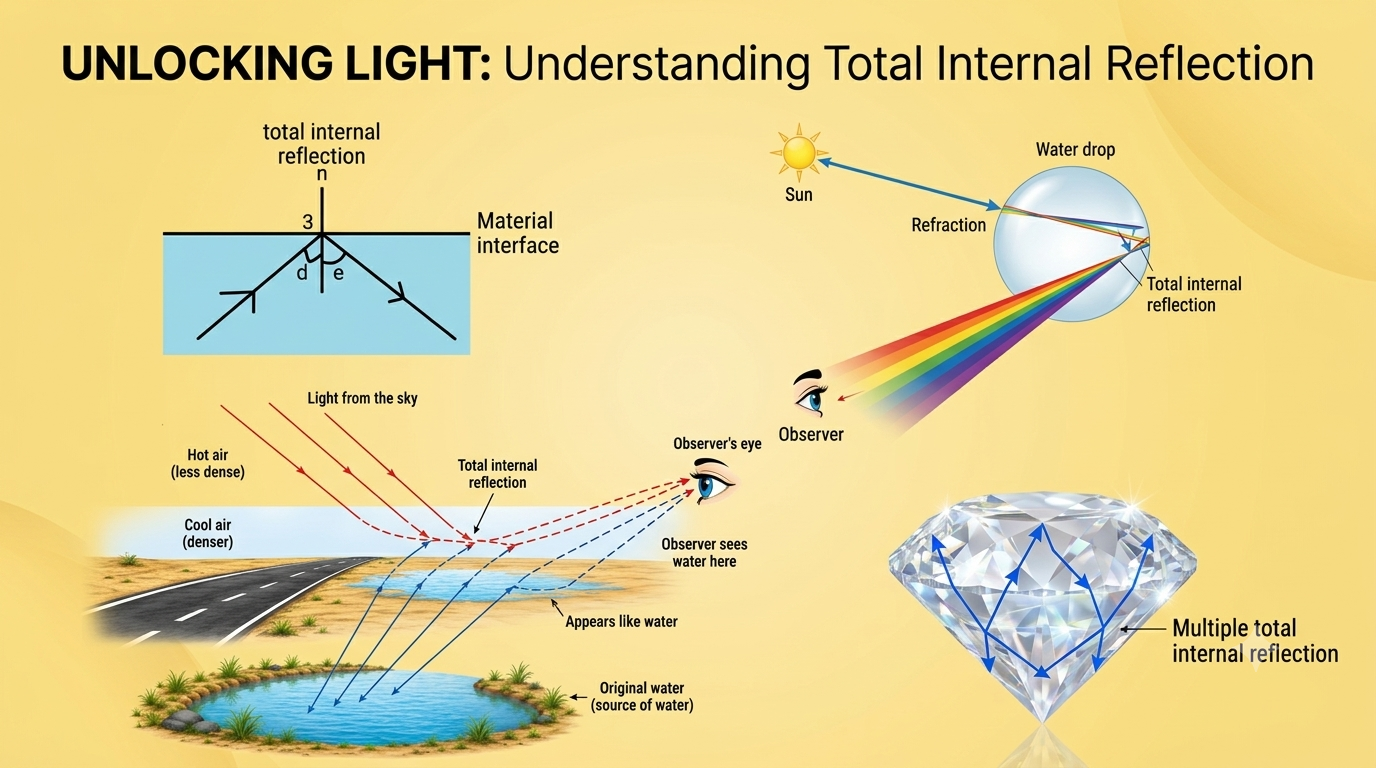
Total Internal Reflection (TIR) is an important phenomenon related to the refraction of light. It occurs when light travelling through an optically denser medium strikes the boundary with an optically rarer medium at an angle greater than the critical angle.
In this article, we will understand Total Internal Reflection Class 10, its conditions, critical angle, examples, applications, and important questions for CBSE Class 10 Science Chapter 9 – Light Reflection & Refraction.
What is Total Internal Reflection?
When a ray of light travels from an optically denser medium to an optically rarer medium, it normally bends away from the normal.
However, when the angle of incidence is increased beyond a certain limiting angle, called the critical angle, the refracted ray disappears and the entire light is reflected back into the denser medium.
This phenomenon is called Total Internal Reflection.
Definition
Total Internal Reflection is the phenomenon in which a ray of light travelling from an optically denser medium to an optically rarer medium is completely reflected back into the denser medium when the angle of incidence is greater than the critical angle.
Conditions Necessary for Total Internal Reflection
There are two essential conditions for Total Internal Reflection:
1. Light must travel from a denser medium to a rarer medium
The light must move from a medium having a higher refractive index to a medium having a lower refractive index.
For example:
- Glass → Air
- Water → Air
- Diamond → Air
TIR does not occur when light travels from a rarer medium to a denser medium.
2. Angle of incidence must be greater than the critical angle
The angle of incidence must be greater than the critical angle (C).
Therefore:
Angle of incidence > Critical angle
i > C
Only then does complete internal reflection take place.
What is the Critical Angle?
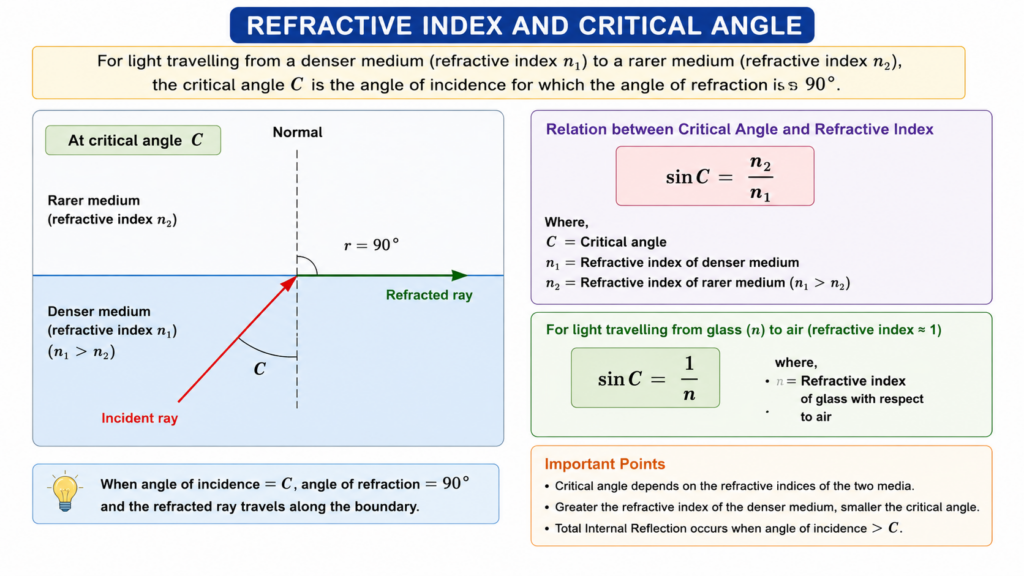
The critical angle is the angle of incidence in the denser medium for which the angle of refraction in the rarer medium becomes 90°.
In other words, when light travels from a denser medium to a rarer medium and the refracted ray just grazes the surface, the corresponding angle of incidence is called the critical angle.
It is represented by C.
At the critical angle:
Angle of refraction = 90°
For Total Internal Reflection:
Angle of incidence > Critical angle
What Happens When the Angle of Incidence Changes?
Suppose light travels from glass to air.
There are three important cases:
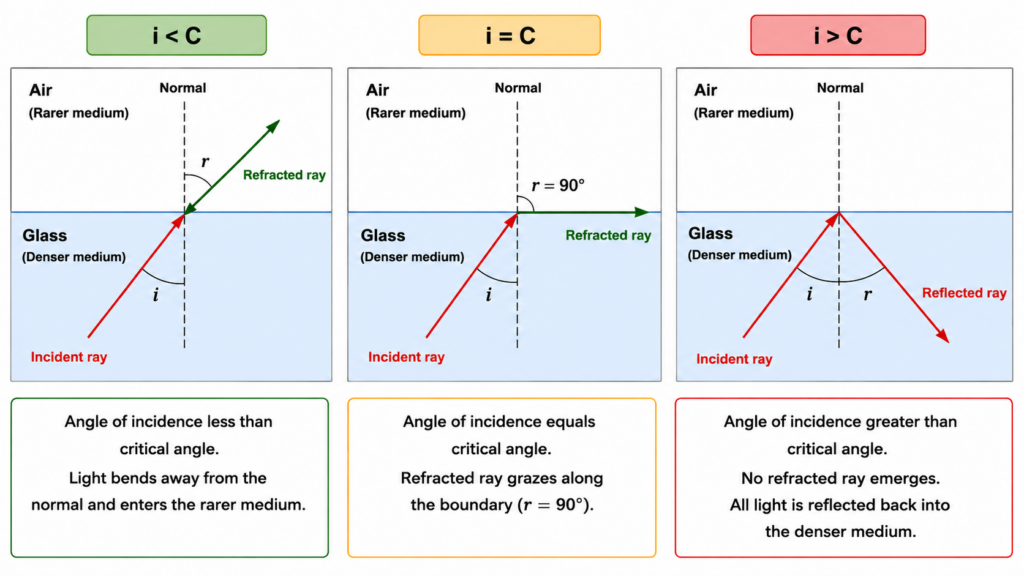
Case 1: Angle of incidence is less than the critical angle
When:
i < C
The ray is refracted into the rarer medium and bends away from the normal.
Case 2: Angle of incidence is equal to the critical angle
When:
i = C
The refracted ray travels along the boundary between the two media.
Therefore:
r = 90°
Case 3: Angle of incidence is greater than the critical angle
When:
i > C
No refracted ray emerges into the rarer medium.
The complete ray is reflected back into the denser medium.
This is Total Internal Reflection.
| Basis of Comparison | Ordinary Reflection | Total Internal Reflection (TIR) |
|---|---|---|
| Meaning | Light is reflected back from a surface when it strikes the surface. | Light is completely reflected back into the denser medium at the boundary of two transparent media. |
| Direction of Light | It can occur for light travelling in any direction towards a reflecting surface. | Light must travel from an optically denser medium to an optically rarer medium. |
| Angle of Incidence | No specific condition regarding the critical angle is required. | The angle of incidence must be greater than the critical angle. |
| Critical Angle | Critical angle is not required. | Critical angle is an essential concept for TIR. |
| Refraction | In ordinary reflection from a transparent surface, some light may be transmitted into the second medium. | No refracted ray emerges into the rarer medium when TIR occurs. |
| Amount of Light Reflected | Generally, only a part of the incident light may be reflected. | Ideally, 100% of the incident light is reflected back into the denser medium. |
| Where It Occurs | At a reflecting surface or boundary. | At the boundary between an optically denser and an optically rarer transparent medium. |
| Main Examples | Reflection from a plane mirror, polished metal surface, etc. | Optical fibres, sparkling of diamonds and totally reflecting prisms. |
| Important Condition | Follows the law of reflection: angle of incidence = angle of reflection. | Requires denser → rarer medium and angle of incidence > critical angle. |
Refractive Index and Critical Angle
For light travelling from a medium of refractive index n₁ to a rarer medium of refractive index n₂, where n₁ > n₂, the critical angle is related by:
sin C = n₂ / n₁
For the special case of light travelling from glass to air, the refractive index of air is approximately 1.
Therefore:
sin C = 1 / n
where n is the refractive index of glass with respect to air.
Why Does Total Internal Reflection Occur?
When light travels from an optically denser medium to an optically rarer medium, the refracted ray bends away from the normal.
As the angle of incidence increases, the angle of refraction also increases.
At a particular angle of incidence, the refracted ray makes an angle of 90° with the normal. This angle is called the critical angle.
If the angle of incidence is increased further, the light can no longer emerge into the rarer medium. Instead, it is completely reflected back into the denser medium.
This is Total Internal Reflection.
Examples of Total Internal Reflection in Daily Life
Total Internal Reflection has several important applications.
1. Optical Fibre
One of the most important applications of Total Internal Reflection is in optical fibres.
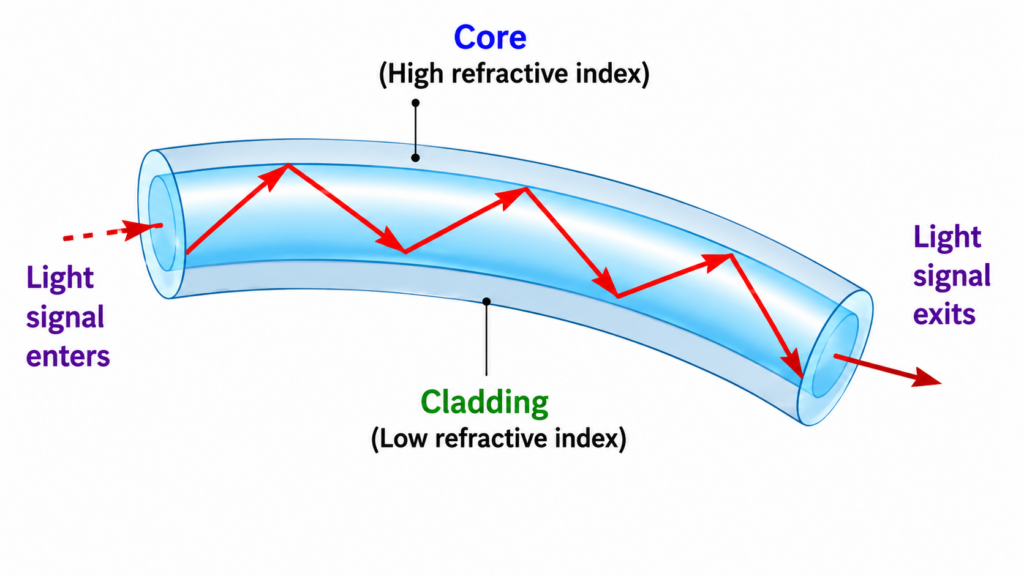
An optical fibre consists mainly of a core surrounded by cladding. The core has a higher refractive index than the cladding.
Light entering the fibre undergoes repeated Total Internal Reflection and travels through the fibre over long distances.
Uses of optical fibres
Optical fibres are used in:
- Internet and high-speed communication
- Telephone communication
- Cable television
- Medical endoscopy
- Data transmission
2. Sparkling of Diamonds
Diamonds sparkle brightly because of Total Internal Reflection.
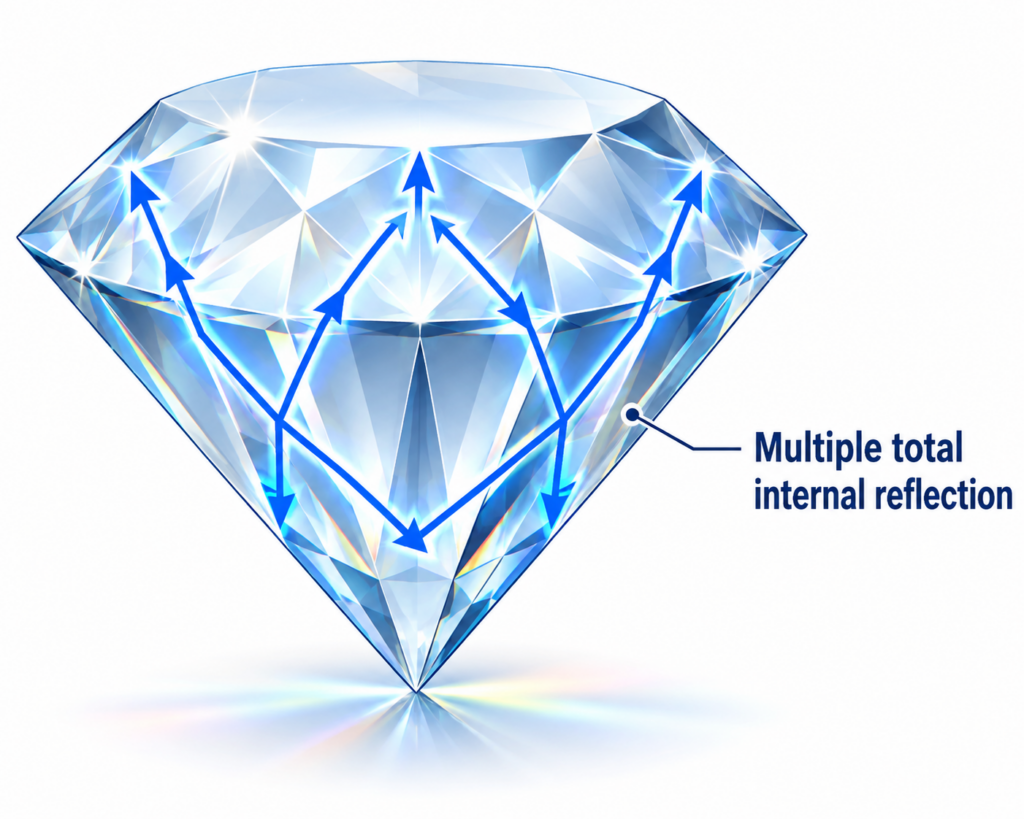
Diamond has a very high refractive index and therefore a small critical angle.
Light entering a diamond can undergo repeated Total Internal Reflection before emerging from the diamond.
This helps produce the characteristic brilliance and sparkle of diamonds.
3. Mirage
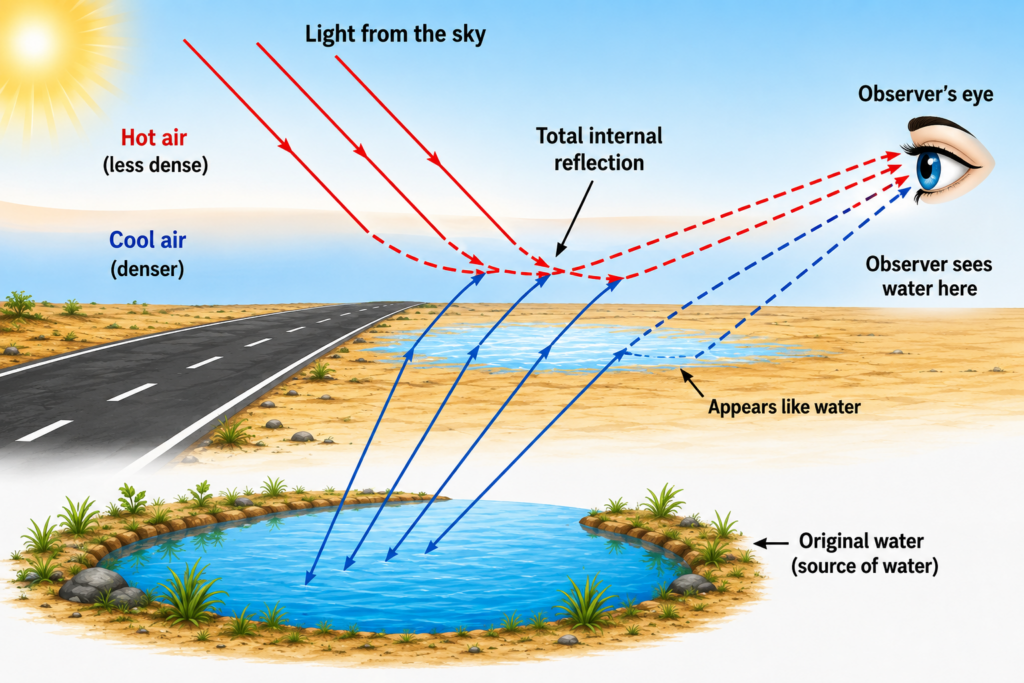
A mirage observed on hot roads or deserts is associated with refraction and Total Internal Reflection in layers of air having different temperatures and densities.
Air near a very hot surface is warmer and optically rarer than the cooler air above it. Light travelling through these layers can bend gradually and may undergo Total Internal Reflection.
As a result, the observer may see an image that appears like water on the road.
4. Totally Reflecting Prisms
Prisms can be designed so that light undergoes Total Internal Reflection inside them.
Such prisms are used in optical instruments to change the direction of light and, in some arrangements, to produce image inversion or reversal.
Optical Fibre and Total Internal Reflection
An optical fibre is a thin, flexible fibre made of transparent material through which light can travel.
It generally consists of:
- Core – the central region through which light travels
- Cladding – surrounds the core and has a lower refractive index
- Protective coating – protects the fibre from damage
Since the refractive index of the core is greater than that of the cladding, light can undergo repeated Total Internal Reflection inside the core.
This allows information to be transmitted over long distances with relatively low loss.
Total Internal Reflection in a Simple Example
Consider a ray of light travelling from glass to air.
Since glass is optically denser than air, the ray moves from a denser medium to a rarer medium.
Suppose the critical angle for the glass-air boundary is 42°.
If i = 30°
Since:
30° < 42°
the ray will be refracted into air.
If i = 42°
Since:
i = C
the refracted ray will travel along the surface.
If i = 50°
Since:
50° > 42°
Total Internal Reflection will occur.
Therefore, the light will be reflected completely back into the glass.
Important Points to Remember
For CBSE Class 10 Science examinations, remember these points:
- TIR stands for Total Internal Reflection.
- Light must travel from an optically denser medium to an optically rarer medium.
- The angle of incidence must be greater than the critical angle.
- At the critical angle, the angle of refraction is 90°.
- In TIR, the light is completely reflected back into the denser medium.
- Optical fibres work on the principle of Total Internal Reflection.
- The sparkle of diamonds is associated with repeated Total Internal Reflection.
- A prism can use Total Internal Reflection to change the direction of light.
- A mirage is associated with refraction and Total Internal Reflection in atmospheric layers.
- TIR cannot occur when light travels from an optically rarer medium to an optically denser medium.
Frequently Asked Questions
What is Total Internal Reflection?
Total Internal Reflection is the phenomenon in which light travelling from an optically denser medium to an optically rarer medium is completely reflected back into the denser medium when the angle of incidence is greater than the critical angle.
What are the two conditions for Total Internal Reflection?
The two conditions are:
- Light must travel from an optically denser medium to an optically rarer medium.
- The angle of incidence must be greater than the critical angle.
What happens when the angle of incidence is equal to the critical angle?
When the angle of incidence is equal to the critical angle, the angle of refraction is 90°, so the refracted ray travels along the boundary.
Can Total Internal Reflection occur when light travels from air to glass?
No. Total Internal Reflection occurs only when light travels from an optically denser medium to an optically rarer medium.
Why do diamonds sparkle?
Diamonds have a high refractive index and a small critical angle. Light entering a diamond can undergo repeated Total Internal Reflection, producing its characteristic sparkle.
Which principle is used in optical fibres?
Optical fibres work mainly on the principle of Total Internal Reflection.
What is the difference between reflection and Total Internal Reflection?
Reflection is the general phenomenon in which light is returned from a surface, whereas Total Internal Reflection specifically occurs when light travels from a denser to a rarer medium and the angle of incidence is greater than the critical angle.
Important Exam Questions
1. Define Total Internal Reflection.
Answer: Total Internal Reflection is the complete reflection of light back into an optically denser medium when light travelling from the denser medium to the rarer medium strikes the boundary at an angle greater than the critical angle.
2. State the two conditions necessary for Total Internal Reflection.
Answer:
- Light must travel from an optically denser medium to an optically rarer medium.
- The angle of incidence must be greater than the critical angle.
3. What happens when the angle of incidence is equal to the critical angle?
Answer: The angle of refraction becomes 90°, and the refracted ray travels along the boundary of the two media.
4. Why is Total Internal Reflection not possible when light travels from air to glass?
Answer: Because Total Internal Reflection can occur only when light travels from an optically denser medium to an optically rarer medium. Air is optically rarer than glass.
5. Name two applications of Total Internal Reflection.
Answer: Two applications are:
- Optical fibres
- Totally reflecting prisms
The sparkle of diamonds and certain atmospheric optical phenomena such as mirages are also associated with Total Internal Reflection.
Conclusion
Total Internal Reflection is an important phenomenon in the study of light. It occurs when light travels from an optically denser medium to an optically rarer medium and the angle of incidence becomes greater than the critical angle.
The phenomenon has many practical applications, especially in optical fibre communication, medical endoscopy, prisms and other optical instruments. Understanding the two conditions of TIR and the concept of the critical angle is particularly important for Class 10 Science examinations.
For more CBSE Class 10 Science notes, NCERT solutions, important questions, MCQs and chapter-wise video solutions, keep learning with Future Study Point.
Class 10 Maths Most Important Questions on Real Numbers
Class 10 Maths Most Important Questions Chapter 1 Real Numbers
Class 10 Maths Basic Sample Paper Solution:
Practise with the Complete CBSE Basic Sample Paper Solution
Class 10 Maths NCERT Solutions CBSE 2026-27 Update
Continue your Class 10 Maths preparation with these useful resources from Future Study Point:
Class 10 Maths Chapter 1 – Real Numbers: Complete NCERT Exercise-Wise Video Solutions
Class 10 Maths Chapter 2 – Polynomials: Complete NCERT Solutions for Polynomials
Class 10 Maths Chapter 3 – Pair of Linear Equations in Two Variables: Complete NCERT Solutions
Class 10 Maths Chapter 4 Quadratic Equations: – Quadratic Equations complete NCERT video solutions
Class 10 Maths Chapter 5 Arithmetic Progression: Arithmetic Progression: complete video solution
👉 Explore these resources to strengthen your concepts, revise important topics, and prepare effectively for the CBSE Class 10 Maths Board Examination 2026–27.