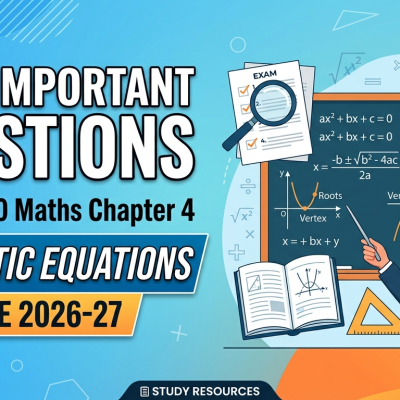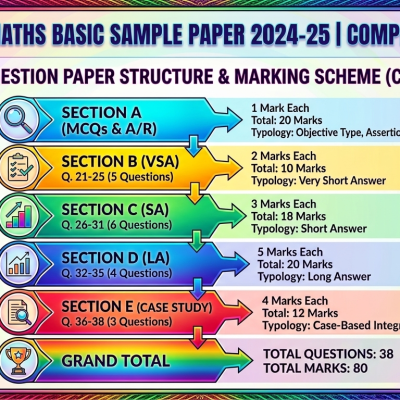
Quadratic Equations is an important chapter in Class 10 Maths, and Class 10 Maths Chapter 4 Quadratic Equations Most Important Questions are an essential part of preparation for the CBSE Board Examination. Questions from this chapter can be asked in different forms, including MCQs, short-answer questions, long-answer questions and application-based problems.Class 10 Maths Most Important Questions are highly valuable for CBSE Board Exam preparation because they help students focus on frequently asked concepts, important question patterns, and exam-oriented practice.
In this chapter, students learn important concepts such as formation of quadratic equations, factorisation, completing the square, the quadratic formula, discriminant and the nature of roots. Word problems based on numbers, ages, speed, distance and dimensions are also important from the examination point of view.
To help students prepare effectively, we have compiled 50 most important questions from Class 10 Maths Chapter 4 – Quadratic Equations. These include 20 questions based on the NCERT Class 10 Maths textbook and 30 questions based on important CBSE previous-year question patterns. The questions have been selected to provide practice across the major concepts and question types of the chapter.
You can also watch the video:Class 10 Maths Chapter 4 Quadratic Equations Most Important Questions
In addition to these 50 questions, we have also provided additional video solutions for Chapter 4 – Quadratic Equations. These videos contain further important questions with complete step-by-step solutions and are designed to give students extra practice beyond the questions listed here.
Students can first practise the 50 important questions and then scroll down to watch the additional video solutions. This will help them understand different approaches to solving quadratic equations and improve their accuracy, speed and confidence for the CBSE Board Examination.
Class 10 Maths Chapter 4 – Quadratic Equations: 50 Most Important Questions
Quadratic Equations is an important chapter for the CBSE Class 10 Mathematics Board Examination. The following 50 questions are carefully selected for revision and practice. The first 20 questions are based on the concepts and question types given in the NCERT Class 10 Mathematics textbook, while the remaining 30 are based on important CBSE previous-year question patterns.
Important topics: Standard form, factorisation, completing the square, quadratic formula, discriminant, nature of roots, and application-based problems.
Part A – 20 Important Questions Based on NCERT Textbook
Section 1 – Introduction and Formation of Quadratic Equations
-
Check whether the following equations are quadratic equations:
(i) (x + 1)2 = 2(x − 3)
(ii) x2 + 3x = 4
(iii) x3 − 2x2 + x = 0
Give reasons for your answers. -
Determine whether the equation
(x − 2)(x + 3) = x2 + 5
is a quadratic equation after simplifying it. - The area of a rectangular plot is 528 m2. Its length is one metre more than twice its breadth. Form a quadratic equation to find the dimensions of the plot.
- The product of two consecutive positive integers is 306. Form the quadratic equation representing the situation and find the two integers.
- A mother is 26 years older than her son. Three years from now, the product of their ages will be 360. Form the required quadratic equation and find their present ages.
Section 2 – Solving Quadratic Equations by Factorisation
-
Solve by factorisation:
x2 − 5x + 6 = 0 -
Solve by factorisation:
2x2 − 7x + 3 = 0 -
Solve:
3x2 − 2x − 8 = 0
using the factorisation method. -
Solve the quadratic equation:
x2 − 9x + 20 = 0 -
Find the roots of:
4x2 − 4x − 15 = 0
by factorisation.
Section 3 – Completing the Square and Quadratic Formula
-
Solve the equation
x2 + 6x + 5 = 0
by completing the square. -
Solve by completing the square:
2x2 + 5x − 3 = 0 -
Solve using the quadratic formula:
2x2 − 7x + 3 = 0 -
Solve using the quadratic formula:
3x2 + 5x − 2 = 0 -
Solve:
5x2 − 6x + 1 = 0
using the quadratic formula.
Section 4 – Nature of Roots and Discriminant
-
Find the discriminant of
2x2 − 4x + 3 = 0
and state the nature of its roots. -
Determine the nature of the roots of:
5x2 − 6x + 2 = 0 -
Find the value of k for which the equation
x2 + kx + 9 = 0
has equal roots. -
Determine whether the equation
4x2 − 4x + 5 = 0
has real roots. Give a reason. -
Find the value of k so that the quadratic equation
kx2 − 2x + 1 = 0
has two distinct real roots.
Part B – 30 Important CBSE Previous-Year/PYQ-Based Questions
These questions are selected from recurring CBSE Board Examination question patterns, including MCQs, short-answer questions, long-answer questions and application-based problems from Quadratic Equations.
Section 1 – MCQ and 1-Mark Questions
-
Which of the following represents a quadratic equation after simplification?
(A) x2 + 2x + 1 = 0
(B) x + 5 = 0
(C) x3 + 2 = 0
(D) 2x + 7 = 0 -
The equation
x + 1/x = 3, x ≠ 0
can be converted into a quadratic equation. Write its standard form. -
For the equation
x2 − 8x + 12 = 0,
find the sum of its roots. - If the discriminant of a quadratic equation is zero, what can you say about its roots?
-
For what values of k will
x2 − 4x + k = 0
have two distinct real roots? -
If the roots of
x2 − 7x + 10 = 0
are α and β, find α + β and αβ. -
If one root of
2x2 + 5x + k = 0
is −1, find the value of k. -
Determine the nature of the roots of:
x2 + 4x + 8 = 0 -
Which condition must be satisfied by the coefficients of
ax2 + bx + c = 0
for it to be a quadratic equation? -
Find the value of k if the equation
x2 + kx + 16 = 0
has equal roots.
Section 2 – 2 and 3-Mark Questions
-
Solve:
6x2 − x − 2 = 0
using the quadratic formula. -
Find the roots of:
2x2 − 5x − 3 = 0
and verify the relationship between the roots and the coefficients. -
Find the value of k for which
x2 + (k + 1)x + k = 0
has equal roots. -
Find the value of k so that
2x2 + kx + 8 = 0
has no real roots. -
Solve:
4x2 − 12x + 9 = 0
and state whether the roots are distinct or equal. -
If α and β are the roots of
3x2 − 5x − 2 = 0,
find α + β and αβ without solving the equation. - Form a quadratic equation whose roots are 3 and −5.
- Form a quadratic equation whose roots have sum 7 and product 10.
- The difference between two positive integers is 3 and their product is 180. Find the integers by forming and solving a quadratic equation.
- The product of two consecutive positive integers is 210. Find the integers.
Section 3 – Important Word Problems and Long-Answer Questions
- A train travels a certain distance at a uniform speed. If its speed is increased by 10 km/h, the journey takes 1 hour less. If the distance is known, form the quadratic equation and determine the original speed.
- An aircraft covers a distance of 2800 km. Due to bad weather its speed is reduced, increasing the journey time by 30 minutes. Form a quadratic equation and determine the original speed.
- A fraction has a denominator that is greater than twice its numerator by a fixed amount. If the fraction and its reciprocal satisfy a given relation, form the corresponding quadratic equation and find the fraction.
- The area of a rectangular garden is 300 m2. Its length is 5 m more than its breadth. Find the dimensions of the garden using a quadratic equation.
- A rectangular field has an area of 528 m2. Its length is one metre more than twice its breadth. Find its length and breadth.
- The product of the ages of two persons is 180. One person is 3 years older than the other. Find their ages using a quadratic equation.
- A cottage industry produces a certain number of articles per day. The total cost of production is related quadratically to the number of articles. Form and solve the resulting quadratic equation when the given cost condition is satisfied.
- A rectangular park has an area of 800 m2. Its length exceeds its breadth by 20 m. Find its dimensions using the quadratic formula.
- A man travels a fixed distance at a certain speed. If he increases his speed by 5 km/h, he reaches his destination 1 hour earlier. If the distance is 150 km, find his original speed.
- A rectangular lawn is surrounded by a uniform walkway. The total area of the lawn and walkway is given, while the dimensions of the lawn are known. Let the width of the walkway be x metres. Form the quadratic equation and find the possible value of x.
Important Topics to Revise Before the CBSE Board Exam
- Standard form of a quadratic equation: ax2 + bx + c = 0, where a ≠ 0
- Checking whether an equation is quadratic
- Formation of quadratic equations from word problems
- Solving quadratic equations by factorisation
- Solving quadratic equations by completing the square
- Solving quadratic equations using the quadratic formula
- Discriminant: D = b2 − 4ac
- Nature of roots using the discriminant
- Conditions for equal, distinct and non-real roots
- Application-based questions involving speed, distance, ages, integers, fractions and areas
Students should practise all three methods of solving quadratic equations and should be especially comfortable with the discriminant. CBSE questions frequently test whether students can form a quadratic equation from a real-life situation before solving it.
How to Prepare These 50 Questions
First solve Questions 1–20 to strengthen the NCERT concepts. Then attempt Questions 21–50 without looking at the solution. Give special attention to questions involving the discriminant, formation of equations and word problems because these question types require both conceptual understanding and correct mathematical presentation.
More Important Questions for Class 10 Maths Chapter 4 – Quadratic Equations
The 50 questions provided above cover the major concepts of Class 10 Maths Chapter 4 – Quadratic Equations. However, students preparing seriously for the CBSE Board Examination should also practise additional questions to become familiar with different levels of difficulty and different ways in which a quadratic equation can be presented.
Quadratic Equations is a chapter where students need to understand the method of solving, rather than simply memorising formulas. A question may ask you to solve a quadratic equation directly, find the nature of its roots, determine an unknown value, or form an equation from a given situation.
1. Quadratic Formula
When factorisation is difficult, the quadratic formula can be used:
x = (-b ± √(b² – 4ac)) / 2a
Students should be careful while identifying the values of a, b and c, particularly when negative signs are involved.
2. Discriminant and Nature of Roots
The discriminant is:
D = b² − 4ac
Its value helps determine the nature of the roots:
- D > 0: Two distinct real roots
- D = 0: Two equal real roots
- D < 0: No real roots
Questions based on the discriminant are particularly important for CBSE Board Exam preparation.
3. Formation of Quadratic Equations
Students should also practise forming quadratic equations from given roots, sum and product of roots, and real-life situations.
4. Word Problems
Application-based questions may involve consecutive integers, ages, speed and distance, areas of rectangles and other geometric situations. In these questions, the most important step is to correctly translate the given information into a quadratic equation.
How to Prepare Chapter 4 for the CBSE Board Exam
For effective preparation, students should first study the concepts and solved examples from the NCERT Class 10 Maths textbook. After understanding the basic methods, solve the NCERT exercises without looking at the solutions.
Next, practise CBSE previous-year questions and additional questions. This will help you understand how the same concept can be tested in different ways.
While solving quadratic equations, always show the important mathematical steps clearly. In Board Examinations, writing only the final answer is not enough for questions that require a complete solution. Proper presentation of the equation, method and calculation can help you avoid unnecessary mistakes.
Common Mistakes Students Should Avoid
While preparing Class 10 Maths Chapter 4 Quadratic Equations, students commonly make mistakes such as:
- Incorrectly converting an equation into standard form.
- Taking the wrong values of a, b and c.
- Making sign errors while calculating the discriminant.
- Forgetting the ± sign in the quadratic formula.
- Making calculation errors while factorising.
- Giving only one root when two roots are required.
- Not checking whether the obtained answer is meaningful in a word problem.
- Not writing the final answer with appropriate units in application-based questions.
Why Practise Previous-Year Questions?
CBSE previous-year questions are useful because they help students understand the types of questions that have appeared in Board Examinations. They also provide practice in applying concepts under examination conditions.
Instead of solving questions randomly, students should identify the concept tested in each question. For example, one question may test factorisation, another may test the discriminant, while an application-based question may require students to first form a quadratic equation and then solve it.
Final Revision Strategy
Before appearing for the CBSE Board Examination, make sure you can confidently:
- Identify a quadratic equation.
- Convert an equation into standard form.
- Solve quadratic equations by factorisation.
- Solve quadratic equations using the quadratic formula.
- Calculate the discriminant correctly.
- Determine the nature of roots.
- Find an unknown value when roots have a particular nature.
- Form a quadratic equation from given roots.
- Solve application-based word problems.
- Present the complete solution step by step.
For more practice, students can also watch the additional video solutions provided on this page. These videos cover further important questions from Quadratic Equations and provide step-by-step explanations to help students strengthen their preparation for the Class 10 CBSE Maths Board Exam.
You can study our following posts also
Class 10 Maths (Basic) Preboard Full Paper Solution | CBSE Board 2025–26
Class 10 Standard Maths Question Paper Solution CBSE Board 2024–25
Class 10 CBSE Standard Maths Previous Year Question Paper 2023–24 Video Solutions
Class 8 Maths NCERT Solutions – Ganita Prakash Part 1 Chapter 1: A Square and a Cube
Class 8 Maths Ganit Prakash Chapter 2 Power Play – Unique ID Code for Milk Packets
Class 10 Science Chapter 9: Light Reflection & Refraction – Total Internal Reflection
How Do Rockets Burn in Space Without Oxygen?
Class 9 Maths Chapter 2 Full Video Solutions | Introduction to Linear Polynomials
Class 10 Maths Standard Question Paper CBSE Board Exam 2025–26 – Full Video Solution
Class 9 Maths Chapter 1 Exercise Question 11 Solution | Orienting Yourself: Uses of Coordinates
Class 10 Science Sample Paper 2025–26 Full Solution CBSE Official