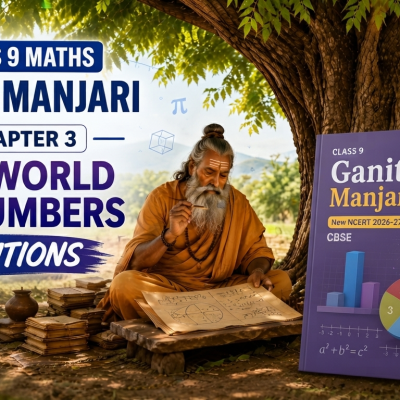
Class 9 Maths Ganit Manjari Chapter 3 – The World of Numbers Solutions
Chapter 3 – The World of Numbers is an important chapter in Class 9 Maths Ganit Manjari. It helps students explore numbers, their properties, relationships and patterns through a variety of mathematical questions. The chapter encourages students to develop logical thinking and apply number concepts while solving problems.
The chapter contains multiple exercises, and each exercise focuses on different aspects of the concepts introduced in The World of Numbers. Students should practise all the exercises carefully because they provide opportunities to understand the concepts, improve calculation skills and develop systematic problem-solving methods.
Class 9 Maths Ganit Manjari Chapter 3 – The World of Numbers
Class 9 Maths Ganit Manjari Chapter 3 – The World of Numbers introduces students to the fascinating world of numbers and their different forms. This chapter builds concepts starting from natural numbers and integers and gradually moves towards rational numbers, irrational numbers and real numbers. Students also explore number patterns, operations on numbers, representation of rational numbers on the number line, and decimal expansions.
The chapter contains Exercise 3.1, Exercise 3.2, Exercise 3.3, Exercise 3.4 and Exercise 3.5, followed by the End-of-Chapter Exercises. Each exercise focuses on different aspects of the number system and provides opportunities to develop mathematical reasoning and problem-solving skills.
In this post, you will find Class 9 Maths Ganit Manjari Chapter 3 solutions covering all the exercise sets as well as the End-of-Chapter Exercises. The complete video playlist is provided below so that students can follow the solutions step by step and revise the entire chapter conveniently.
Exercise-wise Coverage
Exercise Set 3.1 – Natural Numbers and Number Patterns
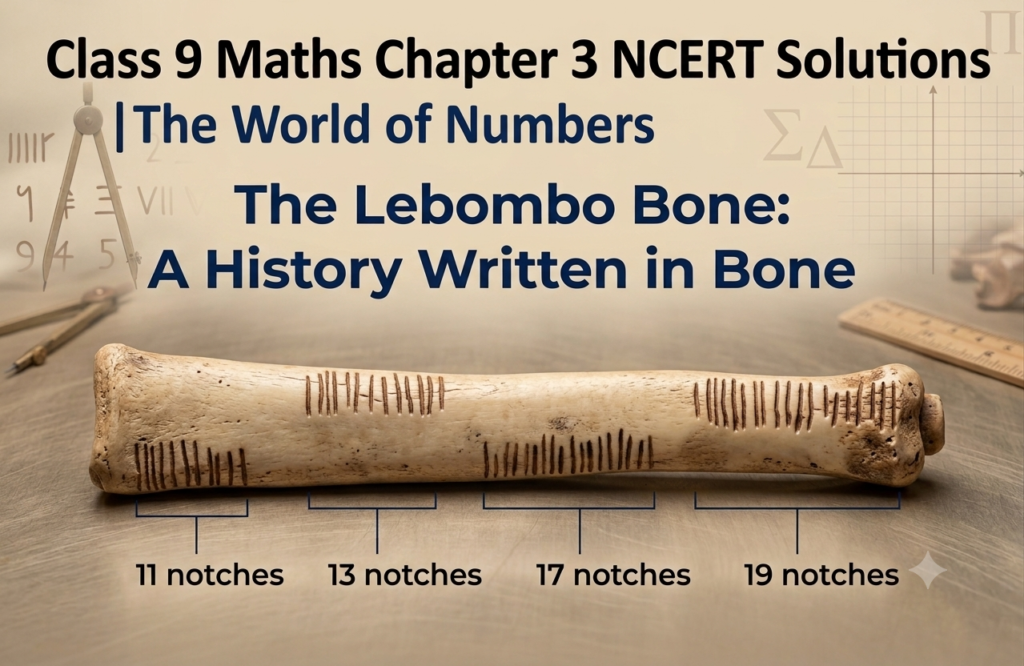
Exercise 3.1 introduces students to the human need for counting and the development of natural numbers.The questions connect mathematics with historical examples such as Lothal and the Ishango bone.Students work with practical counting situations and identify patterns in numbers.The exercise also explores prime numbers and asks students to recognise their patterns.It introduces the idea of closure of natural numbers under different operations, particularly subtraction.Overall, this exercise builds the foundation for understanding how the number system developed and how natural numbers behave.
Exercise Set 3.2 – Integers and Operations
Exercise 3.2 develops the concept of integers, including positive numbers, negative numbers and zero.
The questions use familiar situations such as temperature, profit, loss, debt and fortune to explain positive and negative quantities.Students practise addition, subtraction, multiplication and division involving integers.The exercise also introduces Brahmagupta’s rules for operating with positive and negative numbers.Special attention is given to understanding why subtracting a negative number is equivalent to adding a positive number.This exercise helps students connect the rules of integers with real-life situations.
Exercise Set 3.3 – Rational Numbers and Their Properties
Exercise 3.3 focuses on rational numbers and their basic operations and properties.Students learn to identify and prove when two rational numbers are equal using simplification or cross-multiplication.The exercise includes addition, subtraction, multiplication and division of rational numbers.It also gives ractice with the distributive property and its application to rational numbers.Several questions require students to simplify expressions and verify mathematical statements step by tep.Overall, this exercise strengthens students’ computational skills and develops a clear understanding of rational-number operations.
Exercise Set 3.4 – Rational Numbers on the Number Line
Exercise 3.4 takes rational numbers from calculations to their geometrical representation on the umber line.Students practise locating positive and negative rational numbers, including mixed numbers, on a single number line.The exercise also asks students to find rational numbers lying between two given rational numbers.Students solve problems involving addition and subtraction of rational numbers and their applications in everyday situations.An important idea developed here is that there are infinitely many rational numbers between any two rational numbers.The exercise therefore helps students understand both the numerical and visual nature of rational numbers.
Exercise Set 3.5 – Decimal Expansions, Irrational Numbers and Cyclic Patterns
Exercise 3.5 brings together several important ideas about rational and irrational numbers and decimal expansions.Students determine whether rational numbers have terminating or non-terminating repeating decimal expansions by examining the prime factors of their denominators.They also use long division to investigate repeating patterns, including the fascinating cyclic behaviour of numbers such as 1/13.The exercise asks students to classify numbers as rational or irrational and understand why some decimal expansions never terminate or repeat.Students also explore the result that 0.9999… is exactly equal to 1 using algebra.The final questions encourage students to investigate other reciprocals that produce interesting cyclic repeating decimals.
End-of-Chapter Exercises – Complete Revision of “The World of Numbers”
The End-of-Chapter Exercises provide a comprehensive revision of the major concepts covered throughout Chapter 3.They bring together questions related to rational numbers, decimal expansions, irrational numbers and the real number system.Students are required to apply concepts rather than simply recall definitions or rules.The questions provide an opportunity to practise calculations, representations and reasoning based on different parts of the chapter.These miscellaneous questions are especially useful for checking whether students can connect concepts learned across Exercises 3.1 to 3.5.
Completing this section after all the individual exercises can help students revise the entire chapter and identify areas that need further practice.
Frequently Asked Questions – Class 9 Maths Chapter 3 The World of Numbers
1. What is the name of Chapter 3 in Class 9 Maths Ganit Manjari?
The name of Chapter 3 in Class 9 Maths Ganit Manjari is “The World of Numbers.” The chapter develops students’ understanding of different types of numbers and their properties.
2. What topics are covered in Class 9 Maths Chapter 3 The World of Numbers?
Chapter 3 covers important concepts related to natural numbers, integers, rational numbers, irrational numbers and real numbers. It also discusses number patterns, operations on numbers, decimal expansions, rational numbers on the number line and interesting cyclic patterns.
3. How many exercises are there in Chapter 3 The World of Numbers?
The chapter contains five main exercise sets: Exercise 3.1, Exercise 3.2, Exercise 3.3, Exercise 3.4 and Exercise 3.5. After these, there is an End-of-Chapter Exercises section containing questions based on the concepts covered throughout the chapter.
4. What is covered in Exercise 3.1 of Class 9 Maths Ganit Manjari?
Exercise 3.1 introduces students to natural numbers and number patterns. It also connects the development of numbers with historical examples and explores ideas such as counting, prime numbers and properties of natural numbers.
5. What is covered in Exercise 3.2 of Class 9 Maths Ganit Manjari?
Exercise 3.2 focuses on integers and operations with positive and negative numbers. Students learn to work with addition, subtraction, multiplication and division of integers through mathematical and real-life situations.
6. What is covered in Exercise 3.3 of Chapter 3?
Exercise 3.3 deals mainly with rational numbers and their properties. Students practise operations on rational numbers and solve questions involving equality, simplification and the distributive property.
7. What is covered in Exercise 3.4 of The World of Numbers?
Exercise 3.4 focuses on the representation of rational numbers on the number line. Students also learn how to find rational numbers between two given numbers and understand that there are infinitely many rational numbers between any two rational numbers.
8. What is covered in Exercise 3.5 of Class 9 Maths?
Exercise 3.5 deals with decimal expansions, rational and irrational numbers and repeating decimal patterns. Students investigate terminating and non-terminating repeating decimals and explore interesting patterns in fractions such as .
9. What are the End-of-Chapter Exercises in Chapter 3?
The End-of-Chapter Exercises are a miscellaneous revision section for the entire chapter. The questions require students to apply concepts learned in Exercises 3.1 to 3.5 and help them check their overall understanding of The World of Numbers.
10. Is Chapter 3 The World of Numbers important for Class 9 Maths?
Yes. The World of Numbers is an important foundation chapter because it develops concepts related to different types of numbers and their properties. A clear understanding of this chapter can also help students in higher classes.
11. Where can I find Class 9 Maths Ganit Manjari Chapter 3 solutions?
Students can use the exercise-wise solutions for Exercise 3.1, 3.2, 3.3, 3.4 and 3.5, along with the End-of-Chapter Exercises, to understand the methods used to solve the questions step by step.
12. How should I prepare Chapter 3 The World of Numbers?
First, understand the concepts and examples given in the NCERT Ganit Manjari textbook. Then solve Exercises 3.1 to 3.5 yourself and use solutions to check your work. Finally, attempt the End-of-Chapter Exercises as a complete chapter revision.
13. Can I use video solutions for Chapter 3?
Yes. Video solutions can be useful when you are unable to understand a particular question or want to see the complete solving process. An exercise-wise or complete Chapter 3 video playlist can help students revise all the questions systematically.
14. What is the best way to revise Class 9 Maths Chapter 3?
Revise the important concepts first, then practise questions from all five exercise sets. After completing them, attempt the End-of-Chapter Exercises without looking at the solutions. This helps you identify the topics that require additional practice.
15. Is the End-of-Chapter Exercises section important?
Yes. It is particularly useful because it brings together concepts from different parts of The World of Numbers. Students should attempt these questions after completing Exercises 3.1 to 3.5 as a final chapter-level practice set.
You can study our following posts also
Class 10 Maths (Basic) Preboard Full Paper Solution | CBSE Board 2025–26
Class 10 Standard Maths Question Paper Solution CBSE Board 2024–25
Class 10 CBSE Standard Maths Previous Year Question Paper 2023–24 Video Solutions
Class 8 Maths NCERT Solutions – Ganita Prakash Part 1 Chapter 1: A Square and a Cube
Class 8 Maths Ganit Prakash Chapter 2 Power Play – Unique ID Code for Milk Packets
Class 10 Science Chapter 9: Light Reflection & Refraction – Total Internal Reflection
How Do Rockets Burn in Space Without Oxygen?
Class 9 Maths Chapter 2 Full Video Solutions | Introduction to Linear Polynomials
Class 10 Maths Standard Question Paper CBSE Board Exam 2025–26 – Full Video Solution
Class 9 Maths Chapter 1 Exercise Question 11 Solution | Orienting Yourself: Uses of Coordinates
Class 10 Science Sample Paper 2025–26 Full Solution CBSE Official