Preparing for the CBSE Class 10 Maths Board Exam 2026–27? In this post, you will find the most important questions from Chapter 3 – Pair of Linear Equations in Two Variables, along with useful video solutions and exam-oriented practice.
These questions cover important concepts such as substitution method, elimination method, graphical method, consistency of a pair of linear equations, and important word problems. Watch the videos, practise each question yourself, and strengthen your preparation for the CBSE examination.
Pair of Linear Equations in Two Variables
A pair of linear equations in two variables consists of two linear equations involving the same two variables, usually represented by (x) and (y). In Class 10 Maths, this chapter focuses on finding the solution of such equations using graphical, substitution and elimination methods.
Students also learn how to determine whether a pair of linear equations has a unique solution, no solution, or infinitely many solutions. The chapter includes important word problems and application-based questions, making it an important topic for CBSE Board Exam preparation.
Class 10 Maths Chapter 3 – Pair of Linear Equations in Two Variables
The chapter Pair of Linear Equations in Two Variables is important because questions can test both your conceptual understanding and your ability to solve problems step by step.
You should be comfortable with:
- Pair of linear equations in two variables
- Graphical representation of two linear equations
- Solving equations by the substitution method
- Solving equations by the elimination method
- Conditions for consistency and inconsistency
- Number of solutions of a pair of linear equations
- Word problems based on linear equations
- Application-based and case-study questions
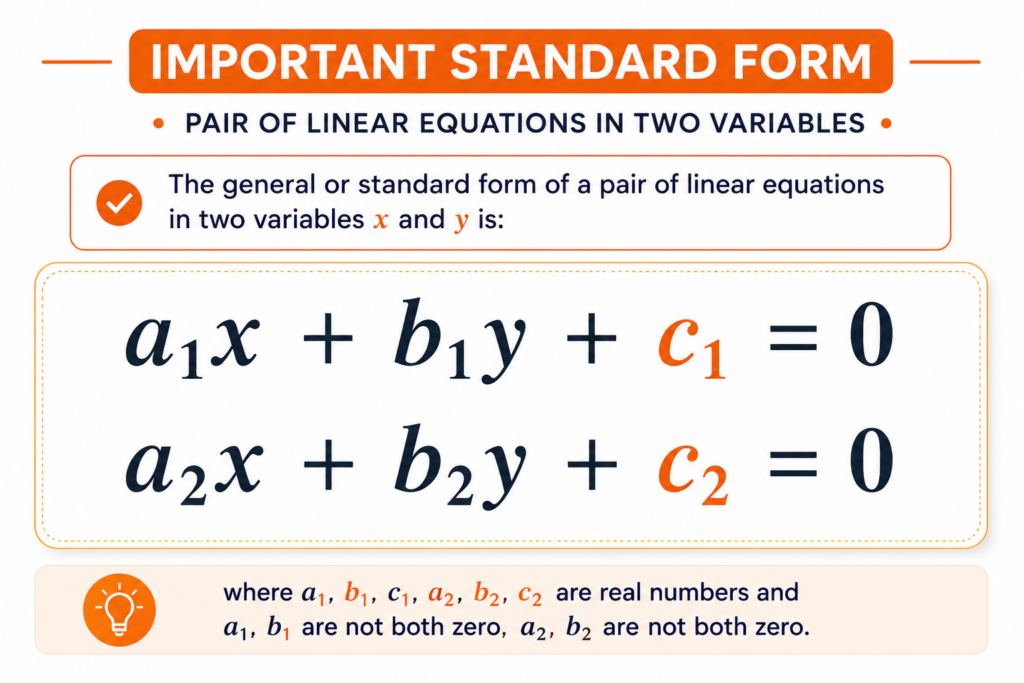
Standard Form of Pair of Linear Equations in Two Variables
3. Identify Whether a Pair Has a Unique Solution, No Solution or Infinitely Many Solutions
This is one of the most important conceptual areas of the chapter.
For a pair of linear equations, we can determine whether the equations have a unique solution, no solution, or infinitely many solutions by comparing their coefficients.
- Unique solution: The two lines intersect at one point.
- No solution: The two lines are parallel and do not intersect.
- Infinitely many solutions: The two lines coincide and have infinitely many common points.
For the equations:
a₁x + b₁y + c₁ = 0
a₂x + b₂y + c₂ = 0
we use the following conditions:
1. Unique solution
a₁/a₂ ≠ b₁/b₂
2. No solution
a₁/a₂ = b₁/b₂ ≠ c₁/c₂
3. Infinitely many solutions
a₁/a₂ = b₁/b₂ = c₁/c₂
Students should learn these conditions carefully because they can appear directly as questions or as part of a larger problem.
Most Important Concepts – Chapter 3
The following questions cover the most important concepts and question patterns from Chapter 3 – Pair of Linear Equations in Two Variables. These are selected to help students prepare for the CBSE 2026–27 examination and strengthen their understanding of both direct and application-based questions.
In this section, we will solve important examples using the three methods prescribed for this chapter: Substitution Method, Elimination Method and Graphical Method. Step-by-step solutions are provided so that students can understand the method clearly and apply it to similar questions in the examination.
1. Substitution Method
In the substitution method, we first express one variable in terms of the other from either of the two equations. We then substitute this value in the second equation to find the required variables.
2. Elimination Method
In the elimination method, we multiply one or both equations by suitable numbers so that the coefficient of one variable becomes the same or opposite. We then add or subtract the equations to eliminate that variable.
3. Graphical Method
In the graphical method, we represent both linear equations as straight lines on a graph. The point where the two lines intersect gives the solution of the pair of linear equations.
These three methods are important for Class 10 Maths Chapter 3, so students should practise questions using each method and understand when and how each method is applied.
1. Solve Using the Substitution Method
Students should practise questions where one equation can easily be rearranged and substituted into the other.
Question:
Solve the following pair of linear equations by the substitution method:
x + y = 7
2x − y = 5
Solution
Given:
x + y = 7 …(1)
2x − y = 5 …(2)
From equation (1):
y = 7 − x
Now substitute the value of y in equation (2):
2x − (7 − x) = 5
2x − 7 + x = 5
3x − 7 = 5
3x = 12
x = 4
Now substitute x = 4 in equation (1):
4 + y = 7
y = 3
Answer
x = 4 and y = 3
Therefore, the solution of the pair of linear equations is (4, 3).
2. Solve a Pair of Linear Equations by Elimination Method
Questions requiring students to eliminate one variable are frequently useful for practising the standard solving procedure.
Example:
Question 1
Solve the following pair of linear equations by the elimination method:
2x + 3y = 11
3x − 2y = 4
Solution
Given:
2x + 3y = 11 …(1)
3x − 2y = 4 …(2)
Multiply equation (1) by 2:
4x + 6y = 22 …(3)
Multiply equation (2) by 3:
9x − 6y = 12 …(4)
Adding equations (3) and (4):
4x + 6y + 9x − 6y = 22 + 12
13x = 34
Therefore,
x = 34/13
Now substitute x = 34/13 in equation (1):
2(34/13) + 3y = 11
68/13 + 3y = 143/13
3y = 75/13
Therefore,
y = 25/13
Answer
x = 34/13 and y = 25/13
3. Graphical Interpretation of a Pair of Linear Equations
The graphs of two linear equations help us understand the number of solutions.
- Intersecting lines → Unique solution
- Parallel lines → No solution
- Coincident lines → Infinitely many solutions
Understanding this visually makes the consistency concept much easier.
Question:
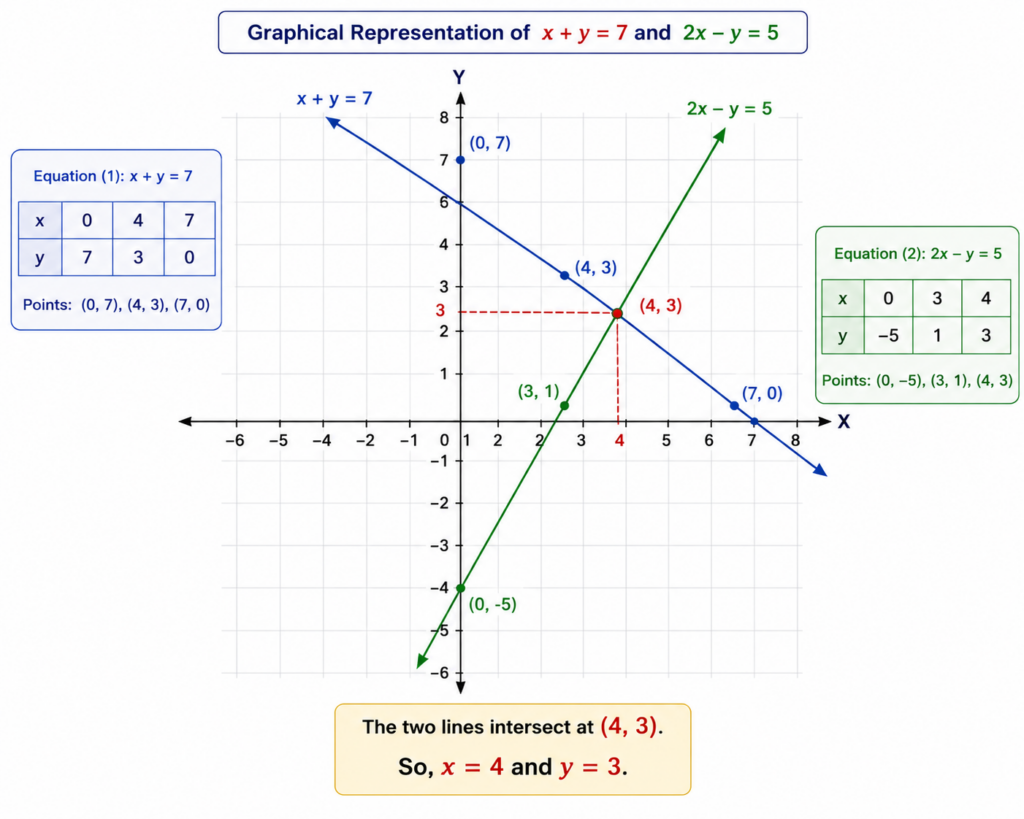
Solve the following pair of linear equations graphically:
x + y = 7
2x − y = 5
Solution
We will find some values of x and y for each equation and plot the corresponding points on the graph.
Equation (1): x + y = 7
| x | 0 | 4 | 7 |
|---|---|---|---|
| y | 7 | 3 | 0 |
Equation (2): 2x − y = 5
| x | 0 | 3 | 4 |
|---|---|---|---|
| y | −5 | 1 | 3 |
Chapter 3 Pair of Linear Equations Important Word Problem Questions
Word problems are an important part of this chapter. While preparing, practise questions involving:
- Ages
- Numbers
- Cost of articles
- Income and expenditure
- Distance and speed
- Geometry-related situations
- Fractions
- Shopping and daily-life situations
The most important skill is converting the information given in the question into two linear equations.
Example
The sum of two numbers is 27 and their difference is 5. Find the numbers.
Such questions require you to:
- Assume suitable variables.
- Form two equations.
- Solve the pair of equations.
- Interpret the final answer.
Class 10 Maths Chapter 3 Most Important Questions Videos
Watch the Future Study Point videos below for detailed explanations and step-by-step solutions.
Standard vs Basic: Pair of Linear Equations
In this video, we will look at the Pair of Linear Equations in Two Variables questions given in the CBSE 2025–26 Sample Papers for both Basic and Standard Mathematics.
I have selected and solved the questions from both sample papers so that you can clearly see the difference in question types, concepts, and difficulty level.
This comparison will help Class 10 students understand what kind of questions they may expect and how they should prepare for the CBSE Board Examination.
Class 10 Maths Chapter 3: Most Important 3-Mark Questions
Pair of Linear Equations in Two Variables
In this video, we solve 20 important 3-mark questions from Chapter 3 – Pair of Linear Equations in Two Variables. These questions are selected to help you revise the important concepts, methods, and question patterns that are relevant for the CBSE Class 10 Maths Board Examination.
The questions cover different approaches to solving a pair of linear equations, including substitution, elimination, and graphical methods, along with application-based questions.
Watch the complete video and practise each question carefully to strengthen your preparation for the 3-mark section of the exam.
Watch the complete video below:
Class 10 Maths Chapter 3 – Pair of Linear Equations in Two Variables | Complete Playlist
This playlist is a complete collection of Class 10 Maths Chapter 3 – Pair of Linear Equations in Two Variables videos, specially designed for CBSE Board exam preparation.
It includes NCERT Solutions, important questions, 2-mark, 3-mark and 5-mark questions, repeated PYQs, sample paper questions, and exam-oriented practice.
Students can use this playlist for complete chapter revision, concept building, and focused board-exam preparation. Watch the videos in sequence, practise along, and strengthen your preparation for Chapter 3.
How to Prepare Chapter 3 for CBSE 2026–27
Don’t simply memorise the methods. Try to understand why each method works.
Step 1 – Understand the concept
First understand what a pair of linear equations represents and how two equations can have different types of solutions.
Step 2 – Learn all solving methods
Practise:
- Graphical method
- Substitution method
- Elimination method
Step 3 – Practise consistency questions
Make sure you can quickly determine whether a pair has:
- One solution
- No solution
- Infinitely many solutions
Step 4 – Practise word problems
Word problems require more thinking than direct equations, so solve several different patterns.
Step 5 – Solve important questions repeatedly
After completing NCERT exercises, revise important questions and previous examination-style problems.
Questions You Should Definitely Practise
Before your examination, make sure you can solve questions based on:
- Solving a pair by substitution method
- Solving a pair by elimination method
- Solving a pair graphically
- Finding the value of a parameter for a unique solution
- Finding the value of a parameter for no solution
- Finding the value of a parameter for infinitely many solutions
- Identifying the nature of the graph
- Forming equations from word problems
- Age-based problems
- Number-based problems
- Cost and quantity problems
- Speed and distance problems
- Case-study questions
- Assertion-reasoning and competency-based questions
- Application-based questions
Quick Revision – Chapter 3
| Topic | What You Should Know |
|---|---|
| Pair of Linear Equations | Standard form and basic concepts |
| Graphical Method | Interpretation of intersecting, parallel and coincident lines |
| Substitution Method | Step-by-step solving |
| Elimination Method | Eliminate one variable |
| Consistency | Determine the nature of solutions |
| Word Problems | Convert statements into equations |
| Application Questions | Apply equations to real-life situations |
Recommended Class 10 Maths Preparation
For complete preparation, don’t study Chapter 3 in isolation. Revise the chapters systematically and practise NCERT questions, important questions, sample papers and previous-year-style questions.
You can also explore other Class 10 Maths chapter-wise videos and NCERT solutions available on Future Study Point.
Related Class 10 Maths Chapters
- Chapter 1 – Real Numbers
- Chapter 2 – Polynomials
- Chapter 3 – Pair of Linear Equations in Two Variables
- Chapter 4 – Quadratic Equations
- Chapter 5 – Arithmetic Progressions
- Chapter 6 – Triangles
- Chapter 7 – Coordinate Geometry
- Chapter 8 – Introduction to Trigonometry
- Chapter 9 – Some Applications of Trigonometry
- Chapter 10 – Circles
- Chapter 11 – Areas Related to Circles
- Chapter 12 – Surface Areas and Volumes
- Chapter 13 – Statistics
- Chapter 14 – Probability
Why Watch Future Study Point Videos?
Our goal is to make difficult mathematics concepts easier to understand through clear explanations, step-by-step solutions and exam-oriented practice.
The Class 10 Maths Most Important Questions Videos are especially useful for students who want to:
✅ Revise important concepts quickly
✅ Practise examination-oriented questions
✅ Understand difficult questions step by step
✅ Improve problem-solving skills
✅ Prepare for CBSE Board examinations
✅ Revise before tests and school examinations
Start Your Chapter 3 Preparation Today
Pair of Linear Equations in Two Variables becomes much easier when you understand the concept and practise different question patterns.
Watch the Class 10 Maths Chapter 3 Most Important Questions Videos from Future Study Point, practise the questions yourself, and revise the important concepts regularly.
Don’t just watch the solution—pause the video, solve the question yourself, and then compare your answer.
That is one of the best ways to improve your Class 10 Maths preparation.
Watch. Practise. Revise. Improve.
Subscribe to Future Study Point for more Class 10 Maths NCERT Solutions, Important Questions, MCQs, Sample Papers and CBSE Board Exam preparation videos.
FAQs – Class 10 Maths Chapter 3: Pair of Linear Equations in Two Variables
1. What is Pair of Linear Equations in Two Variables?
A pair of linear equations in two variables consists of two linear equations involving the same two variables, usually x and y. The equations can be solved to find the values of x and y that satisfy both equations.
2. What are the main methods used to solve a pair of linear equations?
The three important methods are Substitution Method, Elimination Method and Graphical Method. Students should understand all three methods and practise questions based on each method.
3. How do we know whether a pair of linear equations has a unique solution?
A pair of linear equations has a unique solution when the two lines intersect at exactly one point. Algebraically, the condition is:
a₁/a₂ ≠ b₁/b₂
4. When does a pair of linear equations have no solution?
A pair has no solution when the two lines are parallel and do not intersect. The condition is:
a₁/a₂ = b₁/b₂ ≠ c₁/c₂
5. When does a pair of linear equations have infinitely many solutions?
A pair has infinitely many solutions when the two equations represent the same or coincident line. The condition is:
a₁/a₂ = b₁/b₂ = c₁/c₂
6. What type of questions are important in Chapter 3?
Important questions include solving pairs of equations by different methods, checking the consistency of equations, finding unknown values or parameters, graphical questions and application-based word problems.
7. Are word problems important for the CBSE Class 10 Maths examination?
Yes. Word problems based on numbers, ages, prices, fractions, speed and distance, and other real-life situations are important applications of pair of linear equations.
8. Why should students practise video solutions?
Video solutions allow students to understand the step-by-step process, identify common mistakes and learn how to present the solution properly in the examination.
9. Is this video useful for both Basic and Standard Maths?
Yes. The video is designed to help students understand important question patterns and concepts useful for both Basic and Standard levels of Class 10 Maths.
10. Is this chapter important for CBSE 2026–27 preparation?
Yes. Students preparing for the CBSE 2026–27 examination should thoroughly understand the concepts and practise different types of questions from Pair of Linear Equations in Two Variables.
11. How should I prepare Chapter 3 for the board examination?
First understand the concepts and three solving methods. Then practise important questions, consistency-based questions, graphical questions and word problems. Finally, revise sample papers and previous examination-style questions.
12. Where can I find the solutions to the important questions?
The Future Study Point video solutions explain the selected important questions step by step, making it easier for students to understand the concepts and prepare for their examination.
Class 10 Maths Most Important Questions on Real Numbers
Class 10 Maths Most Important Questions Chapter 1 Real Numbers
Class 10 Maths NCERT Solutions CBSE 2026-27 Update
Continue your Class 10 Maths preparation with these useful resources from Future Study Point:
Class 10 Maths Chapter 1 – Real Numbers: Complete NCERT Exercise-Wise Video Solutions
Class 10 Maths Chapter 2 – Polynomials: Complete NCERT Solutions for Polynomials
Class 10 Maths Chapter 3 – Pair of Linear Equations in Two Variables: Complete NCERT Solutions
Class 10 Maths Chapter 4 Quadratic Equations: – Quadratic Equations complete NCERT video solutions
Class 10 Maths Chapter 5 Arithmetic Progression: Arithmetic Progression: complete video solution
Class 10 Maths Basic Sample Paper Solution: Practise with the Complete CBSE Basic Sample Paper Solution
👉 Explore these resources to strengthen your concepts, revise important topics, and prepare effectively for the CBSE Class 10 Maths Board Examination 2026–27.