Table of contents
- Class 10 Maths Chapter 8 – Introduction to Trigonometry
- Topics Covered in Chapter 8
- Important Trigonometric Identities
- Standard Angles
- Why Practise NCERT Solutions?
- Chapter 8 NCERT Solutions – Step-by-Step Approach
- Class 10 Maths Chapter 8 Video Solutions
- Preparation Tips for Chapter 8
- Frequently Asked Questions
- Conclusion
- Class 10 Maths NCERT Solutions CBSE 2026-27 Update
Welcome to Future Study Point, your trusted resource for easy-to-understand and exam-oriented Class 10 NCERT Solutions based on the latest CBSE syllabus. In this post, you will find Class 10 Maths Chapter 8 Introduction to Trigonometry NCERT Solutions, explained step by step to help students understand concepts, solve questions confidently, and prepare effectively for the CBSE Class 10 Board Exam.
Trigonometry is an important chapter for the CBSE Class 10 Maths Board Exam. It introduces students to trigonometric ratios, standard angles, trigonometric identities and their applications in solving mathematical problems. Class 10 Maths NCERT Solutions are important for students because they provide clear, step-by-step methods for solving NCERT questions and help students understand the concepts, learn the correct problem-solving approach, improve accuracy and prepare effectively for the CBSE Class 10 Maths examination. Regular practice of Class 10 Maths NCERT Solutions also builds a strong foundation for more advanced mathematical concepts.
Class 10 Maths Chapter 8 – Introduction to Trigonometry
Chapter: 8 – Introduction to Trigonometry
Class: 10
Subject: Mathematics
Book: NCERT Mathematics
Board: CBSE
Academic Session: 2026–27
Our solutions are presented step by step so that students can understand the method used to solve each question rather than simply memorising the answer.
Topics Covered in Chapter 8
The chapter Introduction to Trigonometry covers the following important concepts:
- Trigonometric ratios of an acute angle
- Sine, cosine and tangent
- Cosecant, secant and cotangent
- Trigonometric ratios of standard angles
- Values of trigonometric ratios at 0°, 30°, 45°, 60° and 90°
- Relationships between trigonometric ratios
- Trigonometric identities
- Applications of trigonometric ratios
- Simplification of trigonometric expressions
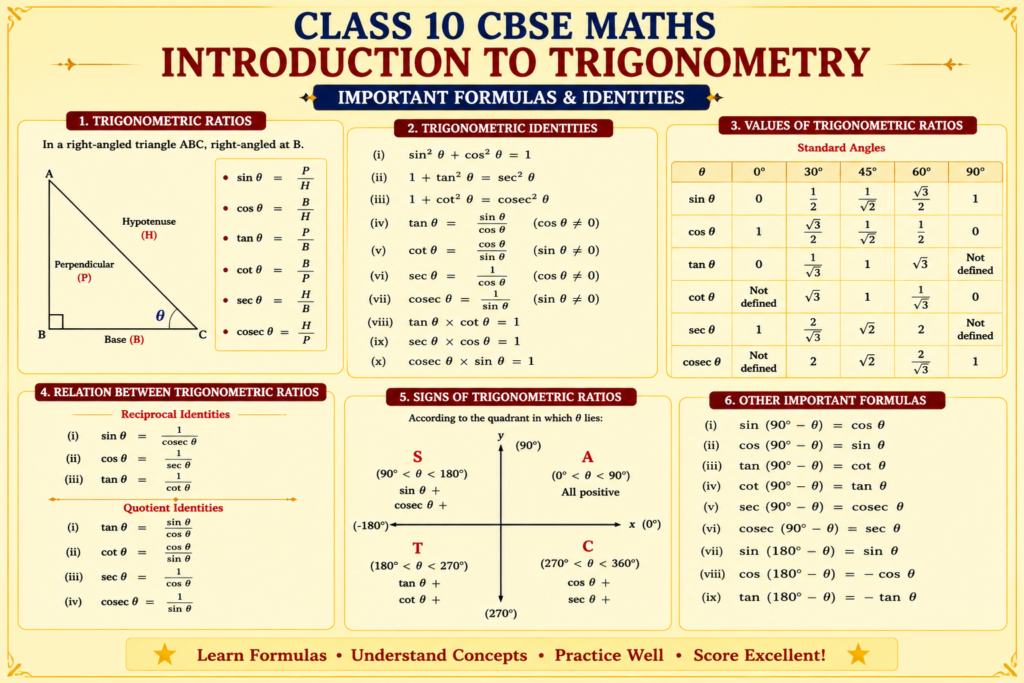
Important Trigonometric Ratios
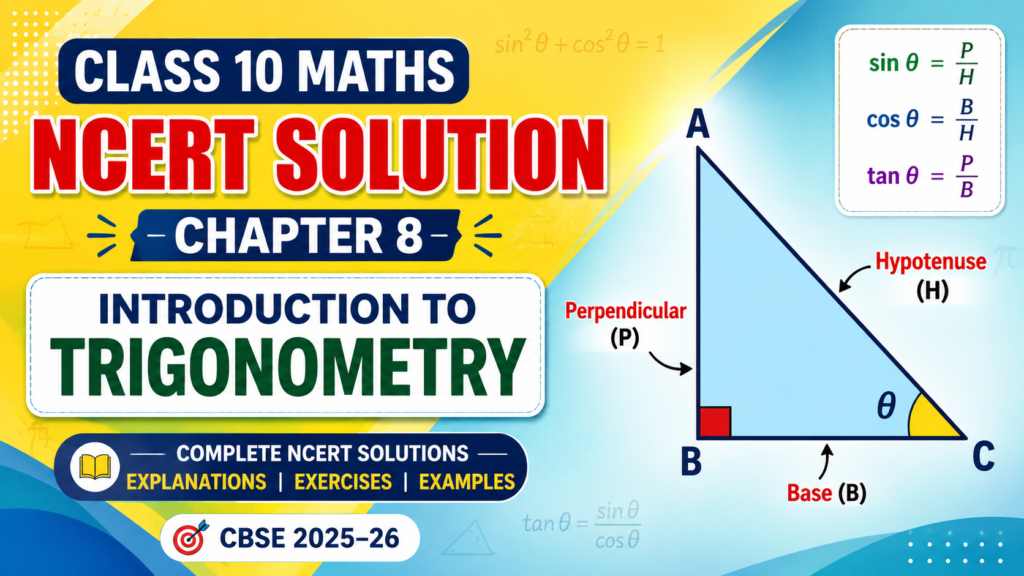
For an acute angle θ in a right-angled triangle:
Similarly,
sin θ = Perpendicular / Hypotenuse
cos θ = Base / Hypotenuse
tan θ = Perpendicular / Base
The reciprocal ratios are:
cosec θ = 1/sin θ
sec θ = 1/cos θ
cot θ = 1/tan θ
Students should learn these ratios carefully because they are used throughout the chapter and in several questions in later chapters.
Important Trigonometric Identities
The following identities are especially important for Class 10 CBSE examinations:
sin² θ + cos² θ = 1
Other important identities include:
1 + tan² θ = sec² θ
1 + cot² θ = cosec² θ
These identities are frequently used to simplify expressions and prove trigonometric identities.
Standard Angles
Students should remember the trigonometric values for:
| Angle | 0° | 30° | 45° | 60° | 90° |
|---|---|---|---|---|---|
| sin θ | 0 | 1/2 | 1/√2 | √3/2 | 1 |
| cos θ | 1 | √3/2 | 1/√2 | 1/2 | 0 |
| tan θ | 0 | 1/√3 | 1 | √3 | Not defined |
These standard values are extremely useful for solving numerical questions quickly.
Why Practise NCERT Solutions?
The NCERT textbook is an important resource for CBSE Class 10 Mathematics. Practising the questions from the chapter helps students:
- Understand the basic concepts of trigonometry.
- Learn how to apply trigonometric ratios.
- Memorise standard-angle values through practice.
- Improve calculation and simplification skills.
- Understand how to prove trigonometric identities.
- Prepare effectively for CBSE board examinations.
Chapter 8 NCERT Solutions – Step-by-Step Approach
While solving questions from this chapter, students should first identify the given information and determine which trigonometric ratio or identity is required.
For right-angled triangle problems, carefully identify the perpendicular, base and hypotenuse before selecting sin, cos or tan.
For identity-based questions, try to convert all terms into sin and cos or use one of the standard identities. Avoid taking unnecessary steps and always show sufficient working in the examination.
Class 10 Maths Chapter 8 Video Solutions
At Future Study Point, we are also providing video solutions of the NCERT questions from Introduction to Trigonometry. These videos explain the questions step by step in a simple manner and are useful for students preparing for their CBSE examinations.
Students can watch the relevant video solution, pause whenever necessary, and then try solving the question independently.
Preparation Tips for Chapter 8
To score well in Introduction to Trigonometry:
- Learn all six trigonometric ratios.
- Practise the standard-angle values regularly.
- Understand the difference between the six ratios.
- Memorise the three fundamental identities.
- Practise NCERT examples and exercise questions.
- Show all important steps in numerical problems.
- Practise identity-based questions without looking at the solution.
- Revise the chapter before attempting sample papers and previous-year questions.
Frequently Asked Questions
What is Chapter 8 of Class 10 Maths?
Chapter 8 of Class 10 Maths is Introduction to Trigonometry.
What are the six trigonometric ratios?
The six trigonometric ratios are sin, cos, tan, cosec, sec and cot.
Which trigonometric identities are important for Class 10?
The three fundamental identities are:
sin² θ + cos² θ = 1
1 + tan² θ = sec² θ
1 + cot² θ = cosec² θ
Are NCERT questions important for CBSE Class 10 Maths?
Yes. Students should thoroughly practise the NCERT textbook examples and exercise questions as part of their CBSE Class 10 Maths preparation.
Conclusion
Class 10 Maths Chapter 8 – Introduction to Trigonometry is an important chapter that builds the foundation for higher-level trigonometry. A clear understanding of trigonometric ratios, standard values and identities can help students solve many questions confidently.
Use these NCERT Solutions for Class 10 Maths Chapter 8 along with regular practice, revision and sample papers to strengthen your preparation for the CBSE Class 10 Mathematics examination.
For more Class 10 Maths NCERT Solutions, CBSE sample papers, important questions and chapter-wise video solutions, keep visiting Future Study Point.
Class 10 Maths NCERT Solutions CBSE 2026-27 Update
Continue your Class 10 Maths preparation with these useful resources from Future Study Point:
Class 10 Maths Chapter 1 – Real Numbers: Complete NCERT Exercise-Wise Video Solutions
Class 10 Maths Chapter 2 – Polynomials: Complete NCERT Solutions for Polynomials
Class 10 Maths Chapter 3 – Pair of Linear Equations in Two Variables: Complete NCERT Solutions
Class 10 Maths Chapter 4 Quadratic Equations: – Quadratic Equations complete NCERT video solutions
Class 10 Maths Chapter 5 Arithmetic Progression: Arithmetic Progression: complete video solution
Class 10 Maths Basic Sample Paper Solution: Practise with the Complete CBSE Basic Sample Paper Solution
👉 Explore these resources to strengthen your concepts, revise important topics, and prepare effectively for the CBSE Class 10 Maths Board Examination 2026–27.

I am Narender Kumar, an educator and the creator of Future Study Point. I hold an M.Sc. in Physics from HNB University. I create easy-to-understand Mathematics and Science lessons, NCERT solutions, important questions, MCQs, sample papers and video explanations for CBSE and NCERT students from Classes 6 to 12. My aim is to help students build strong concepts, practise effectively and prepare confidently for their examinations.