Class 10 Maths Most Important Questions Chapter 5 Arithmetic Progressions are designed to help students prepare for an important chapter that is regularly tested through questions based on the nth term, common difference, sum of terms, consecutive terms, and real-life applications. Practising Class 10 Maths Chapter 5 Important Questions helps students strengthen their understanding of Arithmetic Progressions, improve problem-solving skills, and become familiar with the different types of questions that can be asked in the CBSE Board Examination. Regular practice of Class 10 Maths Most Important Questions also helps students identify important concepts, revise formulas effectively, improve calculation accuracy, and develop confidence in solving both direct and application-based questions within the examination time.
For students preparing for the CBSE Class 10 Maths Board Exam, practising different question patterns is particularly useful. Instead of learning only the formulas, students should understand when and how each formula is applied.
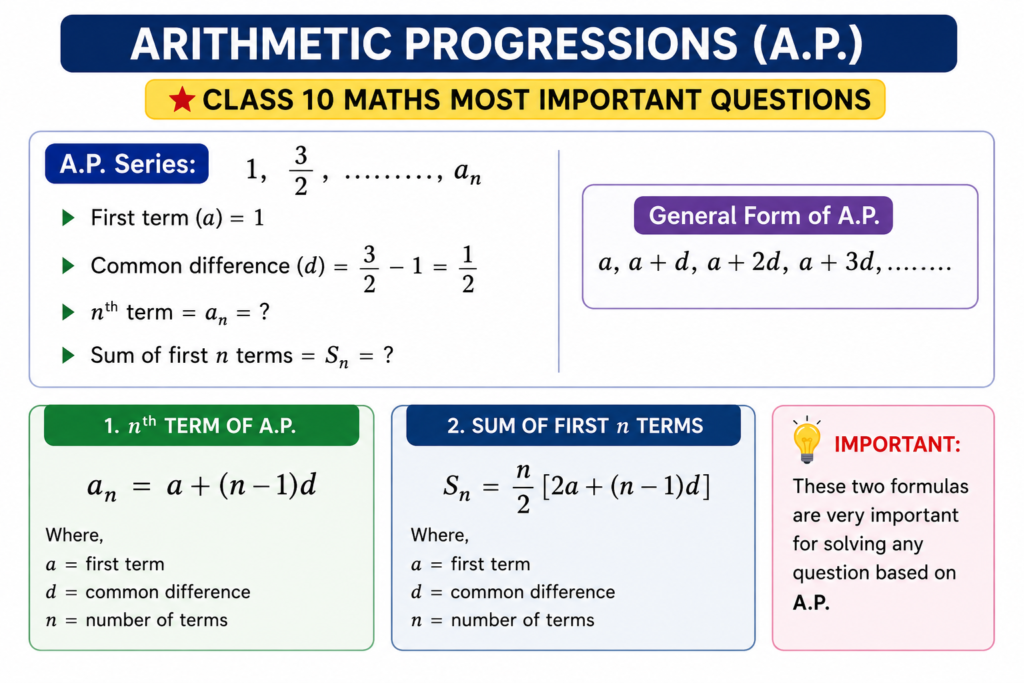
This post provides 50 important Arithmetic Progressions PYQ-based questions for practice. The questions cover different levels, from basic formula-based questions to application and higher-order problems.
Important Formulas of Arithmetic Progressions
Before attempting the questions, revise the following important formulas of Arithmetic Progressions:
- nth term: an = a + (n – 1)d
- Sum of the first n terms: Sn = n/2 [2a + (n – 1)d]
- Sum when the last term is known: Sn = n/2 (a + l)
- Condition for three numbers a, b and c to be in AP: 2b = a + c
Here, a is the first term, d is the common difference, n is the number of terms, and l is the last term.
Watch the Complete Video Solution
Reading questions is useful, but watching the complete step-by-step solution can help you understand how to approach different types of Arithmetic Progressions problems.
I have also explained the important questions in my YouTube video. Before watching the solution, try solving each question yourself. If you get stuck, watch the explanation and then solve the question again without looking at the solution.
Class 10 Maths Chapter 5 – Arithmetic Progressions Most Important Questions
Tip: Pause the video before each question and give yourself a few minutes to solve it. This will make your practice much more effective.
50 Most Important Arithmetic Progressions PYQ-Based Questions
50 Important Arithmetic Progressions PYQ-Based Questions
Question 1
Find the 20th term of the arithmetic progression 3, 7, 11, 15, … .
Question 2
Find the common difference of the AP 15, 12, 9, 6, … .
Question 3
Find the 15th term of the AP 8, 13, 18, 23, … .
Question 4
Which term of the AP 21, 18, 15, 12, … is equal to -81?
Question 5
Find the 25th term of the AP 5, 8, 11, 14, … .
Question 6
Determine the common difference and the 10th term of the AP 2, 7, 12, 17, … .
Question 7
Find the 18th term of the AP -5, -2, 1, 4, … .
Question 8
Which term of the AP 3, 8, 13, 18, … is 78?
Question 9
Find the number of terms in the AP 7, 13, 19, …, 127.
Question 10
Find the 12th term from the end of the AP 4, 9, 14, …, 109.
Question 11
If the nth term of an AP is 4n – 7, find its first term and common difference.
Question 12
If the 7th term of an AP is 20 and the 13th term is 38, find the first term and common difference.
Question 13
If the 5th term of an AP is 17 and the 11th term is 35, find the 20th term.
Question 14
If the 10th term of an AP is 30 and its common difference is 3, find the first term.
Question 15
If the 18th term of an AP is 53 and the first term is 2, find the common difference.
Question 16
Find the sum of the first 20 terms of the AP 3, 7, 11, 15, … .
Question 17
Find the sum of the first 25 terms of the AP 2, 5, 8, 11, … .
Question 18
Find the sum of the first 30 terms of the AP 10, 15, 20, 25, … .
Question 19
Find the sum of all multiples of 7 lying between 10 and 100.
Question 20
Find the sum of all two-digit natural numbers which are divisible by 3.
Question 21
Find the sum of all multiples of 5 between 50 and 200.
Question 22
Find the number of terms and the sum of the AP 6, 10, 14, …, 102.
Question 23
Find the number of terms and the sum of the AP 18, 15, 12, …, -48.
Question 24
Find the sum of the first 15 terms of the AP 20, 17, 14, 11, … .
Question 25
Find the sum of the first 40 positive odd integers.
Question 26
Find three consecutive terms of an AP whose sum is 27 and whose product is 693.
Question 27
Find three numbers in AP whose sum is 24 and whose product is 440.
Question 28
Find three consecutive terms of an AP whose sum is 30 and whose product is 910.
Question 29
If 2x + 3, 4x + 1 and 6x – 1 are consecutive terms of an AP, find x.
Question 30
If x + 2, 3x + 2 and 5x – 4 are consecutive terms of an AP, find x.
Question 31
If 2x, x + 6 and 3x + 2 are consecutive terms of an AP, find x.
Question 32
If a, b and c are three consecutive terms of an AP, prove that 2b = a + c.
Question 33
If a, b and c are three consecutive terms of an AP, show that a + c = 2b.
Question 34
If the first term of an AP is 5 and the common difference is 4, find the sum of its first 35 terms.
Question 35
If the first term of an AP is 12 and the last term is 72 with common difference 3, find the number of terms and their sum.
Question 36
The first term of an AP is 7, the last term is 77 and the sum of all its terms is 840. Find the number of terms and the common difference.
Question 37
The sum of the first 10 terms of an AP is 155 and the sum of its first 20 terms is 510. Find the first term and common difference.
Question 38
If the sum of the first n terms of an AP is Sn = 3n2 + 2n, find its nth term.
Question 39
If the sum of the first n terms of an AP is Sn = 5n2 – 3n, find the nth term and the common difference.
Question 40
If the sum of the first 15 terms of an AP is 300 and the sum of its first 25 terms is 750, find the sum of its first 40 terms.
Question 41
A man saves ₹500 in the first month and increases his monthly saving by ₹100 every month. Find his total saving in one year.
Question 42
A person repays a loan in monthly instalments. The first instalment is ₹500 and each successive instalment increases by ₹50. Find the amount paid in the first 12 instalments.
Question 43
The number of trees planted in successive rows of a park forms an AP. If the first row contains 8 trees and each successive row contains 3 more trees than the previous row, find the number of trees in the 20th row.
Question 44
A theatre has 20 seats in the first row and each succeeding row has 2 more seats than the preceding row. Find the total number of seats in the first 25 rows.
Question 45
A staircase has 15 steps. The lengths of the horizontal portions of the steps form an AP beginning with 20 cm and increasing by 2 cm at every step. Find the total length of the horizontal portions.
Question 46
The first term of an AP is 6 and its common difference is 5. If its nth term is 101, find n and the sum of the first n terms.
Question 47
The 7th term of an AP is 34 and the 13th term is 64. Find the sum of the first 20 terms.
Question 48
If the 4th and 12th terms of an AP are 10 and 34 respectively, find the first term, common difference and 20th term.
Question 49
In an AP, the 5th term is twice the 2nd term and the 11th term is 30. Find the first term and common difference.
Question 50
The sum of the first 16 terms of an AP is 240 and its 16th term is 30. Find the first term and common difference.
How to Use These 50 Questions
Do not try to memorise the answers. A better strategy is to divide the questions into groups and practise them systematically.
First, revise the basic formulas.
Second, solve Q1–Q15 to strengthen your understanding of the nth term and common difference.
Third, practise Q16–Q25 for questions involving the sum of terms.
Fourth, attempt Q26–Q40, which require greater application of the AP formulas.
Finally, solve Q41–Q50 without looking at any formula. These questions are particularly useful for developing confidence in application-based and examination-style problems.
Why These Questions Are Important
The most important thing in Arithmetic Progressions is not simply remembering the formulas. Students must be able to identify which information is given and which formula should be used.
For example, if the question gives the first term, common difference and number of terms, the sum formula can be applied directly. If two terms are given, students may first need to form two equations to determine the first term and common difference.
This is why practising different question patterns is important for Class 10 Maths Board Exam preparation.
Final Revision Tips for Arithmetic Progressions
Before the examination, make sure you can:
- Find the first term and common difference.
- Find the nth term.
- Find the number of terms.
- Find the last term.
- Calculate the sum of n terms.
- Solve problems involving consecutive terms.
- Solve questions involving multiples and natural numbers.
- Form equations from given AP conditions.
- Solve real-life AP problems.
- Present complete steps clearly in the answer sheet.
Most importantly, do not look at the solution immediately. Give yourself enough time to attempt the question first.
Watch the Video for Step-by-Step Solutions
If you are finding any of these questions difficult, watch my Class 10 Maths Chapter 5 Arithmetic Progressions Most Important Questions video. The video explains the questions step by step so that you can understand the method rather than simply memorising the final answer.
Try the question → Watch the solution → Solve it again yourself.
This approach can make your preparation for Class 10 Maths Chapter 5 Arithmetic Progressions much more effective.
Frequently Asked Questions
Is Arithmetic Progressions important for Class 10 Maths?
Yes. Arithmetic Progressions is an important Class 10 Maths chapter and students should practise both direct formula-based questions and application-based problems.
Which formulas should I learn for Arithmetic Progressions?
The two most important formulas are the nth-term formula and the sum-of-n-terms formula:
and
.
Should I practise Previous Year Questions?
Yes. PYQs are useful for understanding the kinds of concepts and question formats that have appeared in CBSE examinations. However, students should also practise NCERT exercises and fresh application-based questions.
How can I improve my marks in Arithmetic Progressions?
Revise the formulas, practise different question types, avoid sign errors, write the given information clearly, and show all important calculation steps in the examination.
You can study our following posts also
Class 10 Maths (Basic) Preboard Full Paper Solution | CBSE Board 2025–26
Class 10 Standard Maths Question Paper Solution CBSE Board 2024–25
Class 10 CBSE Standard Maths Previous Year Question Paper 2023–24 Video Solutions
Class 8 Maths NCERT Solutions – Ganita Prakash Part 1 Chapter 1: A Square and a Cube
Class 8 Maths Ganit Prakash Chapter 2 Power Play – Unique ID Code for Milk Packets
Class 10 Science Chapter 9: Light Reflection & Refraction – Total Internal Reflection
How Do Rockets Burn in Space Without Oxygen?
Class 9 Maths Chapter 2 Full Video Solutions | Introduction to Linear Polynomials
Class 10 Maths Standard Question Paper CBSE Board Exam 2025–26 – Full Video Solution
Class 9 Maths Chapter 1 Exercise Question 11 Solution | Orienting Yourself: Uses of Coordinates
Class 10 Science Sample Paper 2025–26 Full Solution CBSE Official