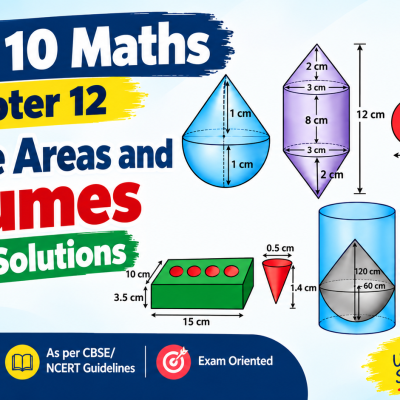
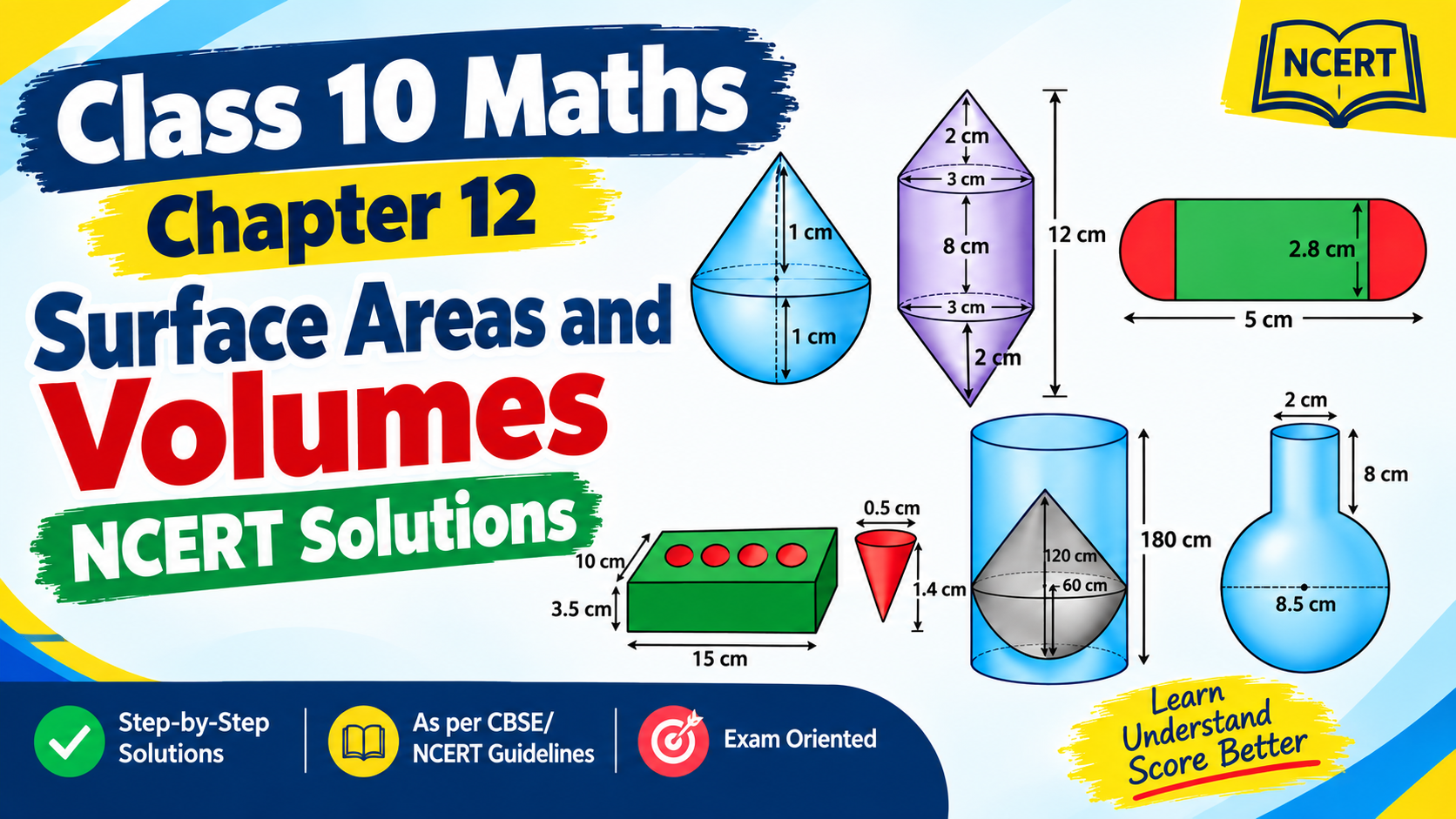
Class 10 Maths Chapter 12 Surface Areas & Volumes NCERT Solutions are extremely important for understanding the concepts of Surface Areas and Volumes. This chapter involves different types of solids such as combinations of solids, cylinders, cones, spheres and hemispheres. By practising the NCERT questions step by step, students can understand how to identify the required formula, substitute the given values correctly and solve questions systematically.
For CBSE Board Exam preparation, Class 10 Maths NCERT Solutions play a very important role. Students should thoroughly practise the NCERT textbook questions because they help in developing a strong understanding of mathematical concepts and the correct method of solving problems. Regular practice of these solutions can also help students improve their accuracy, calculation skills and confidence before the board examination.
Students preparing for the CBSE Class 10 Maths Board Exam should revise Chapter 12 Surface Areas and Volumes multiple times and maintain a proper revision cycle. Along with understanding the formulas, focus on the logic behind each question and practise writing complete step-by-step solutions. These Class 10 Maths Chapter 12 NCERT Solutions can be useful for school exams, pre-board exams, half-yearly exams and final CBSE Board Exam preparation.
Class 10 Maths Chapter 12 NCERT Solutions as per CBSE 2026–27 Exercise –12.1
These Class 10 Maths Chapter 12 NCERT Solutions are prepared according to the CBSE 2026–27 syllabus and curriculum. The chapter Surface Areas and Volumes includes Exercise 12.1 and Exercise 12.2, and all the questions from these exercises have been solved here step by step by a CBSE-experienced Maths teacher to help students understand the concepts clearly and prepare effectively for their examinations.
Exercise 12.1 focuses on calculating the surface areas of composite solids formed by combining two or more basic three-dimensional figures. In this exercise, you will solve problems involving common 3D shapes such as cubes, cuboids, cylinders, cones, and spheres or hemispheres joined together. The key is to identify the exposed surface areas of each component shape—such as adding the curved surface areas of adjacent parts while subtracting any overlapping bases—to determine the total outer surface area of the combined figure.
Video Solutions of Exercise 12.1
Class 10 Maths Chapter 12 NCERT Solutions as per CBSE 2026–27 Exercise –12.2
Exercise 12.2 shifts the focus to calculating the total volume of combined three-dimensional geometrical figures. Similar to the previous section, the questions involve 3D shapes like cylinders, cones, spheres, hemispheres, and cuboids combined or hollowed out from one another. Unlike surface area, volume calculations are strictly additive or subtractive, requiring you to sum the volumes of individual solid components or subtract the volume of any removed cavities to find the total capacity or space occupied by the composite structure.
Would you like to review any specific formulas or step-by-step solutions for questions in these exercises?
video Solutions of Exercise 12.2
Class 10 Maths NCERT Solutions for Chapter 12 – Surface Areas & Volumes
Exercise 12.1
Q1.2 cubes each of volume 64 cm³ are joined end to end. Find the surface area of the resulting cuboid.
Solution

Volume of each cube = Side³ = 64, so Side = ∛64 = 4 cm.
Dimensions of resulting cuboid
Length l = 4 + 4 = 8 cm, Breadth b = 4 cm, Height h = 4 cm
Surface area
Surface area = 2(lb + bh + hl) = 2(8×4 + 4×4 + 4×8) = 2(32 + 16 + 32) = 2 × 80 = 160
Hence the required surface area of the resulting cuboid = 160 cm²
Q2.A vessel is in the form of a hollow hemisphere mounted by a hollow cylinder. The diameter of the hemisphere is 14 cm and the total height of the vessel is 13 cm. Find the inner surface area of the vessel.
Solution

Height of vessel = 13 cm. Diameter of hemisphere = 14 cm, so radius r = 7 cm.
Height of cylinder = 13 − 7 = 6 cm
Inner surface area = CSA of hemisphere + CSA of cylinder
CSA of hemisphere = 2πr² = 2 × 22/7 × 7² = 308 cm²
CSA of cylinder = 2πrh = 2 × 22/7 × 7 × 6 = 264 cm²
Inner surface area of vessel = 308 + 264 = 572 cm²
Q3.A toy is in the form of a cone of radius 3.5 cm mounted on a hemisphere of the same radius. The total height of the toy is 15.5 cm. Find the total surface area of the toy.
Solution

Height of cone = 15.5 − 3.5 = 12 cm. Radius of hemisphere = cone = 3.5 cm.
Total surface area = CSA of hemisphere + CSA of cone
CSA of hemisphere = 2πr² = 2 × 22/7 × 3.5 × 3.5 = 77 cm²
Slant height l = √(r² + h²) = √(3.5² + 12²) = √156.25 = 12.5 cm
CSA of cone = πrl = 22/7 × 3.5 × 12.5 = 137.5 cm²
Total surface area = 77 + 137.5 = 214.5 cm²
Q4.A cubical block of side 7 cm is surmounted by a hemisphere. What is the greatest diameter the hemisphere can have? Find the surface area of the solid.
Solution

The greatest diameter of the hemisphere equals the side of the cube = 7 cm, so radius r = 3.5 cm.
Surface area = TSA of cube + CSA of hemisphere − area of hemisphere base
TSA of cube = 6 × side² = 6 × 7 × 7 = 294 cm²
CSA of hemisphere = 2πr² = 2 × 22/7 × 3.5 × 3.5 = 77 cm²
Area of base = πr² = 22/7 × 3.5 × 3.5 = 38.5 cm²
Surface area of solid = 294 + 77 − 38.5 = 332.5 cm²
Q5.A hemispherical depression is cut out from one face of a cubical wooden block such that the diameter d of the hemisphere is equal to the edge of the cube. Determine the surface area of the remaining solid.
Solution

Let side of cube = a units, so diameter of hemisphere d = a, radius r = a/2.
Remaining surface area = TSA of cube + CSA of hemisphere − area of hemisphere base
TSA of cube = 6a²
CSA of hemisphere = 2πr² = 2π(a/2)² = πa²/2
Area of circular base = πr² = π(a/2)² = πa²/4
Remaining surface area = 6a² + πa²/2 − πa²/4 = 6a² + πa²/4
= (a²/4)(24 + π) sq units
Q6.A medicine capsule is in the shape of a cylinder with two hemispheres stuck to each of its ends. The length of the entire capsule is 14 mm and the diameter of the capsule is 5 mm. Find its surface area.
Solution

Length of capsule = 14 mm, radius r = 5/2 = 2.5 mm.
Length of cylindrical portion = 14 − 2 × 2.5 = 9 mm
Surface area = CSA of cylinder + CSA of two hemispheres
CSA of cylinder = 2πrh = 2 × 22/7 × 2.5 × 9 = 990/7 mm²
CSA of two hemispheres = 4πr² = 4 × 22/7 × 2.5² = 550/7 mm²
Surface area of capsule = 990/7 + 550/7 = 1540/7 = 220 mm²
Q7.A tent is in the shape of a cylinder surmounted by a conical top. If the height and diameter of the cylindrical part are 2.1 m and 4 m respectively, and the slant height of the top is 2.8 m, find the area of the canvas used for making the tent. Also, find the cost of the canvas of the tent at the rate of Rs 500 per m². (The base of the tent is not covered with canvas.)
Solution

Radius r = 4/2 = 2 m. Height of cylindrical part h = 2.1 m. Slant height of cone l = 2.8 m.
Area of canvas = CSA of cylinder + CSA of cone
CSA of cylinder = 2πrh = 2 × 22/7 × 2 × 2.1 = 26.4 m²
CSA of cone = πrl = 22/7 × 2 × 2.8 = 17.6 m²
Area of canvas = 26.4 + 17.6 = 44 m²
Cost of canvas = 500 × 44 = Rs 22,000
Q8.From a solid cylinder whose height is 2.4 cm and diameter 1.4 cm, a conical cavity of the same height and same diameter is hollowed out. Find the total surface area of the remaining solid to the nearest cm².
Solution

Height of cylinder h = 2.4 cm. Diameter = 1.4 cm, so radius r = 0.7 cm. Height of conical cavity = 2.4 cm.
Remaining surface area = CSA of cylinder + area of circular base + CSA of conical cavity
= 2πrh + πr² + πrl = πr(2h + r + l)
Slant height l = √(h² + r²) = √(2.4² + 0.7²) = √6.25 = 2.5 cm
= 22/7 × 0.7 (2×2.4 + 0.7 + 2.5) = 2.2 × 7.6 = 17.6 cm²
Remaining surface area ≈ 18 cm²
Q9.A wooden article was made by scooping out a hemisphere from each end of a solid cylinder. If the height of the cylinder is 10 cm, and its base is of radius 3.5 cm, find the total surface area of the article.
Solution

Radius of cylinder and hemispheres r = 3.5 cm. Height of cylinder h = 10 cm.
Total surface area = CSA of cylinder + CSA of two scooped-out hemispheres
CSA of cylinder = 2πrh = 2 × 22/7 × 3.5 × 10 = 220 cm²
CSA of two hemispheres = 4πr² = 4 × 22/7 × 3.5 × 3.5 = 154 cm²
Total surface area = 220 + 154 = 374 cm²
Exercise 12.2
Q1.A solid is in the shape of a cone standing on a hemisphere with both their radii being equal to 1 cm and the height of the cone is equal to its radius. Find the volume of the solid in terms of π.
Solution

Radius of cone and hemisphere r = 1 cm. Height of cone h = 1 cm.
Volume of solid = Volume of hemisphere + Volume of cone
Volume of hemisphere = (2/3)πr³ = (2/3)π × 1³ = 2π/3
Volume of cone = (1/3)πr²h = (1/3)π × 1² × 1 = π/3
Volume of solid = 2π/3 + π/3 = 3π/3 = π cm³
Q2.Rachel, an engineering student, was asked to make a model shaped like a cylinder with two cones attached at its two ends by using a thin aluminum sheet. The diameter of the model is 3 cm and its length is 12 cm. If each cone has a height of 2 cm, find the volume of air contained in the model (assume outer and inner dimensions are nearly the same).
Solution

Diameter of model = 3 cm, so radius r = 3/2 cm. Height of each cone = 2 cm.
Height of cylinder = 12 − (2 + 2) = 8 cm
Volume of air = Volume of cylinder + volume of both cones
Volume of both cones = (2/3)πr²h = (2/3)π × (3/2)² × 2 = 3π cm³
Volume of cylinder = πr²h = π × (3/2)² × 8 = 18π cm³
Total volume = 3π + 18π = 21π = 21 × 22/7 = 66 cm³
Q3.A gulab jamun contains sugar syrup up to about 30% of its volume. Find approximately how much syrup would be found in 45 gulab jamuns, each shaped like a cylinder with two hemispherical ends, with length 5 cm and diameter 2.8 cm.
Solution

Radius of hemisphere r = 2.8/2 = 1.4 cm.
Length of cylindrical part h = 5 − 2×1.4 = 2.2 cm, radius = 1.4 cm
Volume of one gulab jamun = 2 × volume of hemisphere + volume of cylinder
= πr² × [(4/3)r + h] = 22/7 × 1.4 × 1.4 × [(4/3)×1.4 + 2.2]
= 6.16 × 4.07 ≈ 25.07 cm³
Volume of 45 gulab jamuns = 45 × 25.07 = 1128.15 cm³
Volume of syrup (30%) = 30% of 1128.15 ≈ 338 cm³
Q4.A pen stand made of wood is in the shape of a cuboid with four conical depressions to hold pens. The dimensions of the cuboid are 15 cm by 10 cm by 3.5 cm. The radius of each depression is 0.5 cm and the depth is 1.4 cm. Find the volume of wood in the entire stand.
Solution

Length = 15 cm, Breadth = 10 cm, Height = 3.5 cm. Radius of depression r = 0.5 cm, depth h = 1.4 cm.
Volume of wood = Volume of cuboid − 4 × volume of one conical depression
Volume of cuboid = 15 × 10 × 3.5 = 525 cm³
Volume of one depression = (1/3)πr²h = (1/3) × 22/7 × 0.5² × 1.4 ≈ 0.367 cm³
Volume of 4 depressions = 4 × 0.367 ≈ 1.47 cm³
Volume of wood = 525 − 1.47 = 523.5 cm³
Q5.A vessel is in the form of an inverted cone. Its height is 8 cm and the radius of its top, which is open, is 5 cm. It is filled with water up to the brim. When lead shots, each a sphere of radius 0.5 cm, are dropped into the vessel, one-fourth of the water flows out. Find the number of lead shots dropped in the vessel.
Solution
Radius of cone r = 5 cm, height h = 8 cm. Radius of one lead shot = 0.5 cm.
Volume of water in the cone
= (1/3)πr²h = (1/3)π × 5² × 8 = 200π/3 cm³
Volume of water that flows out (one-fourth) = (1/4) × 200π/3 = 50π/3 cm³
Volume of one spherical shot = (4/3)π(0.5)³ = π/6 cm³
Number of lead shots = volume of water flowed ÷ volume of one shot
= (50π/3) ÷ (π/6) = (50/3) × 6 = 100 lead shots
Q6.A solid iron pole consists of a cylinder of height 220 cm and base diameter 24 cm, which is surmounted by another cylinder of height 60 cm and radius 8 cm. Find the mass of the pole, given that 1 cm³ of iron has approximately 8 g mass.
Solution
Big cylinder: height H = 220 cm, radius R = 24/2 = 12 cm.
Small cylinder: height h = 60 cm, radius r = 8 cm.
Volume of iron = volume of big cylinder + volume of small cylinder
Volume of big cylinder = πR²H = π(12)²(220) ≈ 99565.8 cm³
Volume of small cylinder = πr²h = π(8)²(60) ≈ 12068.5 cm³
Total volume = 99565.8 + 12068.5 = 111634.5 cm³
Mass = Density × Volume = 8 × 111634.5 g ≈ 893 kg
Q7.A solid consisting of a right circular cone of height 120 cm and radius 60 cm standing on a hemisphere of radius 60 cm is placed upright in a right circular cylinder full of water such that it touches the bottom. Find the volume of water left in the cylinder, if the radius of the cylinder is 60 cm and its height is 180 cm.
Solution

Radius of cone = radius of hemisphere = radius of cylinder = 60 cm. Height of cone h = 120 cm. Height of cylinder H = 180 cm.
Total volume of solid = Volume of cone + Volume of hemisphere
= (1/3)πr²h + (2/3)πr³ = (22/21) × 3600 × (120 + 120) = (22/21) × 3600 × 240 cm³
Volume of cylinder = πr²H = 22/7 × 3600 × 180 cm³
Volume of water left = Volume of cylinder − Volume of solid
= 22/7 × 3600 × (180 − 80) = 22/7 × 360000 = 1131428.57 cm³
= 1.131 m³
Q8.A spherical glass vessel has a cylindrical neck 8 cm long, 2 cm in diameter; the diameter of the spherical part is 8.5 cm. By measuring the amount of water it holds, a child finds its volume to be 345 cm³. Check whether she is correct, taking the above as the inside measurements, and π = 3.14.
Solution

Radius of cylindrical part r = 2/2 = 1 cm, height h = 8 cm. Radius of spherical part R = 8.5/2 = 4.25 cm.
Volume of vessel = Volume of spherical part + Volume of cylindrical part
= (4/3)πR³ + πr²h = π[(4/3)(4.25)³ + 8(1)²]
= 3.14 (102.354 + 8) = 3.14 × 110.354 ≈ 346.51 cm³
The child’s answer of 345 cm³ is close but not exact — the correct volume is 346.51 cm³.
NCERT Solutions & Simplified FAQs for Class 10 Maths Chapter 12
What is Chapter 12: Surface Areas and Volumes about?
This chapter teaches you how to find the total surface area and total space (volume) inside shapes created by combining two or more basic 3D figures like cubes, cylinders, cones, and spheres.
What is the main difference between Exercise 12.1 and Exercise 12.2?
- Exercise 12.1: Focuses only on surface area—how much area is visible on the outside of the combined shape.
- Exercise 12.2: Focuses only on volume—how much space or liquid fits inside the combined shape.
How do you find the surface area of a combined shape?
Add up only the curved or exposed outer surfaces you can see and touch. Do not include any inner flat bases where the two shapes are stuck together.
How do you find the volume of a combined shape?
Simply calculate the volume of each individual 3D shape using its standard formula and add them together. If a part is carved or hollowed out, subtract its volume instead.
What happens to the surface area when a piece is hollowed or scooped out of a block?
The surface area actually increases. You keep the outer faces of the original block, add the new inner wall created by the hole, and subtract only the flat circle where the opening was cut.
What formula do you use to find the slant height (l) of a cone?
Use the formula:
where r is the base radius and h is the vertical height. Make sure both measurements use the same unit (like cm or m) before calculating.
Would you like simplified formulas for any specific 3D shape from this chapter?
Class 10 Maths Chapter-wise NCERT Solutions
Chapter 3 – Pair of Linear Equations in Two Variables
Chapter 4 – Quadratic Equations
Chapter 5 – Arithmetic Progressions
Chapter 7 – Coordinate Geometry
Chapter 8 – Introduction to Trigonometry
Chapter 9 – Some Applications of Trigonometry
Chapter 11 – Areas Related to Circles
Chapter 12 – Surface Areas and Volumes
Chapter 13 – Statistics
Chapter 14 – Probability
Class 10 Maths Previous Year Question Papers
Class 10 Maths Standard Question Paper CBSE Board Exam 2025–26
Class 10 Maths Sample Papers
Class 10 Maths CBSE Basic Sample Paper Solution 2025-26
Class 10 Maths CBSE Standard Sample Paper Solution 2025-26
Class 10 Maths Standard Sample Paper Solution 2024-25
Class 10 Maths (Basic) Sample Paper Solution CBSE 2024-25
Class 10 Maths Chapter-wise Most Important Questions
Chapter 1 Real Numbers Most Important Questions
Class 10 Maths Chapter 2 Polynomials Most Important Questions
Class 10 Maths Chapter 3 Most Important Questions Pair of Linear Equations