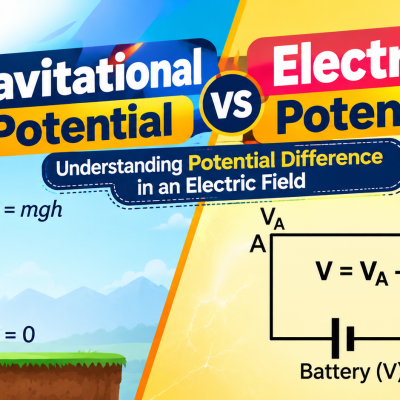
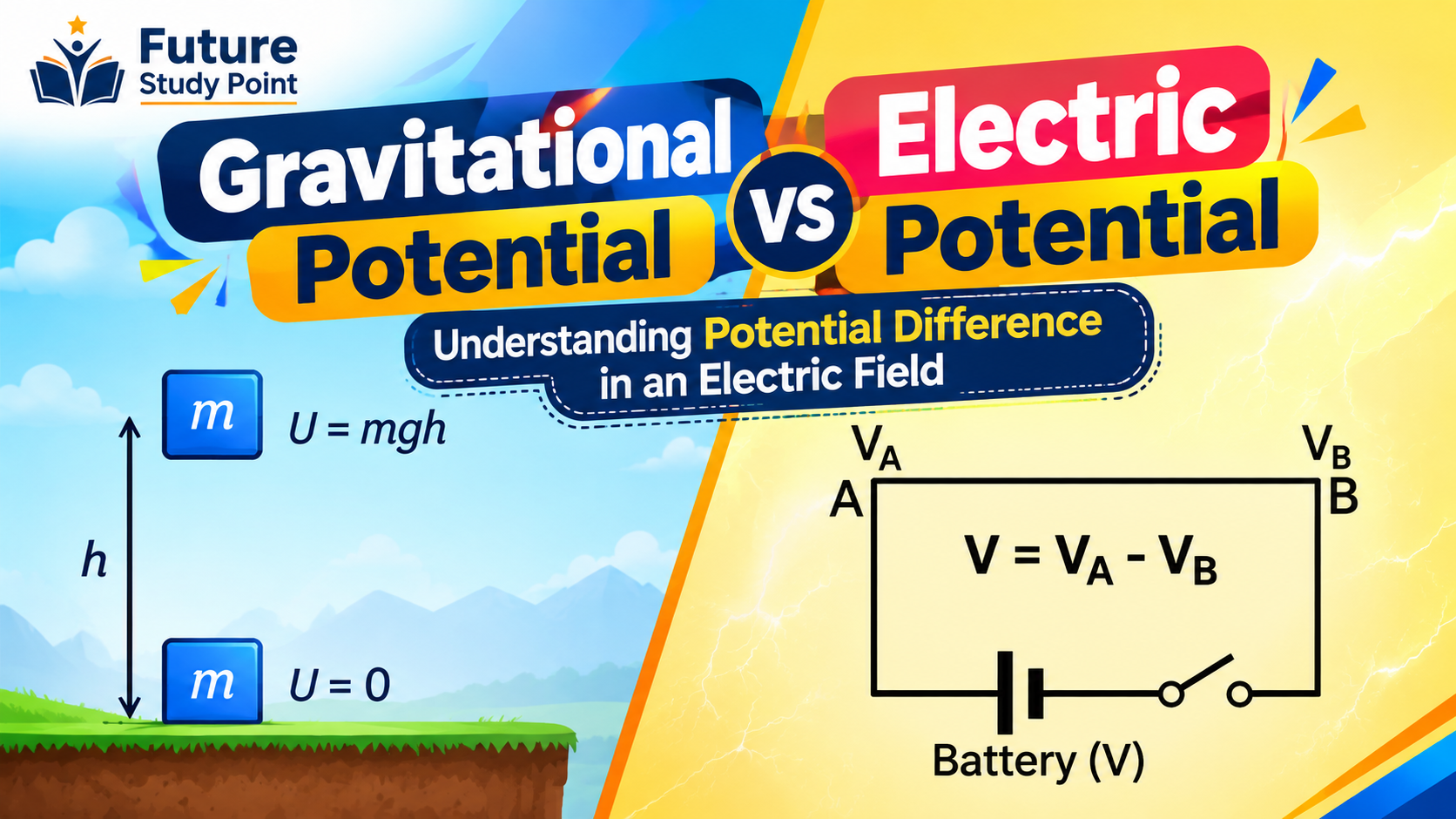
To understand Understanding Potential Difference in an Electric Field, we should first develop a clear idea of potential energy. A simple gravitational example helps us build this connection. Just as an object possesses gravitational potential energy because of its position in a gravitational field, a charged particle can possess electric potential energy because of its position in an electric field.
This analogy provides a strong foundation for understanding electric potential, potential difference, voltage, and electric potential energy. Once these ideas are connected logically, many concepts in electricity become much easier to understand. The aim is not merely to memorize formulas, but to develop a physical understanding that helps science students clear their doubts and confidently move towards more advanced concepts of electricity and electric fields.
Gravitational Potential Energy: A Simple Analogy
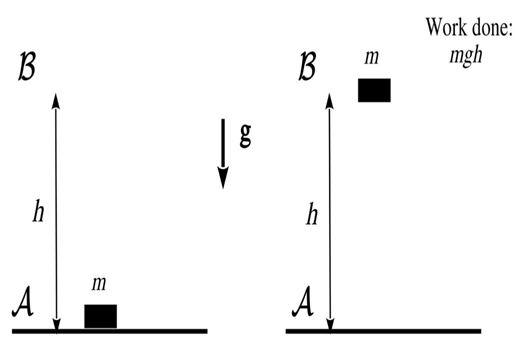
Suppose an object of mass is lifted from point A on the ground to point B, at a height .
The gravitational force acting on the object is F=mg
where:
- = mass of the object
- = acceleration due to gravity
If the object is lifted through a vertical distance , the work done against gravity is W=F×d
Therefore,
or
This work does not simply disappear. It is stored as gravitational potential energy of the object.
Therefore, at height , U=mgh
where represents gravitational potential energy.
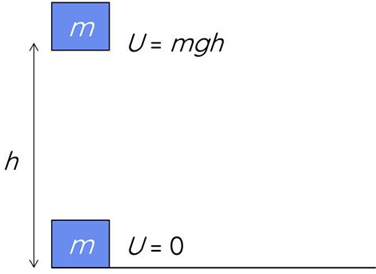
For convenience, we can choose the ground as the reference level and take the gravitational potential energy there to be zero.
Thus, UA=0
and at point ,
But what is gravitational potential?
Here we need to make an important distinction.
Potential energy depends on the mass of the object: U=mgh
whereas gravitational potential is potential energy per unit mass:
So, gravitational potential tells us about the potential energy available per unit mass at a particular point in a gravitational field.
This idea helps us understand electric potential.
What Is Electric Potential?
An electric field is a region of space in which an electric charge experiences an electric force.
To define the electric potential at a point, we consider a small positive test charge and calculate the work required to bring it from a reference point to that location.
Usually, for an isolated charge system, infinity is taken as the reference point and the electric potential at infinity is taken to be zero.
Therefore, the electric potential at a point is defined as:
The work done by an external agent in bringing a unit positive test charge from infinity to that point, without changing its kinetic energy.
Mathematically,
V=W/Q
where:
- = electric potential
- = work done
- = charge
The SI unit of electric potential is the volt (V).
One volt is defined as:
1 V=1 J/C
This means that if 1 joule of work is required to bring a 1 coulomb positive charge to a point, the electric potential of that point is 1 volt relative to the chosen reference.
Electric Potential and Electric Potential Energy Are Different
This distinction is very important.
Electric potential is potential energy per unit charge:
V=U/Q
Therefore, U=VQ
Here:
- = electric potential energy
- Q = charge
- = electric potential
This is analogous to gravitational potential:
Gravitational potential = Gravitational potential energy Mass
Similarly,
Electric potential = Electric potential energy Charge
So, just as gravitational potential tells us about energy per unit mass, electric potential tells us about energy per unit charge.
What Is Potential Difference?
Now consider two points, A and B, in an electric field.
Suppose their electric potentials are and .
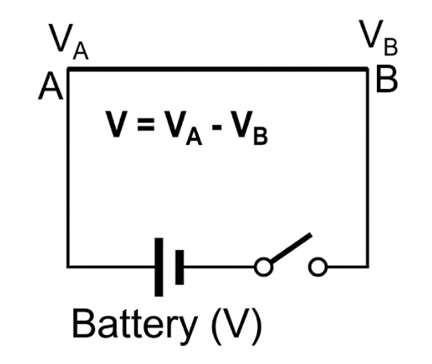
The potential difference between A and B is the difference between their electric potentials:
–
If a charge Q moves from A to B, the change in its electric potential energy is related to the potential difference.
For a positive charge, the work done by the electric field in moving the charge from A to B is
W=Q( – )
Therefore, – =W/Q
where here represents the work done by the electric field.
There is an important point here: if we instead talk about the work done by an external agent in moving the charge slowly from A to B, the sign is reversed:
Wexternal=Q(VB−VA)
This distinction prevents confusion about the sign of work.
Why Does Potential Difference Produce Electric Current?
A potential difference does not automatically mean that current will flow.
For current to flow continuously, there must generally be a closed conducting path and mobile charge carriers.
When a potential difference is applied across a conductor, an electric field is established inside the conductor. This electric field exerts force on the mobile charge carriers and causes their net drift motion.
This organized movement of charge is called electric current.
Therefore, we can say:
Potential difference provides the energy per unit charge that drives charge through a circuit. When a conducting path is available, this can produce an electric current.
For example, a battery maintains a potential difference between its terminals. When the terminals are connected through a conducting circuit, charges move through the circuit and current flows.
Potential Difference Across a Conductor
Suppose a conductor is connected between points A and B.
If the potential at A is and the potential at B is , then the potential difference is
V=−
if we define the voltage from A to B in that direction.
If a charge moves through a potential difference , the corresponding energy transferred is
W=QV
Therefore,
V= W/Q
This equation gives the physical meaning of voltage:
Voltage tells us how much energy is transferred per unit charge.
For example, a potential difference of 12 V means that 12 joules of energy are transferred per coulomb of charge.
12 V=12 J/C
How Is a Potential Difference Generated Between Clouds and the Earth?
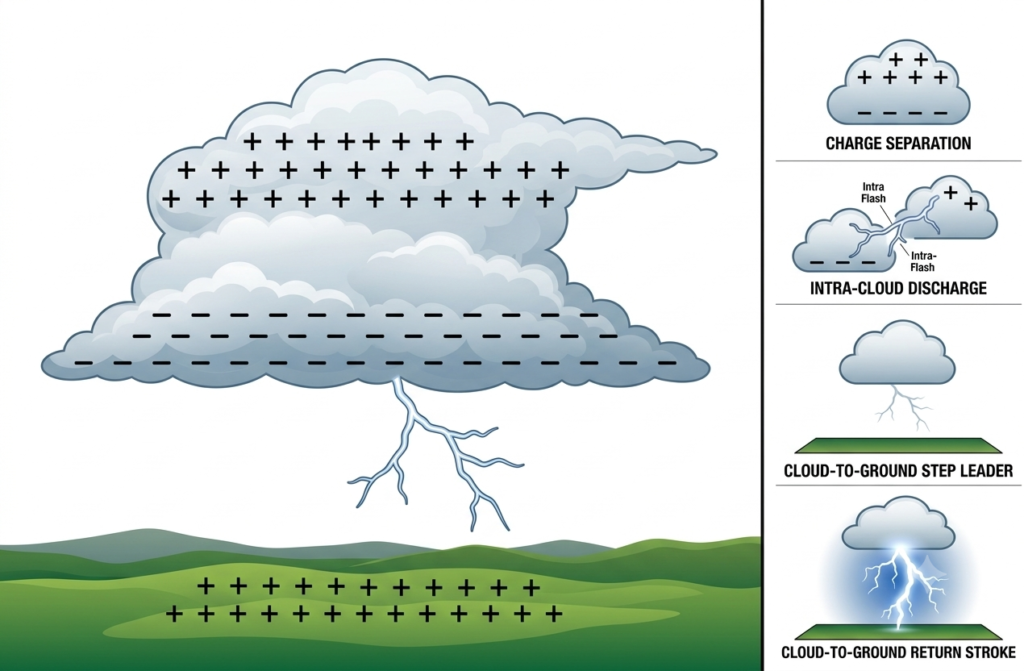
One of the most spectacular examples of a very large potential difference in nature is lightning.
Inside a thundercloud, powerful upward and downward air currents cause collisions among ice crystals, supercooled water droplets, and larger ice particles such as graupel.
These collisions can cause charge separation within the cloud.
As a result, different regions of the cloud acquire different net charges. Typically, the lower part of a thundercloud becomes predominantly negatively charged, while the upper region becomes predominantly positively charged.
The negative charge at the bottom of the cloud also causes electrostatic induction in the Earth’s surface beneath it, making the region of the ground below the cloud relatively more positive.
Thus, a very large electric potential difference can develop between different regions of the cloud and between the cloud and the Earth’s surface.
When the electric field becomes sufficiently strong, the normally insulating air can undergo electrical breakdown. A conducting path called a lightning channel develops, allowing a large amount of charge to move rapidly.
This sudden electrical discharge is what we observe as lightning.
The enormous current flowing through the lightning channel heats the surrounding air to extremely high temperatures. The air expands very rapidly, producing a pressure wave that reaches our ears as thunder.
Class 10 Half Yearly CBSE Science Question Paper Solutions
Class 10 Maths Chapter-wise NCERT Solutions
Chapter 3 – Pair of Linear Equations in Two Variables
Chapter 4 – Quadratic Equations
Chapter 5 – Arithmetic Progressions
Chapter 7 – Coordinate Geometry
Chapter 8 – Introduction to Trigonometry
Chapter 9 – Some Applications of Trigonometry
Chapter 11 – Areas Related to Circles
Chapter 12 – Surface Areas and Volumes
Chapter 13 – Statistics
Chapter 14 – Probability
Class 10 Maths Previous Year Question Papers
Class 10 Maths Standard Question Paper CBSE Board Exam 2025–26
Class 10 Maths Sample Papers
Class 10 Maths CBSE Basic Sample Paper Solution 2025-26
Class 10 Maths CBSE Standard Sample Paper Solution 2025-26
Class 10 Maths Standard Sample Paper Solution 2024-25
Class 10 Maths (Basic) Sample Paper Solution CBSE 2024-25
Class 10 Maths Chapter-wise Most Important Questions
Chapter 1 Real Numbers Most Important Questions
Class 10 Maths Chapter 2 Polynomials Most Important Questions
Class 10 Maths Chapter 3 Most Important Questions Pair of Linear Equations