Class 9 Maths Ganita Manjari Chapter 1 NCERT Solutions Orienting Yourself: The Use of Coordinates are explained in a simple and easy-to-understand way. This post is specially created for students looking for Class 9 Maths Ganit Manjari Chapter 1 NCERT Solutions, end-of-chapter exercise, and video explanations for the new Class 9 Maths syllabus.
In this chapter, students learn how coordinates help us locate points on a plane and how the coordinate system can be used to understand different mathematical situations.
Watch the Video Solutions After Trying the Questions Yourself
Before watching the video solutions, go through all the questions given below and try to solve them on your own. Take your time to understand each question and apply the concepts from Class 9 Maths Chapter 1 – Ganita Manjari: Orienting Yourself: The Use of Coordinates.
Once you have attempted the questions, scroll down to the video solutions embedded after the complete set of questions. Compare your approach with the detailed solutions and check where you made mistakes or where your method can be improved.
This approach will help you learn the concepts, practise independently, and understand the solutions more effectively rather than simply watching the answers.
Class 9 Maths Chapter 1 Orienting Yourself: The Use of Coordinates
The chapter “Orienting Yourself: The Use of Coordinates” introduces the coordinate system and its applications in geometry and everyday situations.
Students will come across concepts such as:
- Coordinates and the coordinate plane
- x-axis and y-axis
- Origin and quadrants
- Locating points on a coordinate plane
- Distance between points
- Midpoint of a line segment
- Collinear points
- Circles using coordinates
- Coordinate-based geometry problems
- Applications of coordinates in real-life situations
Understanding these concepts carefully will help students solve the End-of-Chapter Exercises with greater confidence.
Class 9 Maths Chapter 1 NCERT Solutions | Ganita Manjari Orienting Yourself: The Use of Coordinates
Get complete Class 9 Maths Chapter 1 NCERT Solutions from the new Ganita Manjari textbook. The video solutions cover the exercises and End-of-Chapter Exercises with clear, step-by-step explanations to help students understand the concepts and solve the questions confidently.
Important Concepts to Revise
Coordinates
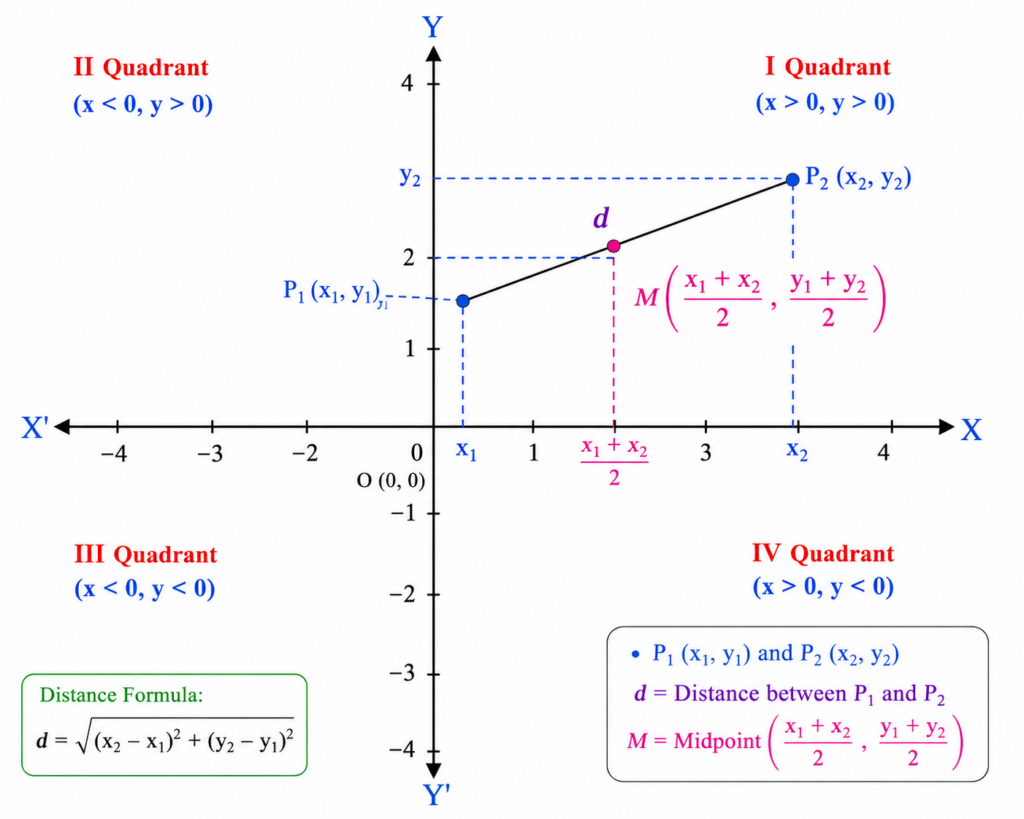
A point on the coordinate plane is represented by an ordered pair:(x,y)
The first coordinate represents the position along the x-axis, while the second coordinate represents the position along the y-axis.
Origin
The point where the x-axis and y-axis meet is called the origin O(0,0)
Distance formula
If the coordinates of two points on the Cartesian plane are (x1 ,y1) and (x2 ,y2),then the distance between them can be calculated using the following formula, where (d) represents the distance between the two points.
d = √[(x₂ − x₁)² + (y₂ − y₁)²]
Mid Point Formula
If the coordinates of two points on the Cartesian plane are (x1 ,y1) and (x2 ,y2),then the coordinates of the midpoint (M) between them can be expressed using the following formula:
M = ((x₁ + x₂)/2, (y₁ + y₂)/2)
1. Exercise Set 1.1 – 1 Question (4 Parts)
This exercise introduces the basic ideas of coordinates and locating points on the coordinate plane. The video explains all 4 parts of the question step-by-step so that students can understand the concept and solve similar questions on their own.
Q1.Fig. 1.3 shows Reiaan’s room with points OABC marking its corners. The x- and y-axes are marked in the figure. Point O is the origin.
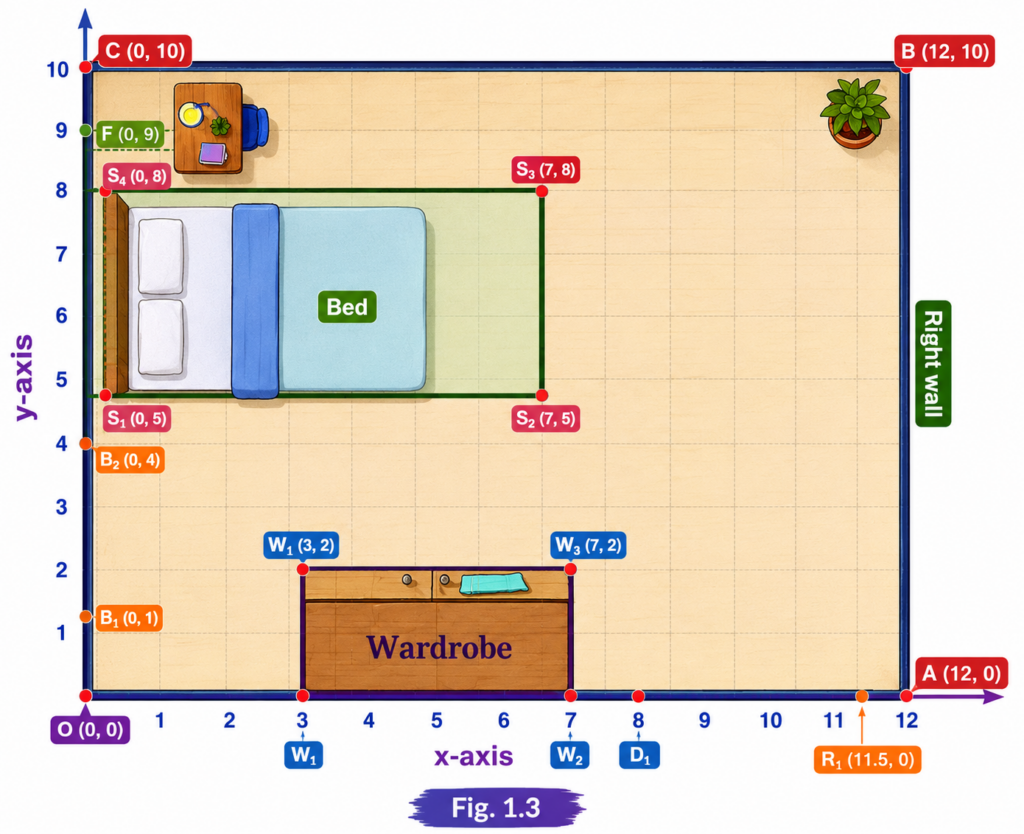
Referring to Fig. 1.3, answer the following questions:
(i) If D1 R1 represents the door to Reiaan’s room, how far is the door from the left wall (the y-axis) of the room? How far is the door from the x-axis?
(ii) What are the coordinates of D1 ?
(iii) If R1 is the point (11.5, 0), how wide is the door? Do you think this is a comfortable width for he room door? If a person in a wheelchair wants to enter the room,will he/she be able to do so easily?
(iv) If B1 (0, 1.5) and B2 (0, 4) represent the ends of the bathroom door, is the bathroom door narrower or wider than the room door?
2. Exercise Set 1.2 – 4 Questions
In Exercise Set 1.2, there are 4 questions based on the concepts introduced in the chapter. Watch the video to understand the correct approach and follow the complete solution of each question in a simple and easy-to-understand manner.
On a graph sheet, mark the x-axis and y-axis and the origin O. Mark points from (– 7, 0) to (13, 0) on the x-axis and from (0, – 15) to (0, 12) on the y-axis. (Use the scale 1 cm = 1 unit.) Using Fig. 1.5, answer the given questions.
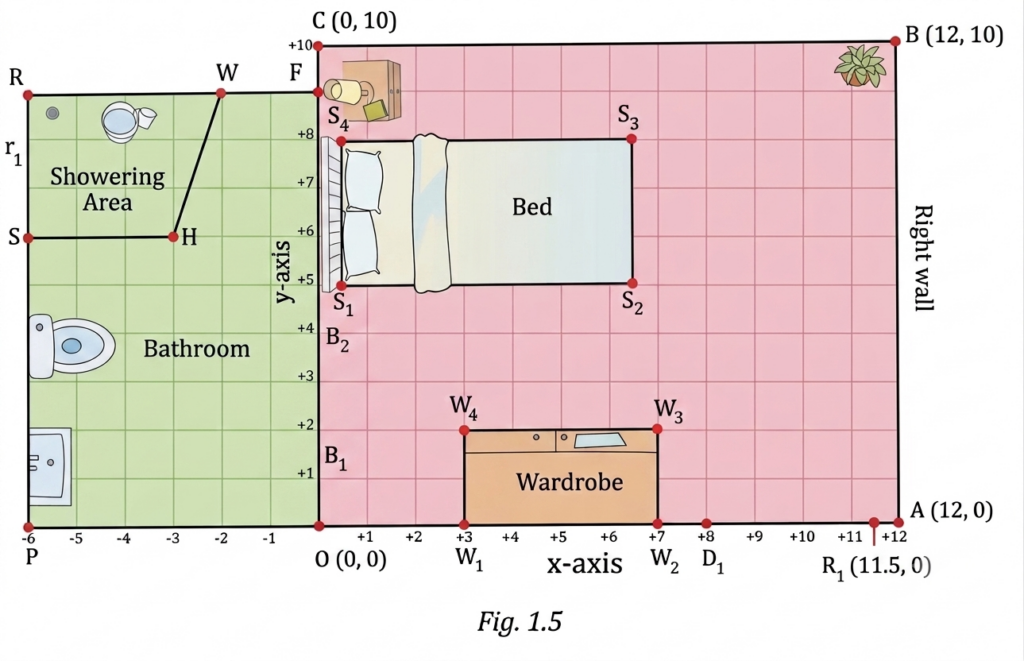
1.Place Reiaan’s rectangular study table with three of its feet at the points (8, 9), (11, 9) and (11, 7).
(i)Where will the fourth foot of the table be?
(ii) Is this a good spot for the table?
(iii) What is the width of the table? The length? Can you make out the height of the table?
2. If the bathroom door has a hinge at B1 and opens into the bedroom, will it hit the wardrobe? Are there any changes you would suggest if the door is made wider?
Are there any changes you would suggest if the door is made wider?
3. Look at Reiaan’s bathroom.
(i)What are the coordinates of the four corners O, F,R, and P of the bathroom?
(ii) What is the shape of the showering area SHWR in Reiaan’s bathroom? Write the coordinates of the four corners.
iii) Mark off a 3 ft × 2 ft space for the washbasin and a 2 ft × 3 ft space for the toilet. Write the coordinates of the corners of these spaces.
4. Other rooms in the house:
(i)Reiaan’s room door leads from the dining room which has the length 18 ft and width 15 ft. The length of the dining room extends from point P to point A. Sketch the dining room and mark the coordinates of its corners.
(ii) Place a rectangular 5 ft × 3 ft dining table precisely in the centre of the dining room. Write down the coordinates of the feet of the table.
3. End-of-Chapter Exercises – 16 Questions
The End-of-Chapter Exercises contain 16 questions covering the important concepts of Orienting Yourself: The Use of Coordinates. These questions provide useful practice in applying coordinates to different mathematical situations. The video explains all 16 questions step-by-step, making it useful for practice, revision and exam preparation.
1. What are the x-coordinate and y-coordinate of the point of intersection of the two axes?
2. Point W has x-coordinate equal to – 5. Can you predict the coordinates of point H which is on the line through W parallel to the y-axis? Which quadrants can H lie in?
2. Point W has x-coordinate equal to – 5. Can you predict the coordinates of point H which is on the line through W parallel to the y-axis? Which quadrants can H lie in?
3. Consider the points R (3, 0), A (0, – 2), M (– 5, – 2) and P (– 5, 2). If they are joined in the same order, predict:
(i)Two sides of RAMP that are perpendicular to each other.
(ii) One side of RAMP that is parallel to one of the axes.
(iii) Two points that are mirror images of each other in one axis.
Which axis will this be?
4. Plot point Z (5, – 6) on the Cartesian plane. Construct a right-angled triangle IZN and find the lengths of the three sides.
(Comment: Answers may differ from person to person.)
5. What would a system of coordinates be like if we did not have negative numbers? Would this system allow us to locate all the points on a 2-D plane?
6. Are the points M (– 3, – 4), A (0, 0) and G (6, 8) on the same straight line? Suggest a method to check this without plotting and joining the points.•
7. Use your method (from Problem 6) to check if the points R (– 5, – 1), B (– 2, – 5) and C (4, – 12) are on the same straight line.Now plot both sets of points and check your answers.
8. Using the origin as one vertex, plot the vertices of:
(i) A right-angled isosceles triangle.
(ii) An isosceles triangle with one vertex in Quadrant III and the other in Quadrant IV.
9. The following table shows the coordinates of points S, M and T. In each case, state whether M is the midpoint of segment ST. Justify your answer.
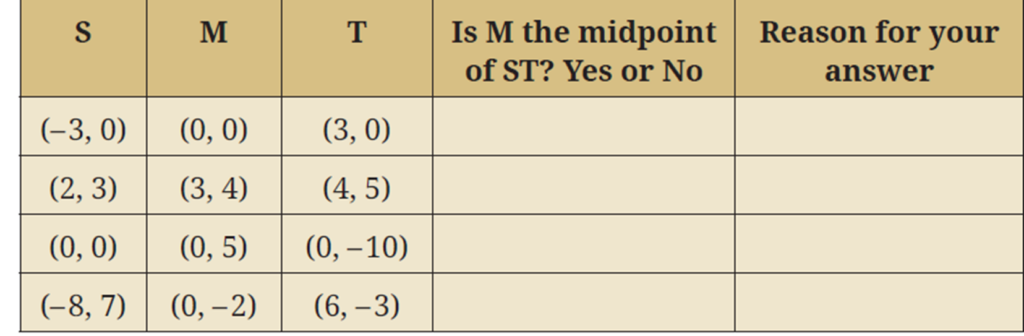
When M is the mid-point of ST, can you find any connection
between the coordinates of M, S and T?
10. Use the connection you found to find the coordinates of B given that M (–7, 1) is the midpoint of A (3, – 4) and B (x, y).
11. Let P, Q be points of trisection of AB, with P closer to A, and Q closer to B. Using your nowledge of how to find the coordinates of the midpoint of a segment, how would you find the coordinates of P and Q? Do this for the case when the points are A (4, 7) and B (16, –2).
12. (i) Given the points A (1, – 8), B (– 4, 7) and C (–7, – 4), show that they lie on a circle K whose center is the origin O (0, 0). What is the radius of circle K?•
(ii) Given the points D (– 5, 6) and E (0, 9), check whether D and E lie within the circle, on the circle, or outside the circle K.
13. The midpoints of the sides of triangle ABC are the points D, E, and F. Given that the coordinates of D, E, and F are (5, 1), (6, 5), and (0, 3), respectively, find the coordinates of A, B and C.
14. A city has two main roads which cross each other at the centre of the city. These two roads are along the North–South (N–S) direction and East–West (E–W) direction. All the other streets of the city run parallel to these roads and are 200 m apart. There are 10 streets in each direction.
(i) Using 1 cm = 200 m, draw a model of the city in your notebook.Represent the roads/streets by single lines.
(ii) There are street intersections in the model. Each street intersection is formed by two streets — one running in the N–S direction and another in the E–W direction. Each street intersection is referred to in the following manner: If the second street running in the N–S direction and 5th street in the E–W direction meet at some crossing, then we call this street intersection (2, 5). Using this convention, find:
(a) how many street intersections can be referred to as (4, 3).
(b) how many street intersections can be referred to as (3, 4).
16. Plot the points A (2, 1), B (–1, 2), C (–2, –1), and D (1, –2) in the coordinate plane. Is ABCD a square? Can you explain why? What is the area of this square?
Watch Class 9 Maths Chapter 1 Ex 1.1 NCERT Solutions Video Explanation
In this video, we explain the Class 9 Maths Chapter 1 Exercise 1.1 – Orienting Yourself: The Use of Coordinates from the new NCERT Ganita Manjari textbook. Each question is solved step-by-step in a simple and easy-to-understand way.
Watch the complete video to understand the concepts, follow the correct method of solving each question, and strengthen your preparation for Class 9 Maths exams.
Class 9 Maths Chapter 1 Exercise 1.2 – NCERT Video Solutions
In this video, we provide complete NCERT solutions for Exercise Set 1.2 of Class 9 Maths Chapter 1, Orienting Yourself: The Use of Coordinates, from the Ganita Manjari textbook. All 4 questions are explained step-by-step in a simple and clear manner.
Watch the video to understand the concepts, learn the correct method of solving each question, and strengthen your preparation for Class 9 Maths exams.
Class 9 Maths Chapter 1 – End-of-Chapter Exercises NCERT Solutions Video
The End-of-Chapter Exercises are one of the most important parts of Class 9 Maths Chapter 1 – Orienting Yourself: The Use of Coordinates. These 16 questions cover a wide variety of concepts and question types, including coordinates, distance, midpoint, collinearity, circles, triangles and applications of the coordinate system.
In this video, all the questions are explained step-by-step in a simple and clear manner. Students should watch the complete video after attempting the questions themselves to check their solutions, understand different approaches and strengthen their exam preparation.
Why Watch the Video Solution?
The video solution is useful for students who want to:
- Understand the questions step-by-step
- Learn how to apply coordinate concepts
- Check their written solutions
- Revise Chapter 1 before exams
- Understand difficult questions visually
- Prepare for school tests and examinations
Tip: Try solving each question yourself first. Then watch the video to check your method and understand any steps that you found difficult.
Frequently Asked Questions
What is Chapter 1 of Class 9 Maths Ganita Manjari?
Chapter 1 of the Class 9 Maths textbook Ganita Manjari is titled “Orienting Yourself: The Use of Coordinates.”
What is covered in Chapter 1?
The chapter introduces coordinates and their applications, including locating points, quadrants, distance, midpoint and other coordinate-based problems.
Where can I find the solutions to the End-of-Chapter Exercises?
The complete step-by-step video solutions are provided in the YouTube video embedded above.
Is the video useful for exam preparation?
Yes. Students can use the video to understand the solving methods, revise important concepts and check their answers after attempting the exercises themselves.
Conclusion
Class 9 Maths Chapter 1 – Orienting Yourself: The Use of Coordinates is an important introduction to the use of coordinates in mathematics. Understanding the basic concepts clearly will make it easier to solve coordinate-based problems in Class 9 and beyond.
Watch the complete YouTube video above for the NCERT solutions of the End-of-Chapter Exercises and learn each question step-by-step.
Also explore our other Class 9 Maths NCERT Solutions and video explanations for complete chapter-wise preparation.
CBSE Class 10 Maths NCERT Solutions
Continue your Class 10 Maths preparation with these useful resources from Future Study Point:
Class 10 Maths Chapter 1 – Real Numbers: Complete NCERT Exercise-Wise Video Solutions
Class 10 Maths Chapter 2 – Polynomials: Complete NCERT Solutions for Polynomials
Class 10 Maths Chapter 3 – Pair of Linear Equations in Two Variables: Complete NCERT Solutions
Class 10 Maths Chapter 4 Quadratic Equations: – Quadratic Equations complete NCERT video solutions
Class 10 Maths Chapter 5 Arithmetic Progression: Arithmetic Progression: complete video solution
Class 10 Maths Basic Sample Paper Solution: Practise with the Complete CBSE Basic Sample Paper Solution
Class 10 Maths Chapter 3 Most Important Questions Videos–Pair of Linear Equations in Two Variables