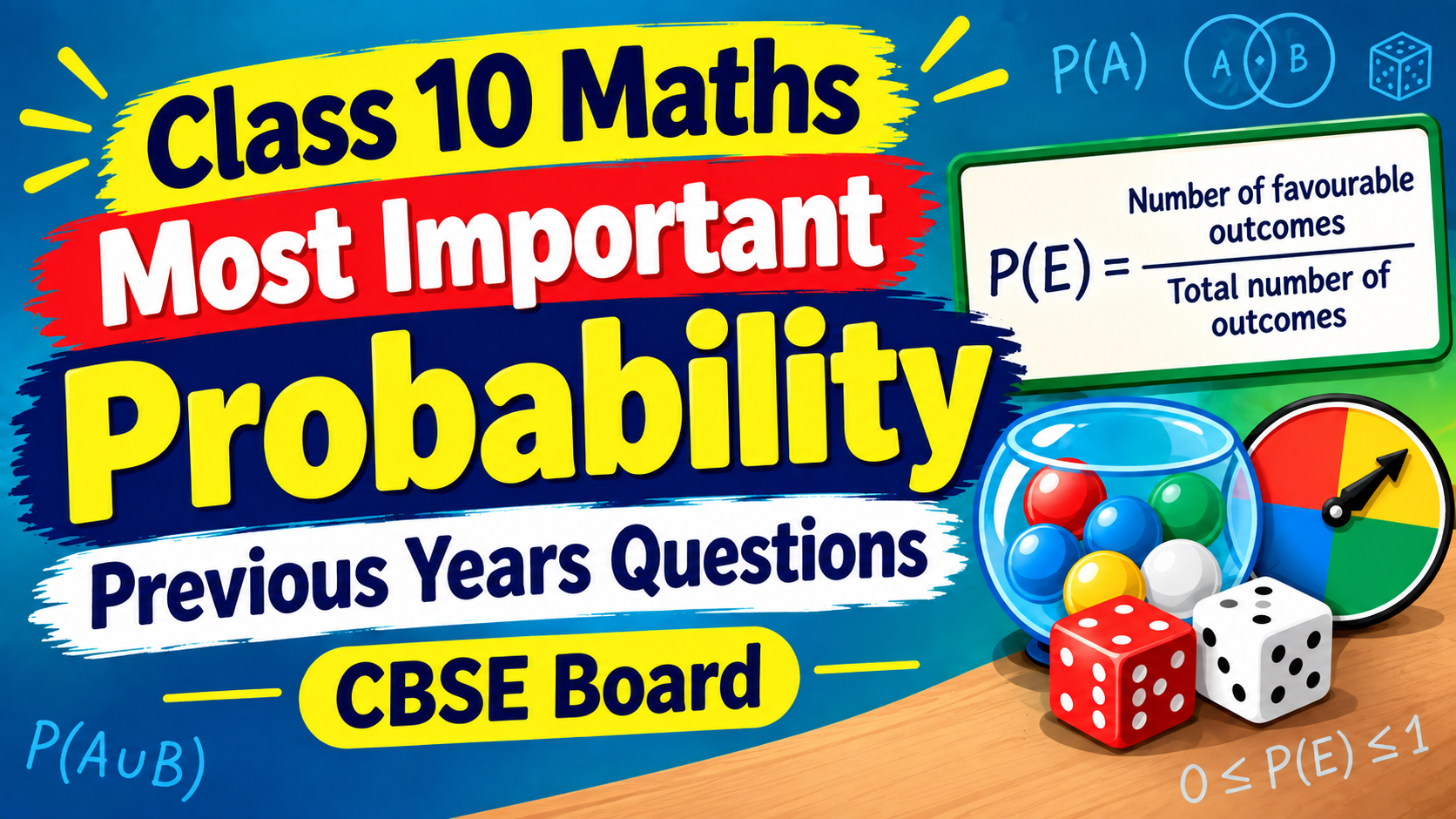
Probability is one of the important chapters of Class 10 Maths for the CBSE Board Exam 2026-27. Practising Class 10 Maths Probability Previous Years Questions helps students understand outcomes, events, favourable outcomes and the calculation of probability. Previous years’ questions also help students become familiar with different question patterns and improve their confidence and accuracy for the CBSE Board Exam 2026-27.
For effective exam preparation, students should practise Class 10 Maths Most Important Probability Previous Years Questions along with NCERT questions, important questions and sample papers. Previous years’ questions help students understand the type, level and pattern of questions that can be asked in the CBSE Board Exam.
In this post, you will find important Probability questions for Class 10 Maths. Video solutions are also available, so students can first try to solve each question themselves and then watch the video solution to understand the correct method.
What is Probability?
Probability is a branch of mathematics that deals with the likelihood or chance of an event occurring.
In simple words, probability tells us how likely or unlikely an event is to happen.
For example:
- Getting a Head when a coin is tossed
- Getting a particular number when a die is thrown
- Drawing a particular card from a deck of cards
- Selecting a particular student from a group
The probability of an event is calculated using:
Probability of an event = Number of favourable outcomes / Total number of possible outcomes
If E is an event, then:
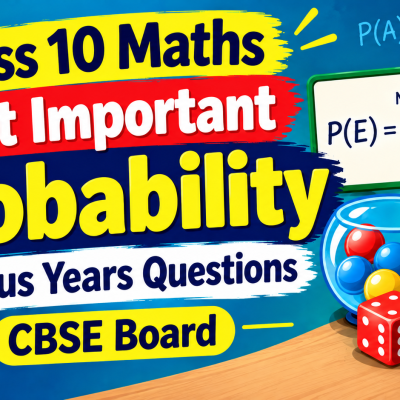
P(E) = Number of favourable outcomes / Total number of outcomes
The value of probability always lies between 0 and 1.
- P(E) = 0 means the event is impossible.
- P(E) = 1 means the event is certain.
- A probability between 0 and 1 represents the likelihood of an event occurring.
Why is Probability Important for Class 10 CBSE Board Exams?
Probability is an important part of the Class 10 CBSE Maths syllabus and students should not ignore it while preparing for their board examinations.
Practising Class 10 Maths Probability Previous Years Questions can help students in several ways.
1. Understand the Question Pattern
Previous years’ questions give students an idea of how probability questions are framed in the CBSE examination.
Questions may involve:
- Coins
- Dice
- Playing cards
- Numbers
- Selection of objects
- Selection of students
- Real-life situations
2. Improve Problem-Solving Skills
Probability questions require students to identify:
- Total number of outcomes
- Favourable outcomes
- The required event
- Appropriate probability formula
Regular practice helps students solve these questions more confidently.
3. Prepare for Different Types of Questions
CBSE examination questions can test the same concept in different ways. Practising previous years’ questions helps students become familiar with different formats.
4. Improve Accuracy
Probability questions are often based on counting outcomes correctly. A small mistake in identifying the total or favourable outcomes can lead to an incorrect answer.
Practising previous years’ questions helps students improve accuracy.
5. Useful for Revision
Probability is a comparatively compact chapter. Once students understand the basic concepts and practise important questions, they can revise the chapter effectively before the CBSE Board Exam 2026-27.
Class 10 Maths Most Important Probability Previous Years Questions
Q1.A card is drawn at random from a well shuffled pack of 52 playing cards. Find the probability of getting neither a red card nor a queen.
Q2.A box contains cards numbered 6 to 50. A card is drawn at random from the box. Calculate the probability that the drawn card has a number which is a perfect square.
Q3.A number is chosen at random from the numbers -3, -2, -1, 0, 1, 2, 3. What will be the probability that square of this number is less than or equal to 1?
Q4.If two different dice are rolled together, calculate the probability of getting an even number on both dice.
Q5.A coin is tossed two times. Find the probability of getting both heads or both tails.
Q6.In a simultaneous toss of two coins, find the probability of getting:
(i) exactly one head,
(ii) atmost one head.
Q7. Three coins are tossed simultaneously. Find the probability of getting exactly two heads.
Q8.A card is drawn at random from a pack of 52 playing cards. Find the probability that the card drawn is neither an ace nor a king.
Q9.The probability of selecting a red ball at random from a jar that contains only red, blue and orange balls is 14 . The probability of selecting a blue ball at random from the same jar is 13 . If the jar contains 10 orange balls, find the total number of balls in the jar.
Q10.A number x is selected at random from the numbers 1, 2, 3 and 4. Another number y is selected at random from the numbers 1, 4, 9 and 16. Find the probability that product of x and y is less than 16.
Watch the Solutions
Below are some important types of Probability questions that Class 10 students should practise.
Question 1: Coin Toss
A coin is tossed once. Find the probability of getting:
(i) a Head
(ii) a Tail.
Question 2: Throwing a Die
A die is thrown once. Find the probability of getting:
(i) an even number
(ii) a prime number
(iii) a number greater than 4.
Question 3: Playing Cards
A card is drawn at random from a well-shuffled deck of 52 playing cards. Find the probability of getting:
(i) a king
(ii) a red card
(iii) an ace
(iv) a face card.
Question 4: Numbers
A number is selected at random from a set of numbers. Find the probability that the selected number satisfies the given condition.
Such questions test the student’s ability to identify the total outcomes and favourable outcomes.
Question 5: Real-Life Selection
A student or object is selected randomly from a given group. Find the probability of selecting an object or person satisfying a particular condition.
These questions are useful because they connect probability with everyday situations.
Tip: Before solving any probability question, clearly write the total number of possible outcomes and the number of favourable outcomes.
Why Should You Practise Previous Years Questions?
Previous Years Questions (PYQs) are extremely useful for examination preparation because they provide practice with questions that have appeared in earlier examinations.
When preparing for the CBSE Board Exam 2026-27, students should follow a systematic approach:
- Understand the concept from NCERT.
- Solve NCERT exercise questions.
- Practise important questions.
- Solve previous years’ questions.
- Attempt sample papers.
- Analyse mistakes.
- Revise the formulas and concepts.
This approach can help students develop both conceptual understanding and exam-solving speed.
Watch Video Solutions of Probability Questions
Reading a solution is useful, but watching a step-by-step explanation can make difficult questions easier to understand.
For the important Probability questions covered in this post, video solutions are also available on the Future Study Point YouTube channel.
Students can use the following method:
First → Read the question
Second → Pause the video and try to solve it yourself
Third → Watch the complete solution
Fourth → Compare your method with the explained method
Finally → Note down your mistake, if any
This method gives students an opportunity to practise the question independently before seeing the solution.
Importance of Probability in Higher Classes
The importance of Probability does not end with Class 10.
Students encounter Probability again in higher classes, where the concepts become more detailed and mathematical.
In Class 11 and Class 12 Mathematics, students study probability in greater depth. They may encounter concepts such as:
- Random experiments
- Events
- Conditional probability
- Independent events
- Bayes’ theorem
- Random variables
- Probability distributions
Therefore, developing a strong foundation in Class 10 Probability can help students understand more advanced concepts in higher classes.
Probability is also useful for students preparing for various competitive and entrance examinations.
Applications of Probability in the Commercial Field
Probability has many practical applications in the commercial and business world.
Businesses often have to make decisions when the future is uncertain. Probability can help them estimate possible outcomes.
1. Insurance
Insurance companies use probability and statistical data to estimate the likelihood of events such as accidents, illness, property damage and other risks.
2. Business Risk Analysis
Companies can use probability to estimate the possibility of different business outcomes and assess potential risks.
3. Sales Forecasting
Businesses can analyse previous sales data to estimate the probability of increased or decreased demand for products.
4. Financial Analysis
Probability is used in financial modelling and risk assessment to understand possible future outcomes.
5. Quality Control
Manufacturing companies can use probability and statistics to estimate the likelihood of defective products and monitor production quality.
Thus, a concept that students learn through coins, dice and cards at school can eventually be used in real-world commercial decision-making.
Applications of Probability in Science and Discover
Probability is also an important mathematical tool in science and research.
Scientific experiments often involve uncertainty, variation and large amounts of data. Probability helps scientists analyse such situations.
1. Physics
Probability is used in several areas of modern physics, particularly in quantum mechanics, where the behaviour of particles is described probabilistically.
2. Biology
Probability and statistics are used in genetics to study the likelihood of particular genetic outcomes.
3. Medical Research
Researchers use probability and statistics when analysing clinical studies, experimental results and population data.
4. Weather and Climate Studies
Probability is used to estimate the likelihood of events such as rainfall, storms and extreme weather conditions.
5. Scientific Discoveries
Scientists often work with incomplete information and uncertain observations. Probability provides mathematical methods for analysing evidence and estimating possible outcomes.
Therefore, learning Probability in Class 10 is not merely about solving examination questions. It introduces students to an important mathematical way of thinking about uncertainty and evidence.
How to Prepare Probability for CBSE Board Exam 2026-2
Follow these simple steps for effective preparation:
Step 1: Understand the Basic Concept
Make sure you understand:
P(E) = Favourable outcomes / Total outcomes
Step 2: Practise NCERT Questions
NCERT should be your first source for building conceptual understanding.
Step 3: Solve Previous Years Questions
Practise Class 10 Maths Most Important Probability Previous Years Questions regularly.
Step 4: Practise Without Looking at the Solution
Try to solve every question independently before checking the answer.
Step 5: Watch Video Solutions
If you cannot solve a question, watch the step-by-step video solution and understand where you went wrong.
Step 6: Revise Before the Examination
Make a short revision list of formulas, concepts and mistakes that you frequently make.
Final Words
Probability is an important and useful topic in Class 10 Maths. It is important not only from the point of view of the CBSE Board Exam 2026-27, but also because probability forms the foundation for more advanced mathematics and has applications in business, finance, science, medicine, weather forecasting and many other fields.
Students should therefore practise Class 10 Maths Most Important Probability Previous Years Questions carefully and focus on understanding the method rather than simply memorising answers.
Try every question yourself first, and then watch the video solution to strengthen your understanding.
Keep practising, keep revising and prepare systematically for the CBSE Board Exam 2026-27.
More Class 10 Maths Preparation
Students can also practise:
- Class 10 Maths NCERT Solutions
- Class 10 Maths Important Questions
- Class 10 Maths Previous Years Questions
- Class 10 Maths Sample Papers
- Class 10 Maths Board Exam Questions
- Class 10 Maths Chapter-wise Questions
- Class 10 Maths Video Solutions
Watch, practise and revise regularly to prepare effectively for your CBSE Board Exam 2026-27.
Class 10 CBSE Maths Most Important Questions
Class 10 Maths Most Important Questions Chapter 1 Real Numbers
Class 10 Maths Most Important Questions Chapter 2 Polynomials
Class 10 Most Important Questions Chapter 3 Pair of Linear Equations
Class 10 Maths Chapter 4 Quadratic Equations Most Important Questions
Class 10 Maths Chapter 5 Arithmetic Progressions Most Important Questions