Author name: Narender Kumar

I am Narender Kumar, an educator and the creator of Future Study Point. I hold an M.Sc. in Physics from HNB University. I create easy-to-understand Mathematics and Science lessons, NCERT solutions, important questions, MCQs, sample papers and video explanations for CBSE and NCERT students from Classes 6 to 12. My aim is to help students build strong concepts, practise effectively and prepare confidently for their examinations.

Class 10 Maths Chapter 2 Polynomials Video Most Important Questions
Class 10 Maths

Class 10 Maths Chapter 2 Polynomials Video Most Important Questions

Preparing for the CBSE Class 10 Maths Board Examination 2026–27? Chapter 2 Polynomials is an important chapter where questions are commonly based on zeros of a polynomial, the relationship between zeros and coefficients, and finding unknown values. In this post, you will find Class 10 Maths Chapter 2 Polynomials Video Most Important Questions with clear, step-by-step explanations. These questions are selected to help you revise important concepts and practise exam-oriented problems. Class 10 Maths Chapter 2 Polynomials – Most Important Questions The following questions cover the major concepts of Class 10 Maths Chapter 2 Polynomials and are useful for CBSE 2026–27 preparation. Question 1: Find the Zeros of a Quadratic Polynomial Find the zeros of the polynomial:p(x)=x2−5x+6p(x)=x^2-5x+6 Also verify the relationship between the zeros and the coefficients. Question 2: Find the Zeros and Verify the Relationship Find the zeros of:p(x)=2×2−7x+3p(x)=2x^2-7x+3p(x)=2×2−7x+3 Verify that:α+β=−ba\alpha+\beta=-\frac{b}{a} andαβ=ca\alpha\beta=\frac{c}{a} where α\alpha and β\beta are the zeros of the polynomial. Video Solution: Watch the complete step-by-step video solution of Class 10 Maths Top 30 Most Important Polynomial Questions below. Question 3: Find the Value of kk If one zero of the quadratic polynomialp(x)=2×2+kx+3p(x)=2x^2+kx+3 is the reciprocal of the other, find the value of kkk. Concept Tested: Relationship between zeros and coefficients. Question 4: Form a Quadratic Polynomial Find a quadratic polynomial whose zeros are 3 and −2. Hint: If the zeros are α\alpha and β, then:p(x)=x2−(α+β)x+αβp(x)=x^2-(\alpha+\beta)x+\alpha\beta Question 5: Find the Polynomial from the Sum and Product of Zeros The sum of the zeros of a quadratic polynomial is 5 and their product is 6. Find the polynomial. Video Solution: Top 15 Polynomial Questions for CBSE 2026–27 | Exam Revision NCERT Exemplar Questions – Video Solutions Watch the most important NCERT Exemplar questions from Class 10 Maths Chapter 2 Polynomials with clear, step-by-step video solutions. These solutions focus on important concepts and exam-oriented problems to help students understand the correct approach and prepare confidently for CBSE 2026–27. Class 10 Maths Chapter 2 Polynomials – 5 Marker Most Confusing Questions Watch the Class 10 Maths Chapter 2 Polynomials | 5 Marker Most Confusing Questions | CBSE Exams Special video to learn how to solve challenging and tricky 5-mark questions from Polynomials. These questions are explained step by step, focusing on common mistakes, important concepts, and the correct approach required to score full marks in the CBSE Board Exams 2026–27. Why Practise These Questions? These Class 10 Maths Chapter 2 Polynomials Video Most Important Questions are useful because they focus on the concepts that students need to master before attempting more challenging questions. By practising these questions, students can: Try solving each question yourself before watching the solution. This will help you identify your mistakes and improve your problem-solving speed. Preparation Tips for Chapter 2 Polynomials Frequently Asked Questions (FAQs) What is Chapter 2 of Class 10 Maths? Chapter 2 of Class 10 Maths is Polynomials. It covers zeros of polynomials and the relationship between zeros and coefficients. What are the important topics in Class 10 Polynomials? Important topics include zeros of a polynomial, geometrical meaning of zeros, relationship between zeros and coefficients, and formation of quadratic polynomials. Is Polynomials important for the Class 10 Board Exam? Yes. Students should practise different types of questions from Polynomials because the chapter tests both conceptual understanding and algebraic skills. How can I prepare Class 10 Maths Chapter 2? Understand the concepts first, revise the formulas, practise important questions, and watch the Class 10 Maths Chapter 2 Polynomials Video Most Important Questions for step-by-step explanations. Conclusion Class 10 Maths Chapter 2 Polynomials Video Most Important Questions are a useful resource for revising the chapter and preparing for the CBSE Board Examination 2026–27. Focus especially on zeros, the relationship between zeros and coefficients, and formation of quadratic polynomials. Keep practising, watch the complete video solutions, and solve the questions yourself before checking the answers. Class 10 Maths NCERT Solutions CBSE 2026-27 Update Continue your Class 10 Maths preparation with these useful resources from Future Study Point: Class 10 Maths Chapter 1 – Real Numbers: Complete NCERT Exercise-Wise Video Solutions Class 10 Maths Chapter 2 – Polynomials: Complete NCERT Solutions for Polynomials Class 10 Maths Chapter 3 – Pair of Linear Equations in Two Variables: Complete NCERT Solutions Class 10 Maths Chapter 4 Quadratic Equations: – Quadratic Equations complete NCERT video solutions Class 10 Maths Chapter 5 Arithmetic Progression: Arithmetic Progression: complete video solution Class 10 Maths Basic Sample Paper Solution: Practise with the Complete CBSE Basic Sample Paper Solution 👉 Explore these resources to strengthen your concepts, revise important topics, and prepare effectively for the CBSE Class 10 Maths Board Examination 2026–27.

Class 10 Maths Most Important Questions for Chapter 1 Real Numbers
Class 10 Maths

Class 10 Maths Most Important Questions Chapter 1 Real Numbers | CBSE Board 2026-27

Class 10 Maths Chapter 1 Important Questions is an important chapter for students preparing for the CBSE Board Exam 2026-27. Questions from Real Numbers can test your understanding of the Fundamental Theorem of Arithmetic, prime factorisation, HCF and LCM, and irrational numbers. In this article, Future Study Point brings you a collection of Class 10 Maths Most Important Questions from Chapter 1 Real Numbers with detailed video solutions. These questions are selected to help you revise important concepts, understand the question-solving approach, and prepare effectively for your CBSE examination. Whether you are studying Class 10 Maths Basic or Standard, practising important questions is an excellent way to strengthen your preparation and improve your confidence before the board examination. Before solving board exam questions, it is essential to understand the rule for the decimal expansion of rational numbers. The following flowchart provides a quick visual summary that helps students identify whether a decimal expansion is terminating or non-terminating recurring, making revision faster and easier. Class 10 Maths Chapter 1 Real Numbers Most Important Questions – Part 1 Watch the Complete Video: Class 10 Maths Chapter 1 – Real Numbers | Top 50 Most Important Questions | CBSE Board Exam Preparing for the CBSE Class 10 Board Exam? Before you start solving the questions below, watch this comprehensive video covering the Top 50 Most Important Questions from Chapter 1 – Real Numbers. The video includes detailed explanations, board-level concepts, previous year question patterns, and exam-oriented shortcuts to help you score maximum marks. Watch the complete video below and strengthen your preparation for the CBSE Board Exam. Class 10 Maths Chapter 1 Real Numbers Important Questions – Part 2 Watch Class 10 Maths Chapter 1 – Real Numbers MCQs (CBSE Board Exam) Boost your CBSE Class 10 Maths Board Exam preparation by watching this complete video on Chapter 1: Real Numbers MCQs. This lesson covers the most important multiple-choice questions (MCQs) based on the latest CBSE exam pattern, along with clear explanations and smart solving techniques. These questions are highly useful for revision, concept building, and scoring better marks in the board examination. Watch the complete video below and master the important MCQs from Class 10 Maths Chapter 1 – Real Numbers. Class 10 Maths Real Numbers Important Questions for CBSE Board Exam 2026-27 – Part 3 Watch Class 10 Maths Chapter 1 – Real Numbers | Top 15 PYQ Important Questions Get exam-ready with this CBSE Class 10 Maths Crash Course on Chapter 1: Real Numbers. In this video, you’ll learn the Top 15 Previous Year Questions (PYQs) that have the highest chances of helping you in the CBSE Board Exam. Each question is explained step by step using easy methods, making it perfect for quick revision, concept clarity, and last-minute preparation. Watch the complete video below and strengthen your board exam preparation with the most important PYQs from Real Numbers. Class 10 Maths Chapter 1 Real Numbers Most Important Questions – Part 4 Watch Class 10 Maths Chapter 1 – Real Numbers | Most Important MCQs Strengthen your CBSE Class 10 Maths preparation with this video featuring the Most Important MCQs from Chapter 1: Real Numbers. These board-oriented multiple-choice questions are selected from important exam patterns and explained in a simple, step-by-step manner to help you understand the concepts quickly and answer confidently in the examination. Watch the complete video below to revise the most important MCQs from Real Numbers and boost your score in the CBSE Board Exam. How to Prepare Chapter 1 Real Numbers for CBSE Board Exam 2026-27 To prepare Class 10 Maths Chapter 1 – Real Numbers effectively, students should first understand all the concepts given in the NCERT textbook. After completing the concepts, practise the NCERT examples and exercises carefully. You should pay special attention to: After completing your NCERT preparation, solve the most important questions and revise the questions that you find difficult. Try to write complete solutions with proper steps, as clear presentation is important in board examinations. Why Practise Important Questions for Class 10 Maths? Practising important questions can help you: However, students should not depend only on selected important questions. For the best preparation, complete the NCERT textbook, practise all exercises, and then use important questions for revision and additional practice. Prepare for CBSE Class 10 Maths Board Exam 2026-27 with Future Study Point At Future Study Point, we are working to provide useful NCERT Solutions, important questions, chapter-wise explanations, MCQs, sample papers, and exam preparation resources for CBSE students. If you are preparing for the CBSE Class 10 Maths Board Exam 2026-27, keep practising regularly and revise every chapter systematically. Use the video solutions given above to strengthen your understanding of Chapter 1 – Real Numbers. Subscribe to the Future Study Point YouTube channel and continue your preparation with our latest Class 10 Maths and Science videos. Keep learning, keep practising, and prepare confidently for CBSE Board Exam 2026-27! Frequently Asked Questions (FAQs) 1. Is Chapter 1 Real Numbers important for the CBSE Class 10 Board Exam 2026-27? Yes. Chapter 1 Real Numbers is one of the most important chapters in Class 10 Maths. Questions based on Euclid’s Division Lemma, Fundamental Theorem of Arithmetic, HCF and LCM, irrational numbers, and prime factorisation are frequently asked in the CBSE Board Examination. 2. What types of questions are asked from Chapter 1 Real Numbers? Students can expect a variety of questions, including: Practising all these question types helps students prepare thoroughly. 3. Is NCERT enough for Class 10 Real Numbers? NCERT should be your first priority because many board questions are based directly on NCERT concepts and exercises. After completing NCERT, students should solve important questions, previous year questions (PYQs), MCQs, and sample papers for better preparation. 4. Which topics should I revise most in Chapter 1 Real Numbers? Focus on these important topics: 5. Are these videos useful for both Basic and Standard Maths? Yes. These video solutions are useful for students studying both CBSE Class 10 Mathematics Basic and Mathematics

Class 10 Maths NCERT Video Solutions Chapter 5: Arithmetic Progressions | CBSE 2026-27 Update.
Class 10 Maths

Class 10 Maths NCERT Solutions Chapter 5 Arithmetic Progressions CBSE 2026-27 Update

Class 10 Maths Chapter 5 Arithmetic Progressions is an important chapter for students preparing for the CBSE Class 10 Maths 2026-27 examination. In this chapter, students learn about arithmetic progressions, the general term of an AP, and the sum of the first n terms of an arithmetic progression. To help students understand the chapter clearly, Future Study Point brings you complete Class 10 Maths Chapter 5 NCERT Solutions with step-by-step explanations. The solutions are explained in a simple and easy-to-understand manner so that students can learn the concepts and solve NCERT questions confidently. In this post, you will find video solutions for all four exercises of Chapter 5: You can watch each video below and solve the questions along with the explanation. Class 10 Maths Chapter 5: Arithmetic Progressions An Arithmetic Progression (AP) is a sequence of numbers in which the difference between any two consecutive terms is constant. This constant difference is called the common difference. For example: 2, 5, 8, 11, 14, … Here, the common difference is: 5 − 2 = 3 8 − 5 = 3 Therefore, the common difference is 3. In Class 10 Maths, students learn how to identify an arithmetic progression, find its common difference, calculate the nth term, and find the sum of the first n terms of an AP. The chapter also includes several important application-based questions that help students understand how arithmetic progressions can be used to solve real-life mathematical problems. Let’s now look at the solutions to each exercise. Exercise 5.1 – Class 10 Maths Arithmetic Progressions Exercise 5.1 introduces students to the basic concept of Arithmetic Progressions. In this exercise, students learn how to identify whether a given sequence is an AP and find the common difference between consecutive terms. Understanding the concept of common difference is very important because it forms the foundation for solving the remaining exercises of this chapter. Students should carefully understand how the terms of an arithmetic progression are arranged and how the common difference remains constant. Watch the complete Exercise 5.1 NCERT Solution video below for a detailed, step-by-step explanation of all the questions. Exercise 5.2 – Class 10 Maths Arithmetic Progressions In Exercise 5.2, students move forward and learn how to find the nth term of an Arithmetic Progression. The general formula for finding the nth term is an important concept that students should understand thoroughly. The formula is: aₙ = a + (n − 1)d where: a = first term of the AP d = common difference n = number of terms aₙ = nth term of the AP This exercise contains questions that require students to apply the formula correctly and identify the given values carefully. Understanding this exercise will also help students solve many important questions asked in school examinations and CBSE board examinations. Watch the complete video solution below to understand Class 10 Maths Exercise 5.2 step by step. Exercise 5.3 – Class 10 Maths Arithmetic Progressions Exercise 5.3 focuses on finding the sum of the first n terms of an Arithmetic Progression. This is one of the most important concepts in Chapter 5 and requires students to understand and apply the correct formula. The formula for finding the sum of the first n terms is: Sₙ = n/2 [2a + (n − 1)d] where: Students should pay special attention to identifying the first term, common difference, and number of terms before substituting values in the formula. Watch the complete Exercise 5.3 NCERT Solution video below to learn how to solve the questions step by step. Exercise 5.4 – Class 10 Maths Arithmetic Progressions Exercise 5.4 helps students apply the concepts of Arithmetic Progressions to different mathematical and real-life situations. The questions may require students to use concepts such as the nth term and the sum of the first n terms of an AP. This exercise is particularly useful for developing problem-solving skills because students need to carefully understand the information given in each question before selecting the appropriate formula. Before solving these questions, make sure that you are comfortable with the concepts covered in Exercises 5.1, 5.2, and 5.3. Watch the complete Class 10 Maths Exercise 5.4 NCERT Solution video below for a detailed explanation of the questions. Important Formulas of Arithmetic Progressions For quick revision, students should remember the following important formulas from Class 10 Maths Chapter 5: nth Term of an AP aₙ = a + (n − 1)d Sum of First n Terms of an AP Sₙ = n/2 [2a + (n − 1)d] Sum of First n Terms When Last Term is Known Sₙ = n/2 (a + l) where: a = first term d = common difference n = number of terms l = last term aₙ = nth term Sₙ = sum of first n terms Students should practise using these formulas in different types of questions to become confident with the chapter. How to Prepare Class 10 Maths Chapter 5 for CBSE 2026-27 To prepare Arithmetic Progressions effectively, follow these simple steps: The NCERT textbook should be an important part of your preparation because it helps you build a strong foundation in the concepts required for Class 10 Maths. Watch More Class 10 Maths Video Solutions If you are preparing for CBSE Class 10 Maths 2026-27, you can watch more chapter-wise NCERT solutions and important questions on the Future Study Point YouTube channel. The videos are designed to help students understand mathematical concepts through detailed explanations and step-by-step solutions. Subscribe to Future Study Point on YouTube and turn on the notification bell 🔔 so that you don’t miss new Class 10 Maths NCERT Solutions, important questions, and CBSE exam preparation videos. Class 10 Maths NCERT Solutions Continue your Class 10 Maths preparation with these useful resources from Future Study Point: Class 10 Maths Chapter 1 – Real Numbers: Complete NCERT Exercise-Wise Video Solutions Class 10 Maths Chapter 2 – Polynomials: Complete NCERT Solutions for Polynomials Class 10 Maths Chapter 3 – Pair of Linear Equations in Two Variables:

Class 10 Maths NCERT Solutions Chapter 4 Quadratic Equations Complete Video Solutions CBSE 2026–27
Uncategorized

Class 10 Maths NCERT Solutions Chapter 4 Quadratic Equations Complete Video Solutions CBSE 2026–27

Looking for Class 10 Maths NCERT Solutions Chapter 4 Quadratic Equations for the CBSE Board Exam 2026–27? In this post, you will find a complete video solution of Class 10 Maths Chapter 4 NCERT Solutions, explained step by step in an easy and understandable way. Instead of simply reading the answers, you can watch the complete video solution given at the end of this post and understand how each NCERT question is solved. Before starting Class 10 Maths Chapter 4 – Quadratic Equations, it is helpful to revise the concepts of polynomials, as quadratic equations are closely connected to polynomial expressions. If you want to strengthen your basics, you can first study our Class 10 Maths Chapter 2 – Polynomials NCERT Solutions, explained with detailed solutions and step-by-step methods. A strong understanding of polynomials will help you understand quadratic equations, their standard form, roots, and methods of solving quadratic equations more effectively. Watch the Full NCERT Solutions | All Exercises | Quadratic Equations Want to understand Class 10 Maths Chapter 4 – Quadratic Equations in a simple and easy-to-follow way? Watch the complete video solution below, where important concepts, methods, and NCERT questions are explained step by step,click the video to watch it. Introduction to Quadratic Equations A quadratic equation is an equation of the form:ax2+bx+c=0,a≠0ax^2+bx+c=0,\quad a\neq0 In Class 10 Maths, Chapter 4 Quadratic Equations is an important chapter for developing problem-solving skills and understanding algebraic equations. In the complete video solution, the NCERT questions are explained systematically so that students can understand the concepts, methods, and steps required to solve different types of quadratic equations. Topics Covered in Class 10 Maths Chapter 4 The complete NCERT video solution covers the important concepts included in this chapter, such as: Important Formula for Quadratic Equations For a quadratic equation:ax2+bx+c=0ax^2+bx+c=0ax2+bx+c=0 the roots are given by the quadratic formula:x=−b±b2−4ac2ax=\frac{-b\pm\sqrt{b^2-4ac}}{2a}x=2a−b±b2−4ac​​ The expressionD=b2−4acD=b^2-4acD=b2−4ac is called the discriminant. The nature of the roots can be determined using the discriminant: Why Is Chapter 4 Quadratic Equations Important? Quadratic equations are not only important for Class 10 Maths but also form the foundation for many concepts that students study in higher classes. The concepts learned in this chapter are useful in: A strong understanding of quadratic equations helps students solve more advanced mathematical problems with greater confidence. Importance for CBSE Board Exam 2026–27 Quadratic Equations is an important chapter from the CBSE Class 10 Mathematics syllabus. Students should understand the concepts and practise NCERT questions carefully because the chapter develops the ability to solve equations using different methods. For the CBSE Board Exam 2026–27, students should pay special attention to: Practising NCERT questions with proper steps can help students improve their accuracy and presentation skills in the board examination. Complete NCERT Video Solutions of Chapter 4 This post is created to support students who want to learn the complete solution process through video. The detailed video solution is provided at the end of this page. You can watch the video to understand the NCERT questions, follow the step-by-step calculations, and revise the important concepts of Quadratic Equations. 👉 Watch the complete Class 10 Maths Chapter 4 Quadratic Equations NCERT Video Solutions at the end of this post. Conclusion Class 10 Maths Chapter 4 – Quadratic Equations is an important chapter for building a strong foundation in algebra. By understanding different methods of solving quadratic equations and practising NCERT questions, students can improve their conceptual clarity and problem-solving skills. If you are preparing for the CBSE Board Exam 2026–27, watch the complete video solution given below and solve the questions along with the explanation. Regular practice and revision will help you approach quadratic equation problems with greater confidence. Watch the Complete Video Solution The complete NCERT video solution for Class 10 Maths Chapter 4 – Quadratic Equations is given below. Watch the full video for detailed, step-by-step explanations of the NCERT questions. Related Class 10 Maths Resources Continue your Class 10 Maths preparation with these useful resources from Future Study Point: 📘 Class 10 Maths Chapter 1 – Real Numbers: Complete NCERT Exercise-Wise Video Solutions 📗 Class 10 Maths Chapter 2 – Polynomials: Complete NCERT Solutions for Polynomials 📙 Class 10 Maths Chapter 3 – Pair of Linear Equations in Two Variables: Complete NCERT Solutions 📝 Class 10 Maths Basic Sample Paper Solution: Practise with the Complete CBSE Basic Sample Paper Solution 👉 Explore these resources to strengthen your concepts, revise important topics, and prepare effectively for the CBSE Class 10 Maths Board Examination 2026–27.

Class 10 Maths NCERT Solutions Chapter 6 Triangles CBSE 2026–27
Class 10 Maths

Class 10 Maths Chapter 6 Triangles Complete NCERT Video Solutions CBSE 2026–27

Looking for Class 10 Maths Chapter 6 NCERT Solutions for the CBSE 2026–27 session? In this post, you will find the complete NCERT video solutions for Chapter 6 – Triangles, explained step by step in a simple and easy-to-understand manner. If you are preparing for the CBSE Class 10 Board Examination 2026–27 and want to understand how to solve the NCERT questions from this chapter, watch the complete video solution below. Watch Complete NCERT Video Solutions – Class 10 Maths Chapter 6 Triangles The video covers the important NCERT questions from Class 10 Maths Chapter 6 – Triangles with detailed explanations and step-by-step solutions. 👉 Watch the complete video below and learn how to solve the NCERT questions correctly. Tip: Try to solve each question yourself first. If you are unable to solve it or want to check your method, watch the video solution and understand the complete approach. About Class 10 Maths Chapter 6 – Triangles Triangles is an important chapter in Class 10 Mathematics. The chapter introduces students to the concept of similarity of triangles and helps them understand the relationship between corresponding sides and angles. The questions in this chapter require students to understand theorems, identify corresponding parts of triangles, and apply the correct mathematical reasoning. The complete NCERT video solutions provided in this post are designed to help you understand the questions and learn the correct method of solving them. What You Will Learn from the Video Solutions By watching the complete video, you can improve your understanding of important concepts related to: The video focuses on understanding the solution process, not just finding the final answer. Important Concepts of Class 10 Maths Chapter 6 class 10 maths triangles, ncert solutions chapter 6, similar triangles, similarity of triangles, criteria for similarity, aa similarity criterion, sas similarity criterion, sss similarity criterion, basic proportionality theorem, bpt theorem, cbse class 10 maths, class 10 triangles solutions Basic Proportionality Theorem The Basic Proportionality Theorem (BPT) is an important theorem in this chapter. It states that if a line is drawn parallel to one side of a triangle and intersects the other two sides, then it divides those two sides in the same ratio. Students should understand both the statement and application of BPT because questions based on proportional line segments require careful reasoning. 👉 The application of the Basic Proportionality Theorem is explained step by step in the complete video solution. Converse of Basic Proportionality Theorem The converse of BPT is also an important result. It helps us determine whether a line is parallel to one side of a triangle when it divides the other two sides in the same ratio. Students should learn to identify when the theorem and when its converse should be applied. Criteria for Similarity of Triangles There are three important criteria for proving the similarity of triangles. AA Similarity Criterion If two angles of one triangle are respectively equal to two angles of another triangle, then the two triangles are similar. SSS Similarity Criterion If the corresponding sides of two triangles are proportional, then the two triangles are similar. SAS Similarity Criterion If one angle of a triangle is equal to one angle of another triangle and the sides including these angles are proportional, then the two triangles are similar. 📌 Watch the complete NCERT video solutions to understand how these criteria are used in actual questions. Important Results and Formulas Similar Triangles Two triangles are said to be similar when their corresponding angles are equal and their corresponding sides are proportional. For example, if:△ABC∼△DEF\triangle ABC \sim \triangle DEF then the corresponding vertices are:A↔D,B↔E,C↔F Corresponding sides are in proportinal to each other Areas of Similar Triangles If two triangles are similar, then the ratio of their areas is equal to the square of the ratio of their corresponding sides. Pythagoras Theorem For a right-angled triangle: where cc is the hypotenuse. These results are useful while solving various questions from the chapter. For detailed questions and applications of these results, watch the complete video solution given above. Why You Should Watch These NCERT Video Solutions Many students find questions from Triangles challenging because they are unsure about which theorem or similarity criterion should be applied. The video solution can help you: Instead of simply memorising the answers, watch the complete explanation and understand the method used to solve each question. Importance of Chapter 6 Triangles in Real Life The concepts of triangles and similarity have several practical applications. They are used in areas such as: For example, similarity can be used to calculate the height of an object when its direct measurement is difficult. Therefore, the concepts studied in this chapter are useful not only for examinations but also for understanding how mathematics is applied in practical situations. Importance of Triangles for Higher Class Mathematics The concepts learned in Class 10 Triangles help students develop a strong foundation in geometry and mathematical reasoning. The ability to: is useful in higher-level mathematics. A strong understanding of this chapter can therefore make it easier for students to approach more advanced mathematical and geometrical concepts in future classes. Importance for CBSE Board Exam 2026–27 Students preparing for the CBSE Board Examination 2026–27 should give proper attention to Chapter 6 – Triangles. While preparing this chapter, students should: Best Preparation Strategy First, try to solve the NCERT question yourself. If you are unable to solve it, watch the corresponding part of the complete video solution and understand the method. After watching the solution, try the question again without looking at the video. This will help you develop better problem-solving skills. Class 10 Maths Chapter 6 Triangles – Complete NCERT Video Solutions Are you ready to solve Class 10 Maths Chapter 6 – Triangles? Watch the complete video solution below and follow the NCERT questions step by step. The video is designed to make the chapter easier to understand and help you prepare effectively for the CBSE 2026–27 Board Examination. 👉 Watch the Complete Video Solution Below 👍 If you

Alt text: Class 10 Maths Chapter 3 Pair of Linear Equations in Two Variables full chapter video solution, NCERT and CBSE 2026–27.
Class 10 Maths

Class 10 Maths NCERT Solutions Chapter 3 Pair of Linear Equations in Two Variables CBSE 2026–27

Welcome to Future Study Point! In this post, you can watch the complete Class 10 Maths Chapter 3 – Pair of Linear Equations in Two Variables video solution. The video covers the important concepts and NCERT questions of the chapter with clear and easy-to-understand explanations.Watch the complete video Class 10 Maths Chapter 3 NCERT Solutions at the bottom of this page. This video is helpful for students preparing for CBSE Class 10 Maths and looking for a complete chapter explanation and NCERT-based solution. Importance of Pair of Linear Equations in Two Variables Pair of Linear Equations in Two Variables is an important chapter in Class 10 Maths and plays a significant role in understanding real-life mathematical situations. It can be used to solve problems related to age, cost, income, distance, speed, and quantities, where two unknown values need to be determined. This chapter also builds a strong foundation for higher-level Mathematics, where students encounter equations, coordinate geometry, algebra, and more advanced mathematical models. A clear understanding of substitution, elimination, graphical methods, and consistency of equations helps students solve complex problems with greater confidence. For students preparing for the CBSE Board Examination 2026–27, mastering this chapter is important because it develops algebraic problem-solving skills, logical thinking, and conceptual understanding. Students should practise the NCERT questions and understand the different methods of solving a pair of linear equations to strengthen their preparation for the Class 10 Maths examination. Table of Contents Class 10 Maths Chapter 3 – Pair of Linear Equations in Two Variables Pair of Linear Equations in Two Variables is an important chapter in Class 10 Maths. In this chapter, students learn how to solve a pair of linear equations using different methods and understand the graphical meaning of their solutions. The chapter includes important concepts such as substitution method, elimination method, graphical method, consistency of a pair of linear equations, and conditions for unique, no, or infinitely many solutions. In the video below, these concepts are explained in a simple and step-by-step manner along with relevant NCERT questions. What You Will Learn in This Video In this complete chapter video solution, you will learn: Important Concepts Covered For the pair of linear equations: a₁x + b₁y + c₁ = 0 a₂x + b₂y + c₂ = 0 the number of solutions can be determined using: Unique Solution a₁/a₂ ≠ b₁/b₂ The pair has a unique solution. No Solution a₁/a₂ = b₁/b₂ ≠ c₁/c₂ The pair has no solution. Infinitely Many Solutions a₁/a₂ = b₁/b₂ = c₁/c₂ The pair has infinitely many solutions. These concepts are explained in detail in the complete video. Watch the Complete Class 10 Maths Chapter 3 Video Solution Watch the complete Pair of Linear Equations in Two Variables video from Future Study Point to understand the chapter concepts and solve the important NCERT questions step by step. 🎯 How This Video Can Help You This video is useful for students who want to: ❓ Frequently Asked Questions (FAQs) What is Chapter 3 of Class 10 Maths? Chapter 3 is Pair of Linear Equations in Two Variables. Which methods are explained in this video? The video explains important methods such as the graphical method, substitution method, elimination method, and cross-multiplication method. Is this video useful for NCERT preparation? Yes. The video is designed to help students understand the concepts and work through the relevant NCERT questions step by step. What are the three possible cases for a pair of linear equations? A pair of linear equations can have a unique solution, no solution, or infinitely many solutions. Conclusion Understanding Pair of Linear Equations in Two Variables is important for building a strong foundation in Class 10 Maths. Watch the complete video solution from Future Study Point, understand the concepts carefully, and practise the NCERT questions yourself for better preparation. 📢 Like, Share & Subscribe to Future Study Point for more Class 10 Maths NCERT solutions, chapter explanations, and CBSE exam preparation videos! Related Class 10 Maths Resources Continue your Class 10 Maths preparation with these useful resources from Future Study Point: 📘 Class 10 Maths Chapter 1 – Real Numbers: Complete NCERT Exercise-Wise Video Solutions 📗 Class 10 Maths Chapter 2 – Polynomials: Complete NCERT Solutions for Polynomials 📐 Class 10 Maths Chapter 6 – Triangles: Complete NCERT Video Solutions for Triangles 📝 Class 10 Maths Basic Sample Paper Solution: Practise with the Complete CBSE Basic Sample Paper Solution 👉 Explore these resources to strengthen your concepts, revise important topics, and prepare effectively for the CBSE Class 10 Maths Board Examination 2026–27.

Class 10 Maths Chapter 2 Polynomials
Class 10 Maths

Class 10 Maths NCERT Solutions Video Chapter 2 Polynomials CBSE 2026–27

Welcome to Future Study Point! In this post, you will find Class 10 Maths Chapter 2 NCERT Solutions Video with clear, step-by-step video explanations. These solutions are designed to help students understand the concepts, solve NCERT textbook questions, and prepare effectively for the CBSE Board Examination 2027.The complete video solution for Class 10 Maths NCERT Chapter 2 Polynomials is provided at the end of this page. In Class 10 Maths, Polynomials is an important chapter that builds on the algebraic concepts studied in Chapter 1 – Real Numbers and prepares students for topics covered in Chapter 3 – Pair of Linear Equations in Two Variables. Class 10 Maths Chapter 2 NCERT Solutions Video are important for students preparing for the CBSE Board Examination 2026–27 because NCERT Mathematics is the foundation of the CBSE curriculum. Solving the NCERT questions helps students understand the concepts clearly and learn how to apply important formulas and relationships in different types of problems. By practising the NCERT Solutions of Polynomials, students can strengthen their understanding of zeros of polynomials, the relationship between zeros and coefficients, quadratic and cubic polynomials, and the division algorithm. Step-by-step solutions also help students identify the correct method, avoid common mistakes, and improve their accuracy and confidence. Class 10 Maths Chapterwise NCERT Solutions Chapter 1 Real Numbers –NCERT Solutions Regular practice of NCERT questions can help students build a strong foundation for CBSE Board Exam 2026–27 and prepare them for application-based and concept-oriented questions. Students should first try each question on their own and then use the solutions to check their approach, understand mistakes, and improve their problem-solving skills. Importance of Polynomials in Class 10 Maths Polynomials is an important chapter in Class 10 Maths and forms a strong foundation for many topics in higher Mathematics. In this chapter, students learn about zeros of polynomials, the relationship between zeros and coefficients, and the division algorithm for polynomials. These concepts help students develop strong algebraic and problem-solving skills. Polynomials are also widely used in higher classes, especially in algebra, equations, functions, coordinate geometry, and advanced Mathematics. A clear understanding of linear, quadratic, and cubic polynomials helps students solve more complex mathematical problems with confidence. For students preparing for the CBSE Board Examination 2026–27, understanding Class 10 Maths Chapter 2 – Polynomials is essential. Practising the NCERT Solutions and learning the important concepts and formulas can help students improve their conceptual clarity, accuracy, and overall performance in the Class 10 Maths examination. Table of Contents Class 10 Maths Chapter 2 – Polynomials Polynomials is an important chapter in Class 10 Mathematics. In this chapter, students learn about zeros of a polynomial, the relationship between zeros and coefficients, and the division algorithm for polynomials. Understanding these concepts is important for building a strong foundation in algebra and solving questions in Class 10 Maths. In this post, you can watch the complete Class 10 Maths Chapter 2 Polynomials NCERT Solutions through easy-to-understand video explanations. What You Will Learn in This Chapter In Class 10 Maths Chapter 2 – Polynomials, you will learn about: 1. Zeros of a Polynomial The value of xxx for which a polynomial becomes zero is called the zero of the polynomial. For example, if: p(x) = x – 3 Then: p(3) = 3 – 3 = 0 Therefore, 3 is the zero of the polynomial. 2. Relationship Between Zeros and Coefficients In Quadratic Polynomials For a quadratic polynomial: p(x) = ax² + bx + c If its zeros are α and β, then: α + β = –b/a and αβ = c/a These relationships are frequently used to solve Class 10 Maths problems. 3. Relationship Between Zeros and Coefficients In Cubic Polynomials A cubic polynomial is generally written as: p(x) = ax³ + bx² + cx + d, where a≠0a \neq 0a=0 If α, β and γ are the zeros of the cubic polynomial, then the relationships between the zeros and coefficients are: α + β + γ = –b/a αβ + βγ + γα = c/a αβγ = –d/a Therefore: These formulas are important for solving questions based on the relationship between zeros and coefficients of a cubic polynomial. 4. Division Algorithm for Polynomials The division algorithm states that: p(x) = g(x) × q(x) + r(x) where: Class 10 Maths Chapter 2 – Polynomials | Complete NCERT Solutions Video Watch the complete video solution of Class 10 Maths Chapter 2 – Polynomials. The video provides clear explanations of the important concepts and NCERT questions in a simple and easy-to-understand manner. Watch the Complete Video Solution: How These Videos Can Help You These Class 10 Maths Polynomials video solutions are useful for students who want to: ❓ Frequently Asked Questions (FAQs) What is Chapter 2 of Class 10 Maths? Chapter 2 of Class 10 Maths is Polynomials. What topics are covered in Polynomials? The chapter covers zeros of a polynomial, geometrical meaning of zeros, relationship between zeros and coefficients, and the division algorithm for polynomials. Is this video useful for CBSE Class 10 students? Yes. The video is designed to help Class 10 students understand the concepts and solve NCERT questions with step-by-step explanations. How can I prepare Polynomials for the CBSE Board Exam? Start by understanding the basic concepts and formulas. Then practise the NCERT questions and revise the relationship between zeros and coefficients. Finally, solve sample papers and previous-year questions for better exam preparation. Conclusion Class 10 Maths Chapter 2 – Polynomials is an important chapter for developing a strong understanding of algebra. By learning the concepts of zeros, coefficients, and polynomial division and practising NCERT questions, students can improve their problem-solving skills and prepare confidently for their examinations. Watch the complete Class 10 Maths Polynomials NCERT Solutions video from Future Study Point, practise the questions yourself, and revise the important concepts regularly. Don’t forget to Like, Share and Subscribe to Future Study Point for more Class 10 Maths NCERT Solutions and CBSE exam preparation videos! Related Class 10 Maths Resources Continue your Class 10 Maths preparation with

Class 10 Maths Chapter 1 Real Numbers NCERT Solutions CBSE 2026-27
Class 10 Maths

Class 10 Maths NCERT Solutions Ch.1 Real Numbers Exercise-wise Video Solutions Updated for 2026–27

Welcome to Future Study Point! In this post, you will find complete Class 10 Maths Chapter 1 NCERT Solutions Video, with exercise-wise video explanations for Real Numbers. These Class 10 Maths Chapter 1 NCERT Solutions Video are based on the latest NCERT/CBSE syllabus for 2026–27 and provide step-by-step explanations to help students understand concepts and solve NCERT questions. Use these Class 10 Maths Chapter 1 NCERT Solutions Video to prepare effectively for the CBSE Board Examination 2027. Table of Contents Class 10 Maths Chapter 1 – Real NumbersWhat You Will Learn in This ChapterExercise 1.1 SolutionsExercise 1.2 SolutionsImportant Concepts and FormulasClass 10 Maths Video SolutionsFrequently Asked Questions (FAQs) Class 10 Maths Chapter 1 – Real Numbers Chapter 1, Real Numbers, is an important chapter in Class 10 Mathematics. In this chapter, students learn about Euclid’s Division Lemma, the Fundamental Theorem of Arithmetic, prime factorisation, HCF and LCM, and the relationship between HCF and LCM. Topics Covered in Class 10 Maths Real Numbers: Class 10 Maths Chapter 1 – Real Numbers: Introduction & Complete Concept Explanation Watch this complete Class 10 Maths Chapter 1 – Real Numbers Introduction video to understand all the important concepts in a simple and detailed way. Learn about Real Numbers, Rational Numbers, Irrational Numbers, Integers, and Natural Numbers with clear explanations and examples. This video is helpful for NCERT Class 10 Maths, CBSE 2026–27 syllabus, and Board Exam 2027 preparation. Class 10 Maths Chapter 1 – Fundamental Theorem of Arithmetic Learn the Fundamental Theorem of Arithmetic from Class 10 Maths Chapter 1 – Real Numbers with a clear and easy-to-understand explanation. Understand prime factorisation, uniqueness of prime factors, HCF, LCM, and important applications as per the NCERT and CBSE Class 10 Maths 2026–27 syllabus. Exercise 1.1 & 1.2 – NCERT Solutions | Class 10 Maths Chapter 1 Watch the complete Exercise 1.1 and Exercise 1.2 solutions from Class 10 Maths Chapter 1 – Real Numbers. This video provides clear, step-by-step solutions to the New NCERT textbook questions, helping students understand the concepts and prepare effectively for CBSE Class 10 Maths 2026–27 and the Board Exam. How These Videos Can Help You These Class 10 Maths NCERT video solutions are useful for students who want to: More Class 10 Maths NCERT Solutions Coming Soon We are continuously adding chapter-wise Class 10 Maths NCERT solutions and video explanations based on the latest syllabus. Keep visiting Future Study Point for more NCERT solutions, important questions, and exam preparation resources. ❓ Frequently Asked Questions (FAQs) 1. What is Chapter 1 of Class 10 Maths? Chapter 1 of Class 10 Maths is Real Numbers. It covers important concepts such as the Fundamental Theorem of Arithmetic and its applications. 2. Are these videos based on the new NCERT Class 10 Maths textbook? Yes, these videos are created to help students understand the concepts and questions from the latest NCERT Class 10 Maths curriculum. 3. Are these Class 10 Maths videos useful for CBSE Board Exam preparation? Yes. These videos can help students understand important concepts, practise NCERT questions, and strengthen their preparation for the CBSE Class 10 Maths Board Examination. 4. Where can I find the solutions to Exercise 1.1 and Exercise 1.2? You can watch the embedded video solutions for Exercise 1.1 and Exercise 1.2 on this page, with step-by-step explanations. 5. Which topics are covered in the Real Numbers chapter? The chapter includes topics such as Real Numbers, Fundamental Theorem of Arithmetic, Prime Factorisation, HCF, LCM, and their applications. 📌 Conclusion The Real Numbers chapter is an important part of Class 10 Mathematics and provides the foundation for understanding several mathematical concepts. We hope these Class 10 Maths NCERT video solutions help you understand the concepts clearly and solve NCERT questions with confidence. Keep practising regularly and continue learning with Future Study Point for more Class 10 Maths NCERT Solutions and CBSE Board Exam preparation resources. Related Class 10 Maths Resources Continue your Class 10 Maths preparation with these useful resources from Future Study Point: 📗 Class 10 Maths Chapter 2 – Polynomials: Complete NCERT Solutions for Polynomials 📙 Class 10 Maths Chapter 3 – Pair of Linear Equations in Two Variables: Complete NCERT Solutions 📐 Class 10 Maths Chapter 6 – Triangles: Complete NCERT Video Solutions for Triangles 📝 Class 10 Maths Basic Sample Paper Solution: Practise with the Complete CBSE Basic Sample Paper Solution 👉 Explore these resources to strengthen your concepts, revise important topics, and prepare effectively for the CBSE Class 10 Maths Board Examination 2026–27.

Class 10 Maths CBSE Basic Sample Paper 2025-26
Class 10 Maths, CBSE Sample Papers

Class 10 Maths CBSE Basic Sample Paper Complete Video Solution 2025-26

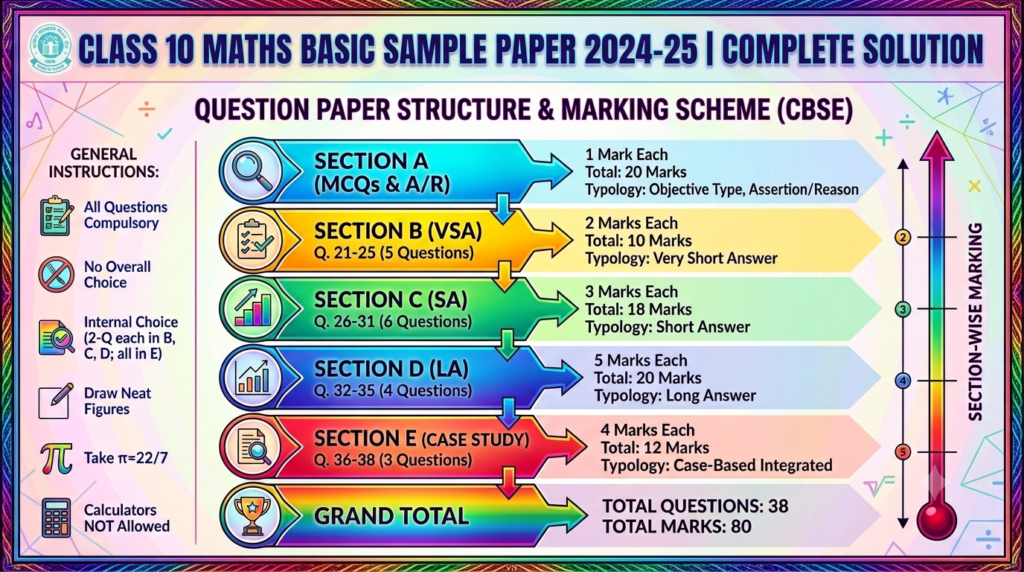
Preparing for the CBSE Class 10 Mathematics (Basic) Board Examination 2025-26? You are at the right place! This post provides the complete Class 10 Maths Basic Sample Paper Video Solution with section-wise explanations of the latest CBSE sample paper. The Class 10 Maths Basic Sample Paper Video Solution covers every question step by step according to the latest CBSE marking scheme. These Class 10 Maths Basic Sample Paper Video Solution explanations make it easier to understand concepts, improve problem-solving skills, and score better in the final board examination. Use the Class 10 Maths Basic Sample Paper Video Solution for effective revision and confident exam preparation. Whether your goal is passing confidently or scoring 90+ marks, solving the official CBSE sample paper is one of the smartest strategies. CBSE Class 10 Maths Basic Sample Paper 2025-26 Exam Pattern The CBSE Class 10 Mathematics (Basic) Sample Paper follows the latest examination pattern prescribed by the Central Board of Secondary Education. Section-wise Distribution of Questions Section A Includes: Section B These questions test basic concepts and calculations. Section C Students should write complete steps with proper mathematical reasoning. Section D Detailed solutions are expected. Section E These questions are based on real-life applications of Mathematics. Why Should You Solve the Official CBSE Sample Paper? The official CBSE Sample Paper is the most important resource before the board examination because it: Students who solve the official sample paper generally perform much better in the final examination. Section-wise Video Solutions Section A MCQs Solution Section A of the CBSE Class 10 Maths Basic Sample Paper 2025-26 contains 20 Multiple Choice Questions (MCQs), carrying 1 mark each. These questions test important concepts from different chapters of the syllabus. Each question is explained step by step with a simple and clear approach to help students improve accuracy and prepare effectively for the CBSE Board Examination 2026. Section B – Very Short Answer Questions Section B of the CBSE Class 10 Maths Basic Sample Paper 2025-26 contains 5 questions, carrying 2 marks each. These questions assess students’ understanding and application of mathematical concepts. Each question is explained step by step according to the CBSE marking scheme. Section C – Short Answer Questions Section C of the CBSE Class 10 Maths Basic Sample Paper 2025-26 contains 6 questions, carrying 3 marks each. These questions test the application of mathematical concepts and problem-solving skills. Each question is explained step by step according to the CBSE marking scheme. Section D – Long Answer Questions Section D of the CBSE Class 10 Maths Basic Sample Paper 2025-26 contains 4 questions, carrying 5 marks each. These questions require detailed application of concepts and proper step-by-step calculations. Each solution is explained clearly according to the CBSE marking scheme to help students understand the method and score maximum marks. Section E – Case Study-Based Questions Section E of the CBSE Class 10 Maths Basic Sample Paper 2025-26 contains 3 case study-based questions, carrying 4 marks each. These questions are based on real-life situations and test students’ ability to apply mathematical concepts. Each case study is explained step by step with a clear approach according to the CBSE marking scheme. Tips to Score 95+ Marks in CBSE Class 10 Maths Frequently Asked Questions (FAQs) Q1.Is the CBSE Sample Paper enough for board preparation? The official CBSE Sample Paper is one of the most important resources. However, students should also complete NCERT, Exemplar, and Previous Year Questions. Q2.How many sections are there in the CBSE Class 10 Maths Basic Sample Paper? There are five sections: Q3.What is the total marks of the Maths Basic Board Exam? The theory examination carries 80 marks. Q4.How many questions are there in the sample paper? The sample paper contains 38 questions divided into five sections. Q5.Are competency-based questions included? Yes. The latest CBSE pattern includes competency-based, application-based, assertion-reason, and case study questions. Q6.Is this solution suitable for self-study? Yes. Every solution is explained step by step according to the CBSE marking scheme, making it suitable for self-study and revision. Final Words The CBSE Class 10 Maths Basic Sample Paper Solution 2025-26 is one of the best resources for last-minute revision and board exam preparation. Watch every section carefully, solve each question yourself before checking the solution, and revise regularly. Best wishes for your CBSE Board Examination! Practice consistently, stay confident, and success will follow. Happy Learning! Class 10 Maths Most Important Questions on Real Numbers Class 10 Maths Most Important Questions Chapter 1 Real Numbers Class 10 Science Sample Paper 2025-26 Full Solution Class 10 Maths NCERT Solutions CBSE 2026-27 Update Continue your Class 10 Maths preparation with these useful resources from Future Study Point: Class 10 Maths Chapter 1 – Real Numbers: Complete NCERT Exercise-Wise Video Solutions Class 10 Maths Chapter 2 – Polynomials: Complete NCERT Solutions for Polynomials Class 10 Maths Chapter 3 – Pair of Linear Equations in Two Variables: Complete NCERT Solutions Class 10 Maths Chapter 4 Quadratic Equations: – Quadratic Equations complete NCERT video solutions Class 10 Maths Chapter 5 Arithmetic Progression: Arithmetic Progression: complete video solution 👉 Explore these resources to strengthen your concepts, revise important topics, and prepare effectively for the CBSE Class 10 Maths Board Examination 2026–27.

Learn, Practice & Excel

Empowering students with quality educational resources from Class 6 to Class 12. Access NCERT Solutions, Maths and Science study materials, English Grammar lessons, CUET preparation resources, previous years’ question papers, and sample papers—all in one place.

Your trusted learning platform for Class 6–10 Maths & Science, Class 11–12 Maths, English Grammar, CUET Maths & Reasoning, Previous Years Question Papers, and Sample Papers. Learn smarter, practice better, and achieve academic success.

Classes

Class 6 Maths & Science

Class 7 Maths & Science

Class 8 Maths & Science

Class 10 Maths & Science

Class 11 Maths

Class 12 Maths

Resources

NCERT Solutions

English Grammar

CUET Maths & Reasoning

Previous Years Question Papers

Science Sample Papers

Maths Sample Papers

Contact

© 2026 Future Study Point. All Rights Reserved.
Helping Students Build Strong Foundations in Maths, Science & English.