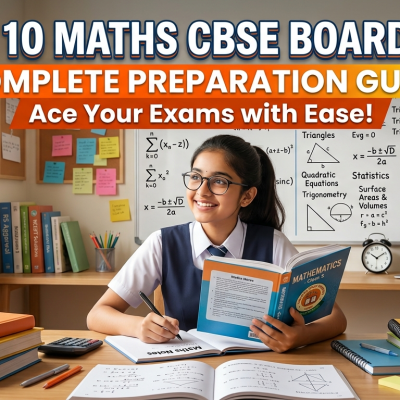
Class 10 Maths CBSE Board Exam Complete Preparation
Preparing for the Class 10 Maths CBSE Board Exam requires more than simply completing the textbook. Students need a systematic combination of NCERT Solutions, previous year question papers, PYQs, sample papers, important questions, repeated questions, formulas and important mathematical concepts.
This Class 10 Maths CBSE Board Exam Complete Preparation guide brings all these resources together in one place. You can use the links below to study chapter-wise, revise important concepts, practise board-level questions and test your preparation with sample and previous year papers.
Whether you are preparing for CBSE Class 10 Maths Basic or Standard, this page can serve as your central preparation hub.
Class 10 Maths CBSE Board Exam Preparation Resources
Use the following resources according to your stage of preparation.
1. Class 10 Maths NCERT Solutions
NCERT Mathematics is the foundation of Class 10 CBSE Maths preparation. Students should first understand the concepts and practise the questions given in the textbook.
Our chapter-wise Class 10 Maths NCERT Solutions provide step-by-step explanations to help students understand the correct method of solving questions.
👉 Class 10 Maths NCERT Solutions – Chapter-wise
You can use these solutions while completing each chapter and checking your answers.
2. Class 10 Maths Important Concepts
Before solving difficult questions, it is important to understand the basic concepts and formulas of every chapter.
Revise important concepts such as:
- Real Numbers
- Polynomials
- Pair of Linear Equations in Two Variables
- Quadratic Equations
- Arithmetic Progressions
- Triangles
- Coordinate Geometry
- Introduction to Trigonometry
- Some Applications of Trigonometry
- Circles
- Areas Related to Circles
- Surface Areas and Volumes
- Statistics
- Probability
Class 10 Maths Important Concepts | CBSE Board
1. Real Numbers
- Euclid’s Division Lemma
- Euclid’s Division Algorithm
- Fundamental Theorem of Arithmetic
- Prime factorisation
- HCF and LCM using prime factorisation
- Relationship between HCF and LCM
- Irrational numbers
- Proofs of irrationality
- Decimal expansion of rational numbers
- Terminating and non-terminating recurring decimals
2. Polynomials
- Definition and types of polynomials
- Zeroes of a polynomial
- Geometrical meaning of zeroes
- Relationship between zeroes and coefficients of a quadratic polynomial
- Relationship between zeroes and coefficients of a cubic polynomial
- Division Algorithm for polynomials
- Finding zeroes using factorisation
- Problems based on given zeroes and coefficients
3. Pair of Linear Equations in Two Variables
- Linear equations in two variables
- Graphical representation
- Consistent and inconsistent equations
- Unique solution
- No solution
- Infinitely many solutions
- Conditions for the nature of solutions
- Substitution method
- Elimination method
- Cross-multiplication method
- Word problems based on linear equations
4. Quadratic Equations
- Standard form of a quadratic equation
- Finding roots by factorisation
- Completing the square
- Quadratic formula
- Discriminant
- Nature of roots
- Relationship between roots and coefficients
- Formation of quadratic equations from given roots
- Word problems based on quadratic equations
5. Arithmetic Progressions
- Meaning of an Arithmetic Progression (AP)
- First term and common difference
- Finding the nth term
- Finding the number of terms
- Finding the last term
- Sum of first n terms
- Finding missing terms
- Problems involving consecutive terms
- Word problems based on AP
6. Triangles
- Similar figures
- Similarity of triangles
- Basic Proportionality Theorem (BPT)
- Converse of BPT
- Criteria for similarity:
- AAA
- SSS
- SAS
- Areas of similar triangles
- Ratio of areas of similar triangles
- Pythagoras Theorem
- Converse of Pythagoras Theorem
- Problems based on proportional sides
7. Coordinate Geometry
- Cartesian plane
- Coordinates of points
- Distance between two points
- Section formula
- Internal division of a line segment
- Midpoint formula
- Area of a triangle using coordinates
- Collinearity of points using area
- Finding unknown coordinates
8. Introduction to Trigonometry
- Trigonometric ratios
- sin θ, cos θ and tan θ
- cosec θ, sec θ and cot θ
- Reciprocal relationships
- Quotient relationships
- Values of trigonometric ratios at 0°, 30°, 45°, 60° and 90°
- Trigonometric identities
- Proving trigonometric identities
- Finding unknown trigonometric ratios
- Using one ratio to determine other ratios
9. Some Applications of Trigonometry
- Heights and distances
- Angle of elevation
- Angle of depression
- Drawing appropriate diagrams
- Using trigonometric ratios in real-life situations
- Problems involving heights of buildings, towers and trees
- Problems involving distances and angles
- Choosing the correct trigonometric ratio
10. Circles
- Tangent to a circle
- Number of tangents from a point
- Tangent-radius relationship
- Tangent perpendicular to radius at point of contact
- Equal tangents from an external point
- Proof-based questions on tangents
- Problems involving tangent lengths
- Using properties of tangents in geometrical proofs
11. Areas Related to Circles
- Circumference of a circle
- Area of a circle
- Area of a sector
- Length of an arc
- Area of a segment
- Area of minor and major sectors
- Area of minor and major segments
- Perimeter of sectors
- Problems involving combinations of circles and other figures
- Shaded-region problems
12. Surface Areas and Volumes
- Surface area and volume of a cuboid
- Surface area and volume of a cube
- Surface area and volume of a cylinder
- Surface area and volume of a cone
- Surface area and volume of a sphere
- Surface area and volume of a hemisphere
- Slant height of a cone
- Conversion of one solid into another
- Combination of solids
- Problems involving melting and recasting
- Unit conversions
- Finding unknown dimensions
13. Statistics
- Grouped frequency distribution
- Class intervals
- Class marks
- Mean of grouped data
- Direct method
- Assumed mean method
- Step-deviation method
- Median of grouped data
- Cumulative frequency
- Median class
- Mode of grouped data
- Modal class
- Empirical relationship between mean, median and mode
- Missing-frequency problems
- Graphical interpretation of data
14. Probability
- Basic concept of probability
- Random experiments
- Outcomes
- Events
- Equally likely outcomes
- Favourable outcomes
- Classical definition of probability
- Probability of an event
- Probability of an impossible event
- Probability of a sure event
- Range of probability
- Complementary events
- Probability of “not” an event
- Problems based on coins
- Problems based on dice
- Problems based on playing cards
- Problems based on everyday situations
This section is especially useful for students who find certain chapters difficult or need quick revision before solving questions.
3. Class 10 Maths Important Formulas
Formula revision can save valuable time during the board examination. Students should maintain a chapter-wise formula revision list and practise applying each formula to different types of questions.
Important formulas include:
- Quadratic formula
- Arithmetic progression formulas
- Distance formula
- Section formula
- Trigonometric ratios
- Trigonometric identities
- Areas and volumes formulas
- Mean, median and mode formulas
- Probability formula
Revise the formulas regularly instead of trying to memorise everything immediately before the examination.
Class 10 Maths Formulas – Chapter-Wise Formula Sheet
Complete Class 10 CBSE & NCERT Mathematics formulas for all 14 chapters. Use this formula sheet for quick revision, board exam preparation, and practice.
1. Real Numbers
Euclid’s Division Lemma
a = bq + r, where 0 ≤ r < b
Fundamental Theorem of Arithmetic
Every composite number can be expressed as a product of primes, and this factorisation is unique apart from the order of the factors.
HCF and LCM
For two positive integers a and b:
HCF(a, b) × LCM(a, b) = a × b
Terminating Decimal Condition
If a rational number is written in lowest form as p/q, its decimal expansion terminates if:
q = 2m × 5n
2. Polynomials
Quadratic Polynomial
For p(x) = ax2 + bx + c, if α and β are its zeroes:
- α + β = −b/a
- αβ = c/a
Cubic Polynomial
For p(x) = ax3 + bx2 + cx + d, if α, β and γ are its zeroes:
- α + β + γ = −b/a
- αβ + βγ + γα = c/a
- αβγ = −d/a
Division Algorithm
Dividend = Divisor × Quotient + Remainder
3. Pair of Linear Equations in Two Variables
General Form
a1x + b1y + c1 = 0
a2x + b2y + c2 = 0
Conditions for Solutions
- Unique solution: a1/a2 ≠ b1/b2
- No solution: a1/a2 = b1/b2 ≠ c1/c2
- Infinitely many solutions: a1/a2 = b1/b2 = c1/c2
Cross-Multiplication Formula
For equations:
a1x + b1y + c1 = 0
a2x + b2y + c2 = 0
x/(b1c2 − b2c1) = y/(c1a2 − c2a1) = 1/(a1b2 − a2b1)
4. Quadratic Equations
Standard Form
ax2 + bx + c = 0, where a ≠ 0
Quadratic Formula
x = (−b ± √(b2 − 4ac)) / 2a
Discriminant
D = b2 − 4ac
- D > 0: Two distinct real roots
- D = 0: Two equal real roots
- D < 0: No real roots
Relation Between Roots and Coefficients
If α and β are the roots:
- α + β = −b/a
- αβ = c/a
Equation from Given Roots
If α and β are roots:
x2 − (α + β)x + αβ = 0
5. Arithmetic Progressions
Common Difference
d = a2 − a1
nth Term
an = a + (n − 1)d
Sum of First n Terms
Sn = n/2 [2a + (n − 1)d]
Also:
Sn = n/2 (a + l)
where l is the last term.
Last Term
l = a + (n − 1)d
6. Triangles
Basic Proportionality Theorem
If a line is drawn parallel to one side of a triangle, it divides the other two sides proportionally.
AD/DB = AE/EC
Similarity Criteria
- AAA – Angle Angle Angle
- SAS – Side Angle Side
- SSS – Side Side Side
Areas of Similar Triangles
If two triangles are similar:
Area(△ABC) / Area(△DEF) = (AB/DE)2
Pythagoras Theorem
In a right-angled triangle:
Hypotenuse2 = Perpendicular2 + Base2
7. Coordinate Geometry
Distance Formula
For points A(x1, y1) and B(x2, y2):
AB = √[(x2 − x1)2 + (y2 − y1)2]
Section Formula
If P divides AB internally in the ratio m:n:
P = ((mx2 + nx1)/(m+n), (my2 + ny1)/(m+n))
Midpoint Formula
((x1 + x2)/2, (y1 + y2)/2)
Area of Triangle
Area = 1/2 |x1(y2 − y3) + x2(y3 − y1) + x3(y1 − y2)|
8. Introduction to Trigonometry
Trigonometric Ratios
| Ratio | Formula |
|---|---|
| sin θ | Perpendicular / Hypotenuse |
| cos θ | Base / Hypotenuse |
| tan θ | Perpendicular / Base |
| cosec θ | Hypotenuse / Perpendicular |
| sec θ | Hypotenuse / Base |
| cot θ | Base / Perpendicular |
Reciprocal Relations
- sin θ = 1/cosec θ
- cos θ = 1/sec θ
- tan θ = 1/cot θ
Quotient Relations
- tan θ = sin θ / cos θ
- cot θ = cos θ / sin θ
Trigonometric Identities
- sin2θ + cos2θ = 1
- 1 + tan2θ = sec2θ
- 1 + cot2θ = cosec2θ
9. Some Applications of Trigonometry
Important Relations
- tan θ = Height / Distance
- sin θ = Height / Hypotenuse
- cos θ = Distance / Hypotenuse
Angle of Elevation
The angle formed when an observer looks upward at an object is called the angle of elevation.
Angle of Depression
The angle formed when an observer looks downward at an object is called the angle of depression.
10. Circles
Tangent to a Circle
The tangent at any point of a circle is perpendicular to the radius through the point of contact.
Radius ⟂ Tangent
Tangents from an External Point
The lengths of two tangents drawn from an external point to a circle are equal.
PA = PB
11. Areas Related to Circles
Circumference of Circle
C = 2πr
Area of Circle
A = πr2
Area of Semicircle
A = 1/2 πr2
Perimeter of Semicircle
P = πr + 2r
Length of Arc
Arc length = (θ/360°) × 2πr
Area of Sector
Area of sector = (θ/360°) × πr2
Area of Segment
Area of segment = Area of sector − Area of triangle
12. Surface Areas and Volumes
Cuboid
- Volume = lbh
- LSA = 2h(l + b)
- TSA = 2(lb + bh + hl)
Cube
- Volume = a3
- LSA = 4a2
- TSA = 6a2
Cylinder
- Volume = πr2h
- CSA = 2πrh
- TSA = 2πr(h + r)
Cone
- Slant height: l = √(r2 + h2)
- CSA = πrl
- TSA = πr(l + r)
- Volume = 1/3 πr2h
Sphere
- Surface Area = 4πr2
- Volume = 4/3 πr3
Hemisphere
- CSA = 2πr2
- TSA = 3πr2
- Volume = 2/3 πr3
13. Statistics
Mean of Grouped Data
x̄ = Σfixi / Σfi
Assumed Mean Method
x̄ = a + (Σfidi / Σfi)
Step-Deviation Method
x̄ = a + h(Σfiui / Σfi)
Median
Median = l + [(n/2 − cf) / f] × h
Mode
Mode = l + [(f1 − f0) / (2f1 − f0 − f2)] × h
Empirical Relation
Mode = 3 Median − 2 Mean
14. Probability
Classical Probability
P(E) = Number of favourable outcomes / Total number of equally likely outcomes
Range of Probability
0 ≤ P(E) ≤ 1
Probability of Impossible Event
P(E) = 0
Probability of Sure Event
P(E) = 1
Complementary Event
P(not E) = 1 − P(E)
Therefore:
P(E) + P(not E) = 1
Quick Revision – Class 10 Maths
- Real Numbers – Euclid’s algorithm, HCF & LCM
- Polynomials – Relationship between zeroes and coefficients
- Pair of Linear Equations – Conditions for solutions
- Quadratic Equations – Formula and discriminant
- Arithmetic Progressions – nth term and sum
- Triangles – Similarity and Pythagoras theorem
- Coordinate Geometry – Distance, section and area formulas
- Trigonometry – Ratios and identities
- Applications of Trigonometry – Heights and distances
- Circles – Tangent properties
- Areas Related to Circles – Area, arc and sector
- Surface Areas & Volumes – All major solids
- Statistics – Mean, median and mode
- Probability – Basic probability and complementary events
4. Class 10 Maths Most Important Questions
Practising important questions helps students identify the types of problems they should be particularly comfortable solving before the board examination.
Our Class 10 Maths Most Important Questions collection focuses on important concepts, commonly tested question types and questions useful for board exam preparation.
👉 Class 10 Maths Most Important Questions – Chapter-wise
Try solving the questions yourself before watching or reading the solution.
5. Class 10 Maths Most Repeated Questions
Some concepts and question patterns appear repeatedly in CBSE examinations, although the exact wording or numerical values may change.
Practising Class 10 Maths Most Repeated Questions can help students become familiar with commonly tested concepts and question formats.
👉 Class 10 Maths Most Repeated Questions
Do not depend only on repeated questions. Use them as an additional revision resource after completing NCERT and other important preparation material.
6. Class 10 Maths Previous Year Question Papers
Solving Class 10 Maths Previous Year Question Papers is one of the best ways to understand the actual examination pattern.
Previous year papers help students practise:
- Different types of questions
- Marks distribution
- Time management
- Step-by-step presentation
- Application-based questions
- Competency-based questions
- Frequently tested concepts
👉 Class 10 Maths Previous Year Question Papers – Full Solutions
Try solving each paper within the prescribed examination time before checking the solution.
7. Class 10 Maths PYQs
Previous Year Questions (PYQs) are particularly useful for identifying important concepts and understanding the level of questions asked in CBSE examinations.
You can practise PYQs chapter-wise as well as topic-wise.
👉 Class 10 Maths PYQs – Chapter-wise Questions
After completing a chapter, solve its PYQs to check whether you can apply the concepts independently.
8. Class 10 Maths Sample Papers
After completing your syllabus and practising important questions, start solving Class 10 Maths Sample Papers.
Sample papers provide an opportunity to practise a complete examination-style paper before the actual board examination.
👉 Class 10 Maths Sample Papers with Solutions
While solving a sample paper:
- Sit in a quiet place.
- Set a timer.
- Follow the examination time limit.
- Avoid looking at solutions while solving.
- Check your answers afterwards.
- Identify the questions where you made mistakes.
- Revise those concepts again.
Chapter-wise Class 10 Maths Preparation
A chapter-wise preparation strategy makes revision easier and more organised.
Chapter 1 – Real Numbers
Focus on Euclid’s division algorithm, fundamental theorem of arithmetic, prime factorisation and applications involving HCF and LCM.
Class 10 Maths Chapter 1 Important Questions
Class 10 Maths Chapter 1 NCERT Solutions
Chapter 2 – Polynomials
Revise zeroes of polynomials and the relationship between zeroes and coefficients of quadratic polynomials.
Class 10 Maths Chapter 2 Important Questions
Class 10 Maths Chapter 2 NCERT Solutions
Chapter 3 – Pair of Linear Equations in Two Variables
Practise graphical and algebraic methods of solving pairs of linear equations and questions based on consistency.
Class 10 Maths Chapter 3 Important Questions
Class 10 Maths Chapter 3 NCERT Solutions
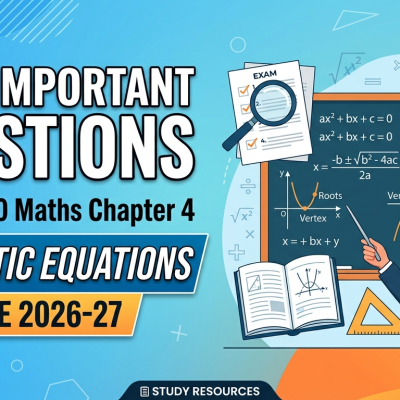
Chapter 4 – Quadratic Equations
Focus on solving quadratic equations by factorisation, completing the square and the quadratic formula, along with questions based on the discriminant.
Class 10 Maths Chapter 4 Important Questions
Class 10 Maths Chapter 4 NCERT Solutions
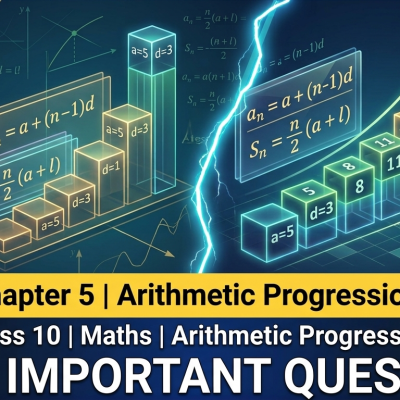
Chapter 5 – Arithmetic Progressions
Practise finding the nth term and sum of the first n terms of an AP. Word problems are also important for examination preparation.
Class 10 Maths Chapter 5 Important Questions
Class 10 Maths Chapter 5 NCERT Solutions
Chapter 6 – Triangles
Understand similarity criteria and practise problems involving proportional sides, areas and related results.
Class 10 Maths Chapter 6 Important Questions
Class 10 Maths Chapter 6 NCERT Solutions
Chapter 7 – Coordinate Geometry
Revise the distance formula, section formula and area of a triangle and practise numerical problems carefully.
Class 10 Maths Chapter 7 Important Questions
Class 10 Maths Chapter 7 NCERT Solutions
Chapter 8 – Introduction to Trigonometry
Learn the trigonometric ratios and standard values and practise the important trigonometric identities.
Class 10 Maths Chapter 8 Important Questions
Class 10 Maths Chapter 8 NCERT Solutions
Chapter 9 – Some Applications of Trigonometry
Practise problems based on heights and distances, including questions involving angles of elevation and depression.
Class 10 Maths Chapter 9 Important Questions
Class 10 Maths Chapter 9 NCERT Solutions
Chapter 10 – Circles
Understand tangent properties and practise questions based on tangents to a circle.
Class 10 Maths Chapter 10 Important Questions
Class 10 Maths Chapter 10 NCERT Solutions
Chapter 11 – Areas Related to Circles
Revise formulas for circumference and area and practise questions involving sectors and segments.
Class 10 Maths Chapter 11 Important Questions
Class 10 Maths Chapter 11 NCERT Solutions
Chapter 12 – Surface Areas and Volumes
Practise problems involving combinations of solids and conversions between different three-dimensional shapes.
Class 10 Maths Chapter 12 Important Questions
Class 10 Maths Chapter 12 NCERT Solutions
Chapter 13 – Statistics
Focus on mean, median and mode and practise questions requiring appropriate formulas and calculations.
Class 10 Maths Chapter 13 Important Questions
Class 10 Maths Chapter 13 NCERT Solutions
Chapter 14 – Probability
Understand the basic concept of probability and practise questions involving outcomes and events.
Class 10 Maths Chapter 14 Important Questions
Class 10 Maths Chapter 14 NCERT Solutions
How to Prepare for the Class 10 Maths Board Exam
A good preparation strategy can be divided into several stages.
Step 1 – Complete NCERT
Start by studying each chapter carefully and solving the NCERT questions. Do not skip questions simply because they appear easy.
Step 2 – Revise Important Concepts and Formulas
After completing a chapter, revise its important concepts, formulas and methods of solving questions.
Step 3 – Practise Important Questions
Solve chapter-wise important questions to strengthen your understanding and identify weak areas.
Step 4 – Solve PYQs
Practise previous year questions to understand the types of questions asked in CBSE examinations.
Step 5 – Solve Sample Papers
Once you have completed sufficient chapter-wise practice, solve complete sample papers under examination conditions.
Step 6 – Analyse Your Mistakes
After every paper, make a list of your mistakes. Categorise them as:
- Conceptual mistakes
- Calculation mistakes
- Formula mistakes
- Reading mistakes
- Time-management problems
- Presentation mistakes
Then revise the relevant topic and solve similar questions again.
Basic Maths vs Standard Maths
CBSE Class 10 students may appear for Mathematics Basic (241) or Mathematics Standard (041), depending on their chosen subject.
The preparation resources on this page can be used for both, but students should practise questions according to the level of their examination.
For Mathematics Basic
Give special attention to:
- NCERT concepts
- Basic and moderate-level questions
- Formula revision
- Direct application questions
- Regular practice
For Mathematics Standard
Along with NCERT, give additional attention to:
- Higher-level application questions
- Competency-based questions
- Case-study questions
- Multi-step problems
- Previous year questions
- Sample papers
Class 10 Maths Board Exam Revision Plan
A simple revision cycle can be:
First Revision: NCERT + concepts + formulas
Second Revision: Important questions + PYQs
Third Revision: Previous year papers
Final Revision: Sample papers + formulas + mistakes
The objective should not be to solve thousands of questions. It is more important to understand the concepts and become confident with the major question types.
Class 10 Maths Video Solutions
If you prefer learning through videos, you can also use our Class 10 Maths video solutions and important-question videos.
These videos can help you understand the step-by-step approach to solving questions and improve your presentation of mathematical solutions.
👉 Watch Class 10 Maths Important Questions Video Solutions
👉 Watch Class 10 Maths NCERT Solutions
👉 Watch Class 10 Maths PYQs and Previous Year Paper Solutions
Class 10 Maths CBSE Board Exam – Quick Preparation Checklist
Before the examination, make sure that you have:
- Completed NCERT
- Revised all important concepts
- Revised important formulas
- Practised chapter-wise important questions
- Solved PYQs
- Solved previous year question papers
- Practised sample papers
- Revised your mistakes
- Practised time management
- Prepared a final formula revision sheet
Frequently Asked Questions
Is NCERT enough for Class 10 Maths CBSE Board Exam?
NCERT should be the foundation of your preparation. After completing NCERT thoroughly, students should also practise PYQs, sample papers and other relevant board-level questions.
How many previous year papers should I solve?
Instead of focusing only on a particular number, solve enough papers to become comfortable with the examination pattern, question types and time management.
Should I solve PYQs before sample papers?
A useful approach is to complete NCERT and important questions first, then practise PYQs and finally use sample papers for full-paper examination practice.
How can I improve my Class 10 Maths marks?
Build strong concepts, practise regularly, revise formulas, solve PYQs and sample papers, and carefully analyse your mistakes.
Is this preparation useful for both Basic and Standard Maths?
Yes. The basic concepts and NCERT preparation are useful for both. However, Standard Maths students should include sufficient higher-level and application-based practice.
Final Words
Success in the Class 10 Maths CBSE Board Exam comes from consistent preparation rather than last-minute study. Start with NCERT, strengthen your concepts, practise important questions, solve PYQs and previous year papers, and finally test yourself with sample papers.
Use this page as your Class 10 Maths CBSE Board Exam Complete Preparation hub and visit the linked resources whenever you need detailed chapter-wise study material, solutions, questions or revision resources.
Keep practising, learn from your mistakes, and stay consistent. Your preparation today can make your board examination much easier tomorrow.